
Defining DeFi: What Is Decentralized Finance? (technically speaking)
Blockchain is enabling DeFi, a completely democratized access to financial services. Entire new industries are being built on top of DeFi and blockchain.
DeFi sounds good, right? The promise of building a Decentralised Finance ecosystem that can reach billions of people worldwide that remain unbanked. This is a huge problem, and its root cause is the largely centralized structure of the institutions that make up our traditional financial system.
DeFi is a great trustless alternative that offers the users greater control over their money. Financial instruments like loans, insurance, and derivatives that are presently controlled by big organizations will witness these middlemen’s elimination.
The anonymity that blockchains ensure will also enable faster borrowing and lending of money without any need for trust in the form of KYC or credit scores.
In simple terms, DeFi can be defined simply as an open or decentralized financial system that’s devoid of a centralized setup in which powers are in the hands of a few powerful organizations such as exchanges or banks, with the help of blockchain technology and smart contracts.
Thanks to DeFi, existing financial instruments (like loans, savings, trading, etc.) can now be accessed in a decentralized, trustless manner by anyone, anywhere in the world. This enables financial processes and workflows to be more streamlined in terms of speed, cost and accessibility.
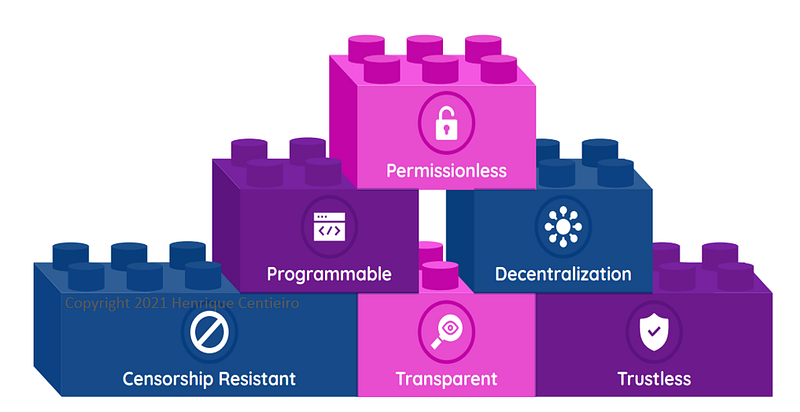
Properties of Decentralized Finance (DeFi)
Here are three prerequisites financial solutions must satisfy to be truly decentralized.
- Interoperability
Interoperability simply means cross-communication. In this case, it means different blockchains’ ability to communicate with each other or see, access, and share information across blockchain networks without intermediary intervention. Central exchanges currently play this role.
Interoperability isn’t just a good feature, but it is incredibly critical in the DeFi space due to various blockchain networks’ ability to communicate with each other. This then creates an ecosystem in which several different dApps are able to “borrow” various functions by integrating with other dApps. Transparency is also an advantage of interoperability.
- Composability
DeFi apps are open source, and, as such, anyone can view or use the code as the basis to develop new applications. This concept is known as composability i.e. something existing can be used to create a new product using different arrangements or combinations.
Lego is a great example of composability. You can use parts from existing projects and then change the bricks’ sequence to make something completely different each time. These apps can then be used together to create more complex and efficient financial products.
- Programmability
Programmability is basically the ability to automate processes; it is what makes smart contracts, well, “smart”. Since smart contracts are essentially pieces of code, the automation level that can be integrated depends on how sophisticated the program is.
Ethereum is considered the best option for building decentralized finance solutions because of its flexibility. Thanks to Solidity, the programming language used to build and deploy smart contracts on the Ethereum blockchain.
The sad truth, however, is that only a few DeFi solutions meet all three points. This is partly due to the fragmented state of the current blockchain landscape, making interoperability and composability difficult to achieve.
As such, most decentralized finance solutions are left with the third prerequisite (i.e., programmability), achieved through smart contracts — and nothing more.
Why are DeFi projects attracting so many investors?
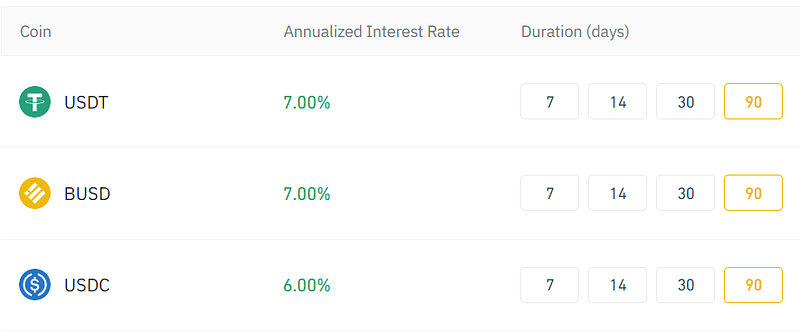
Some of these projects offer very very attractive APY’s considering the high demand for liquidity. DeFi projects often need liquidity in order to fulfil the lending request in order to have liquidity for the Decentralized Exchanges liquidity pools.
Yields can be sometimes over 10% in some cryptocurrencies or close to 8% in USD stablecoins such as USDT and DAI. These rates are mind-boggling considering that the rates offered by banks close to zero.
Okay, now that we know the theory, what does this DeFi thing looks like in reality? Let’s look at a few (yes, only a very few) of them:
Lending projects:
Aave: https://app.aave.com/
Blockfi: https://blockfi.com/
Compound: https://compound.finance/
MakerDAO: https://makerdao.com/en/ (also stablecoin DAI)
DEXs (AKA Decentralized Exchanges):
0X: https://0x.org/
1Inch: https://1inch.exchange/
Bancor: https://app.bancor.network/
UniSwap: https://uniswap.org/
Derivatives:
Augur: https://augur.net/
This is not an exhaustive list but hopefully can give you a good panorama view of the DeFi ecosystem!
🚀 Follow me and check also my 🧱 blockchain book and course:
📖 Unblockchain Book — Kindle and Paperback
Disclosure: views expressed are purely personal and do not reflect any organisation’s views or thoughts the writer of this article may be affiliated or associated with. This is NOT financial advice and I’m not recommending anything. This article is only for educational purposes.