
Defiance: Breaking the Obedience Habit
Why you need to stop listening to “authority figures”

Obedience can be dangerous.
A regular person may commit criminal acts without much hesitation when commanded by an authority figure even if they would never imagine themselves doing these things when acting on their own accord or under other circumstances.
This is because when we are told to do something by an authority figure, not only do we often believe the authority is legitimate, but we also feel that we are only carrying out someone else’s wishes, which allows us to not feel the same level of responsibility for our actions.
One example of this in history is the Nazi extermination of the Jews in concentration camps between 1933 to 1945, which was one of the most shocking and immoral acts carried out by thousands of people because they were instructed to do so by an authority figure.
The Milgram experiment is a famous and controversial study that examined people’s willingness to obey authority in the absence of any threats.
It also demonstrated people’s reluctance to confront those who abuse their position of power. At the beginning of the experiment, the experimenter informs the participants that the study wants to explore the effects of punishment on learning. Participants are told to play the role of the teacher and instructed to administer electric shocks of increasing intensity to a learner whenever he makes an error.
The teachers are placed in a different room from the learners, who were in fact actors and receive no shocks whatsoever. The electric shocks begin from 15 volts and increase all the way up to 450 volts, 300 volts being lethal. Switches with labels are provided which start from “Slight Shock” to “Danger: Severe Shock” and “XXX” for the final three.
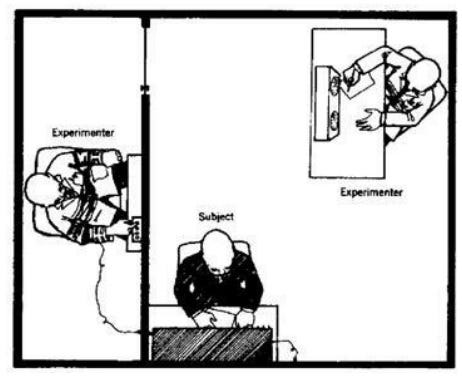
The learners begin to show discomfort at 75 volts. At 150 volts they start demanding the experiment to stop. Their protests become increasingly forceful and emotional as the shocks escalate. In one version of the experiment, their response eventually turns into an agonized scream. In another, they start pounding the walls to get out.
The point of the experiment is to see how far a person will proceed in a concrete and measurable situation in which he is ordered to inflict increasing pain on a protesting victim. At what point will the subject refuse to obey the experimenter?¹
The results of the study were shocking and controversial. The majority of participants were willing to administer shocks to the maximum level. Even though the learners asked them to stop, when the experimenter ordered the teachers to continue, many were willing to obey.
Upon reading this study, most may wonder why anyone in their right mind would carry on once the learners begin to express discomfort, let alone when they start pleading to end the experiment. These results were also shocking to the observers who were watching the experiment through one-way mirrors. Most are likely to believe that if they were in the participants’ place, they would simply refuse to carry on with the experiment any further.
A lot of the participants who continued delivering electric shocks experienced a level of stress and showed their disagreement with the experimenter. Regardless, a considerable number of them continued to deliver to the last shock even if it seemed very painful, and ignored the learners' pleas to stop.
This experiment does not study the process of devaluation of the victim prior to committing acts against them.
In Germany, the anti-Jewish propaganda that lasted for a decade prepared the population to accept the victimization of the Jews who were gradually denied all their human rights.
Such systemic devaluation provides psychological justification for the harsh and inhumane treatment of victims. The participants in Milgram’s experiment would have found it even easier and may not have experienced any stress if the learners had been portrayed as cruel, callous, murderous, or perverted people who somehow deserved the punishment.
Interestingly, even though there was no prior devaluation during the experiment, many participants proceeded to devalue the learner afterward with comments such as
He was so stupid and stubborn he deserved to get shocked.¹
This is because, to avoid carrying the burden of responsibility, the participants needed to believe that their role in the mistreatment of the learners was inevitable due to the learner's own deficiencies of intellect.
The results suggest that people are highly influenced by authority figures, and highly obedient.
65% of the participants delivered the maximum shock level (450 volts) in the first version of the experiment where no vocal complaint is heard from the victims but the walls are pounded in protest until they cease to answer and the pounding stops.
On the other hand, when the experiment was repeated with different variations to see if there was a difference, the obedience levels dropped.
- Experiment 2 was the same as the first experiment but vocal protests were introduced instead of pounding the walls. The percentage of obedient participants was 62.5%, which is not a significant drop.
- Experiment 3 was similar to the second but the learner was in the same room as the subject. The percentage of obedient participants was 40%.
- Experiment 4 was the same as the third but the learners only received shocks when their hands rested on the plate. From 150 volts onwards, they would refuse to place their hand but the experimenter would order the participants to force it onto the plate. The percentage of obedient participants in this case was 30%.
Despite the drop in obedience levels, 30% is still a substantial amount of people who were willing to force someone to receive electric shocks. Many participants blindly accepted the experimenter’s claim that even though the shocks were painful, they were not dangerous and ignored the learners’ protests.
There was a marked distinction between the level of shock the participants were willing to administer and the level they would be willing to accept themselves.
The participants were interviewed after the experiment and asked:
What is the maximum sample shock you would be willing to accept?¹
- 3 participants who weren’t obedient said they would accept shocks more powerful than they had administered to the learner.
- 7 out of 26 obedient participants would accept the 450-volt shock which would have been fatal, whilst the other 19 were not.
Unfortunately, we are taught from a young age that always listening to authority figures is not a bad thing.
For instance, we are conditioned to listen to our parents and trust that they know what’s best for us. There are however many situations where that’s not the case. Parents can be abusive and therefore untrustworthy. The same applies to other authority figures in our lives. We often come across teachers, bosses, managers, police officers and other law enforcement agencies who are willing to abuse their position of power.
Blindly trusting authority figures places one in a bad situation. Milgram’s experiment was simply an experiment, and therefore the consequences were not real. But imagine if it WAS real and the experimenter was actually irresponsible and unconcerned about the learner’s well-being.
Even if being expected to deliver 450 volts in such a setting may be unrealistic, what if the shocks only went up to 200 volts and the learners complained about the emotional damages and the trauma inflicted on them during the experiment? If the learners had called the police over such an experiment, would the participants also not be held responsible?
Also, why not imagine a scenario where the experimenter doesn’t know or hasn’t considered something? Just because someone is in a position of power doesn’t automatically mean they know what they are doing. Maybe they asked you to deliver shocks to the learner that are not fatal but didn’t consider the implications when the learner withdraws consent — I don’t see any situation that is legal to deliver someone any amount of pain without consent.
Considering all of this, it is crucial that people get into the habit of forming their own opinions in situations and not expect to be told the right way to behave by people they perceive to be in a position of authority.
References:
[1]: Milgram, S. (1974). Obedience to Authority: An Experimental View. Harper & Row.
If you enjoyed this post and would like to read more, you can subscribe here — https://medium.com/subscribe/@ella_harris to get an email whenever I publish a story. You can also buy me ☕ via — https://ko-fi.com/ella_harris
This post contains affiliate links. If you use these links to buy something I will earn a commission. Thanks.


