
Defeated by HarmonyOS, Struggling to Continue the Android Myth, Google is Considering Abandoning Fuchsia
Google Plans to Abandon Fuchsia: No Longer Introducing Full Chrome Browser
Once had high expectations for Google Fuchsia, now there might be as much disappointment. According to the latest report from 9to5google, Google has decided not to introduce the full Chrome browser to the Fuchsia operating system.
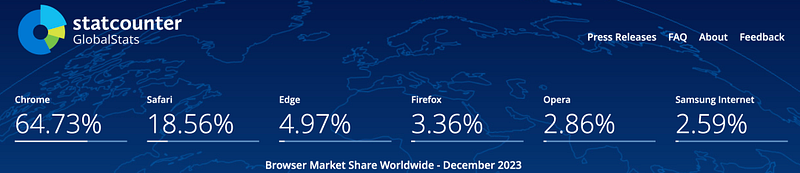
It’s worth noting that as the world’s largest browser, Chrome holds a market share of as much as 64.73%. If Fuchsia does not support Chrome, it will inevitably deviate from the original goal of becoming the operating system for the era of interconnected everything. At least, the majority of users would not accept a PC that does not support the Chrome browser.
As a result, Google’s move has sparked considerable discussion and is even seen by many as a significant step toward abandoning the Fuchsia project.
01 Google: Officially Ceases Introducing the Full Chrome Browser Experience to Fuchsia
In fact, Fuchsia’s status within Google was far more significant at least a few years ago, and the Google development team made every effort to ensure Fuchsia’s feature iterations and improvements.
As early as 2018, before Fuchsia was officially unveiled to the public, many foreign media outlets discovered traces of a simplified web browser running on Fuchsia. It used the Chromium browser engine as its foundation, but the browser did not provide common features such as an address bar or tabs. Therefore, during testing, the Fuchsia operating system felt quite suboptimal as the primary operating system.
In 2021, according to the Chromium Bug Tracker log, a new project was initiated in May of that year to “build Chrome browser binaries” for Fuchsia OS. In simple terms, this meant bringing the complete Google Chrome browser experience to Fuchsia, including key features such as synchronization.
However, adding support for a brand-new operating system to Chrome is not an easy task. During the trial period, there were hundreds of independent bug reports submitted by the development team. Several months later, someone recorded a video to showcase the progress, demonstrating that Chromium could work relatively well on Fuchsia-driven devices.
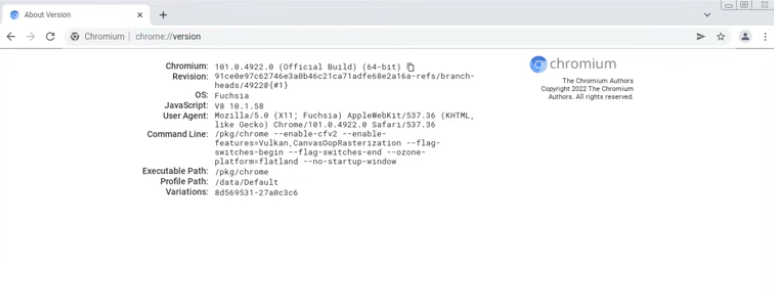
At that time, the entire range of Google Nest Hub smart displays began to be supported by Fuchsia, restricting the web browsing functionality of these displays through an embedded version of the browser.
In comparison to this minimalist experience, Google seems to have been striving to bring all the features of Chrome to Fuchsia.
For many, this signals Google’s intention to elevate Fuchsia beyond smart home applications and position it as a complete desktop operating system. After all, what use is a laptop or desktop without a web browser?
Therefore, since Fuchsia ran on Google Pixelbook hardware in the past, many fans of the Fuchsia project have been anticipating its eventual expansion to desktop environments.
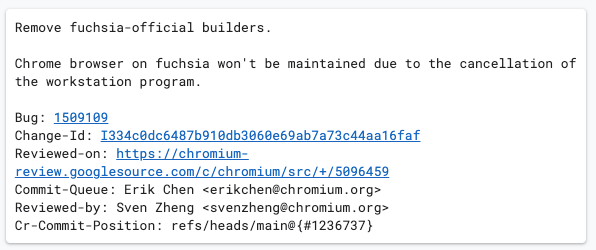
Unfortunately, with the Chromium code changes released last month and related bug tracking posts, it appears that Fuchsia’s Chrome browser will no longer receive maintenance.
02 Is Chrome on Fuchsia Just an Experiment?
In explaining the reasons for removing Chrome from Fuchsia, the post mentions that bringing the Chrome browser to Fuchsia was considered “an experiment” and “is no longer in use.”
To be more specific, in the mid-2022, the Fuchsia team shared plans to conclude the “workstation” project, which aimed to provide developers with a more user-friendly way to test their software on the emerging operating system.
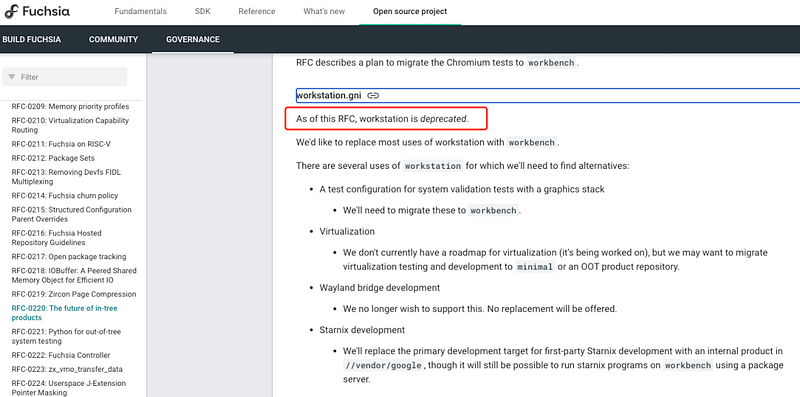
After abandoning the workstation, Fuchsia embarked on the development of a more streamlined “workbench,” designed specifically for developer testing. Google states that the workbench is not intended as the foundation for Fuchsia-based products like Nest Hub software.
It functions as a literal workbench, supporting development tools and allowing developers to debug and modify the system. It is not intended to be a product delivered to users or the foundation for such products.
Initially, the shift from workstation to workbench seemed like a simple name change, but the subsequent discontinuation of Chrome for Fuchsia almost confirms that Google seems unwilling to release desktop/mobile devices directly supported by Fuchsia in the foreseeable future.
03 Fuchsia: From Anticipated HarmonyOS Competitor to Tumbling from Grace
Recalling the initial hype around Fuchsia before its release, it truly captured everyone’s attention.
In 2016, there were reports that Google was secretly developing a new operating system, Fuchsia, sparking widespread interest. Considering Google already had Android for mobile and ChromeOS for desktop within its ranks, many wondered about Fuchsia’s purpose.

Upon closer inspection, Fuchsia stood apart from Chrome OS and Android, both based on the Linux kernel. Fuchsia was developed using the new Zircon microkernel and primarily written in C and C++. Importantly, its design goal wasn’t to replace existing operating systems but to run on all platforms, including smartphones, PCs, smart devices, and IoT devices.
Despite Fuchsia’s dedicated development over the years, it remained low-key, and little was known about the system until 2019. With the significant release of Huawei’s HarmonyOS that year, Google seemed to sense a threat and began taking action:
- In 2019, Google launched the official Fuchsia.dev website (https://fuchsia.dev/) to guide developers on better development for Fuchsia and provide insights into creating Fuchsia applications on a smaller scale.
- In 2020, Fuchsia’s source code was officially opened to the public. This move allowed anyone to view or download the source code and customize the operating system. Google expressed the hope of encouraging more people to participate and collaborate on the open-source development of the operating system.
- In 2021, users of Google’s first-generation Nest Hub received system update notifications. After the upgrade, the system transitioned from the Linux-based Cast OS to Fuchsia OS.
However, the good times didn’t last. Over the past two years, as international competition intensified and significant changes occurred in the market economy, Google underwent multiple rounds of layoffs, and the Fuchsia department suffered severe setbacks.
At that time, according to reports from The New York Times, when Google announced the largest layoff in its history affecting 12,000 employees, one of the hardest-hit departments was the Fuchsia operating system development team.
After several adjustments, the anticipation for Fuchsia has gradually turned into disappointment. Now, with the announcement of abandoning the introduction of Chrome, Fuchsia has undoubtedly taken a downhill path, leaving many users feeling regretful:
It’s very disappointing, but a desktop version of Fuchsia is already a done deal. I do hope that one day it could replace the Android kernel in some way, perhaps by running the Android Chrome browser through Starnix.
Unfortunately, Fuchsia has absorbed everything we’ve learned from automatic software updates, running untrusted and semi-trusted code, proprietary drivers in open-source software kernels, devices not forced to update by manufacturers, the impracticality of a user-centric security model, containers, etc., and applied them to a new kernel and operating system.
Fuchsia is more or less the kind of untrusted operating system architecture that I, as an end user and developer, would like to run because I have to run a lot of random third-party code locally.
As for the failure of Fuchsia, many users attribute it to “the inability to generate enthusiasm among original equipment manufacturers (OEMs) for Fuchsia”:
Google has not emphasized the importance of Fuchsia for quite some time. With Chrome no longer supporting Fuchsia, it means it cannot become the operating system for any consumer devices. The next step might be to consider properly shutting down the team. Apart from Nest, has Fuchsia launched any other products? Is it associated with any server-side products within Google?
My speculation is that they failed to generate enthusiasm among original equipment manufacturers (OEMs) for Fuchsia. At least, I believe manufacturers like Samsung would not be excited about relinquishing more control to Google. And I don’t think this is a recent development; it probably became apparent several years ago, and since then, the project has been slowly fading away.
In addition, there is a Google internal employee sharing their firsthand experience on HN:
I have been working at Google (Chrome Browser Team) since the inception of Fuchsia and in the years that followed.
The team has some of Google’s finest engineers working on it. Technically, they have some very impressive things.
However, I don’t think anyone can elucidate a path to its success to me. In other words, assuming you’ve built an amazing, powerful new operating system, how do you get others to truly adopt it?
What frustrates me is that neither Android nor Chrome OS even have an answer. Why develop a new operating system that is useless for both platforms?
If I were in charge of this system, I would take a more pragmatic approach. Chrome OS is obviously the first target — it’s built on Linux, but it doesn’t have to be. The operating system essentially only needs a very small number of native binaries to run on it:
- Chrome Browser
- Chrome OS GUI (shares a lot of code with the Chrome Browser but is different)
- Android VM
- Linux VM
If you can port these four programs to run on another operating system, then you’ve succeeded. You can start releasing Chrome OS devices based on the new operating system.
I think porting Android to run on Chrome OS, essentially replacing the Linux kernel, is a reasonable goal. Perhaps it’s necessary to add some Linux compatibility layers to enable Linux drivers for a few years, with the goal of eventually launching devices that don’t need Linux.
But the Fuchsia team wanted to build an entirely new operating system from scratch, including a brand new GUI, a brand new developer SDK, etc.
Why?
Finally, what are your thoughts on Google no longer bringing the full Chrome browser to Fuchsia? Feel free to share your perspective.
Reference Links:
- https://news.ycombinator.com/item?id=39005470
- https://9to5google.com/2024/01/15/google-is-no-longer-bringing-the-full-chrome-browser-to-fuchsia/
Stackademic
Thank you for reading until the end. Before you go:


