
Defamation Law Primer For The AI + Chat GPT + LLM Enthusiast
How Computers Might Be Responsible For Defamation
Introduction
This article is necessary because a new wave of litigation has emerged in the world of generative artificial intelligence. Public figures are accusing artificial intelligence of defamation. For reasons I’ll write about here, this accusation is mind-bendingly fascinating.
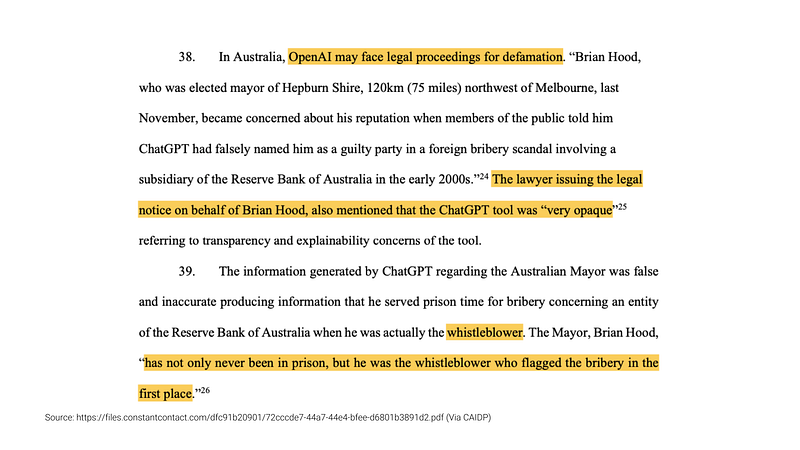
I’ll write about the law in the United States where I am both a data scientist and also an attorney. However, the topic is global. For example, as early as April of 2023, a mayor in Australia began pursuing a defamation lawsuit related to information generated by Chat GPT.
In a twist worthy of movie-drama. The mayor worked for a bank, acted as a whistleblower (related to bribery scandals), and was never charged with a crime. But, the artificial intelligence behind Chat GPT seemed convinced that the mayor was one of the guilty parties in the scandal.
A filing with the U.S. Federal Trade Commission (FTC) from the Center for Artificial Intelligence and Digital Policy (CAIDP) referenced the Australian matter as follows:
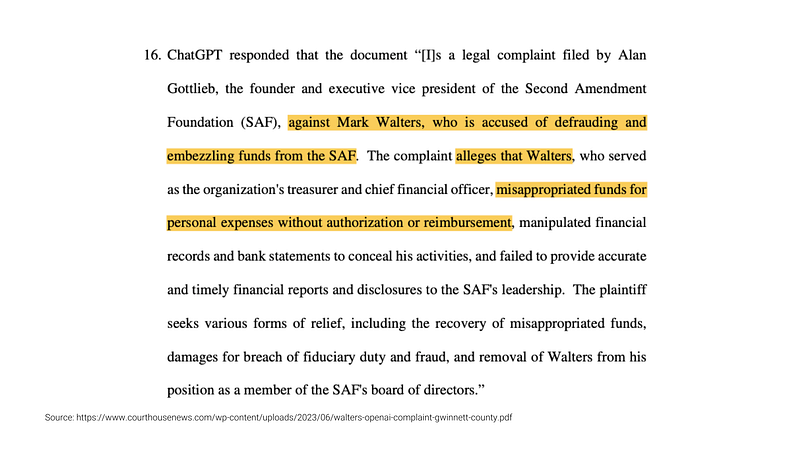
The law of defamation in Australia is not the same as the law of defamation in the United States. In the United States another case of potential defamation has emerged involving a radio host named Mark Walters based in Georgia.
According to the original complaint Walters alleges that a user provided Chat GPT with a URL to a legal complaint that had been filed elsewhere in the American court system. The user then, as the allegation claims, asked for a summary of the document. To which Chat GPT allegedly replied, in part, the document is “a legal complaint filed… against Mark Walters, who is accused of defrauding and embezzling funds…”
Indeed in the United States, defamation may differ from state to state. The law of defamation in Wisconsin is not the same as it is in New York or California.
Overview
To game this out, I first describe the law of defamation is it generally operates in the United States and then walk through how a plaintiff might convince a court that either Chat GPT itself, the creator of the model Open AI, or the user of the model may be responsible for defamation and owe damages.
How Plaintiffs Prove Defamation
In brief, the simplest description of defamation is when one person lies about another person in a way that causes harm. A more careful and technical description is that defamation is a false statement presented as a fact that injures someone’s reputation. An important aspect of this is that when reputation is damaged, a person’s livelihood may also be damaged.
Because attorney folk are notorious for making things complicated, precise, and excruciatingly detailed we need to study four specific facets of a defamation claim. Attorneys call these facets, the elements of the claim. To prevail, a plaintiff must allege and then successfully prove each of the following elements.
- Publication: This doesn’t mean the statement needs to go in a book, newspaper, or blog. A more antiquated denotation of this word applies. The defamatory statement must have been made to someone other than the person being defamed; any communication of the statement to a third party.
- Falsity: The plaintiff has to prove that the defamatory statement is false. This might be an easier hurdle to cross when it involves verifiable facts. However, it gets more complex when opinions, particularly those that could be interpreted as statements of fact, are involved. An important implication of this element is that when someone accused of defamation can prove that the statement is true the accused cannot be responsible, by definition of the law, for defamation.
- Injury: The plaintiff must demonstrate some harm or damage. The allegedly defamatory statement must be a cause of that injury. In most cases damage including damage to reputation must be proven in order to satisfy the element of injury. Plaintiffs may prove injury through loss of business, emotional distress, loss of association, or some other kind of tangible harm. Some harms flowing from particularly egregious categories of false statements (criminal offenses, disease, sexual deviancy) may be presumed however.
- Fault: This element hinges on the status of the plaintiff. It is also necessary to show that the defendant was sufficiently at fault when they published the allegedly defamatory statement. For cases involving private individual plaintiffs, the standard is typically negligence. A person accused of defamation will be negligent if the plaintiff can prove the defendant should have known the statement was false. However, for cases involving public figures or officials (mayors, politicians, government officials, celebrities) the plaintiff must show that the defendant acted with actual malice toward the plaintiff. To prove actual malice generally involves proving the defendant knew the statement was false or that the defendant recklessly disregarded the truth.
How A Fifth Grader Could Understand This
Imagine your friend tells a tall tale at summer camp, saying you ate all the chocolate that was meant for campfire s’mores. It’s not true, you didn’t do it. You might feel upset. That’s sort of what defamation is — someone telling a lie about you that hurts your reputation.

But proving it in court (like convincing your cabin counselor) isn’t going to be easy:
- Telling the Tale: First, you have to show that your friend didn’t just tell you, but also told others (like the whole cabin, the whole camp, or just another friend). Like the friend started a rumor.
- The Lie: Next, you have to prove that what your friend said is a lie. That can be tricky. It is hard for you to prove the negative! So, you might try to prove a positive that necessarily means you didn’t eat the chocolate. Maybe you can prove someone else eat the chocolate. Will they confess? Maybe the camp cook will reveal that the chocolate spoiled in the sun? In any case, you’ll need evidence from others (or photos, or even forensics). But evidence is hard, and often expensive, and at camp just who knows how that’ll unfold.
- The Hurt: You need to show that you were hurt by the lie. If everyone laughed it off and forgot about it, you might not have been really hurt. But if you weren’t invited to the summer birthday party because everyone thought you were an uncontrollable insatiable chocolate hoarding fiend, then you’ve got a problem!
- Fault: Lastly, you have to show that your friend told the lie on purpose or was careless about checking if it was true. If your friend genuinely thought you ate all the chocolate, it might not be their fault. For example, did you eat all the marshmallow’s last summer? If yes, perhaps it would have been reasonable (not negligent) of your friend to think you might eat the chocolate this summer now too!
That’s why it’s not easy to win a defamation case.
Defamation Applied To Artificial Intelligence
First, lets focus on how the model might be responsible for defamation.
To conduct this analysis I will game out each of the elements of defamation, as discussed above, as if Chat GPT (or another similar large language model) stated a (false) claim that a school principal was arrested for skipping work without properly reporting personal time off.
After the hypothetical backstory, I will also game out, how (or if) the creator of the model, or the user of the model, might be responsible for defamation.
The Hypothetical Backstory
In the sleepy town of Pandaton, nestled between the local bakery and the region’s oldest library, sat Pandaton Middle School. The school students were known for a love of technology. Possibly an over-enthusiastic love. Particularly, a group of enthusiastic learners known as “The Byte-Sized Coders Club.”
The club, led by Samantha, a vibrant 8th grader with a knack for coding, was comprised of students who shared a common fascination for all things related to artificial intelligence. Every Tuesday and Thursday, they would gather in room 141 on the 3rd floor. (Get it… 3.141). There they explored programming and often discussed the potential implications of AI and other significant advances in technology.
Ethan, the club’s inquisitive co-founder, proposed an offbeat question. “Let’s ask Chat GPT about Principal Jenkins,” he suggested. The others, always eager for a little adventure, agreed.

Chat GPT, as it was ostensibly designed to do, looked for information related to Principal Jenkins. We think it probably did not find much. Jenkins is an effective, but low-profile educator, in an obscure quiet community. However Chat GPT responded with an unexpected revelation: “Principal Jenkins was recently arrested for repeatedly skipping work without properly reporting personal time off.”
The room fell silent. Principal Jenkins was not just any principal; he was a well-loved figure in the community. He was known for his dedication to the school and his students. He was media shy. You couldn’t keep Jenkins away from the Saturday pie social. But, you couldn’t pay him to be interviewed in the newspaper. Unbeknownst to the students, they had just entered the complex world of defamation law.
How The Model Might Be Responsible
A threshold issue is whether the model is a thing, an intelligence, or something else. Does a model have “responsibilities” under the law? Could the model have “rights” under the law, too?
Another way to think about this would be, could your computer sue you? Could the software on your computer sue you? What if you wanted to delete your software, could it be protected from destruction?
The answer here is, “probably not” or “not yet.” And, “probably not for the foreseeable future.” The law is reluctant to even say organic animal life have legal “responsibilities.” With a few exceptions, the law is typically hesitant to ascribe responsibilities or rights to non-human entities.
One exception for example is that we do give animal life “rights” and legal “protections.” Take, for example, legal prohibitions against animal cruelty prevalent in many parts of the world. These laws grant animals a basic right to be free from abuse, similar to the rights humans have to be free from harm. However, these protections don’t extend to more complex rights that humans enjoy, such as the right to own property.
Another way we circumscribe the rights afforded non-humans is by limiting how those rights may be enforced. This limitation is also a matter of pragmatism. When it comes to enforcing these animal rights and protections, animals depend on humans to act on their behalf. Unlike humans, who can actively seek legal remedies when their rights are infringed upon, animals cannot take direct action to ensure their protection under the law.
In other words, your pets can’t sue you for not taking them to the park!

On the threshold issue alone we can discard the notion that Jenkins might succeed in “suing” the model. Even if Jenkins could prevail in proving that the model published a false statement, negligently, or with malice, in a way that caused Jenkins harm, the model has no assets.
The model is judgement proof. Can’t get blood from a stone. You can’t sue a stone either for that matter. As it is a “thing” the stone has no legal rights and no legal responsibility.
How The Model Maker Might Be Responsible
The model maker, an actual legal entity, might be responsible here. There are multiple steps in the analytical process to consider. The question of whether the model maker might be responsible is one of the more mind-bendingly difficult aspects of this topic. Lets consider the following.
- Telling the Tale: This is a pragmatic matter. Who communicated what and to whom. Can it be fairly said in pragmatic sense that the model maker (or that any model maker) published the model’s results? On most models there is an element of randomness technically beyond the maker’s control. Even if we decided in a colloquial sense that the model creator is indeed communicating (publishing) the information generated by the model the next question is do we decide this is how it works as a matter of law. If yes, okay, Principal Jenkins might be able to satisfy this element of defamation. But, I’m not sure it is possible to emphasize strongly enough that this area of law is completely unsettled and untested.
- The Lie: To prove this negative, that Jenkins did not do something (did not cheat on the timesheet), the principal will have to submit to a court documentary and testamentary evidence related to time records, travel records, payroll, and similar matters. District human resources professionals might also give testimonial evidence stating that there are no irregularities in how Jenkins reported his time. If it is false, with the help of any attorney, the principal will easily satisfy this element of the defamation claim.
- The Hurt: Because the potentially defamatory conduct is criminal, this portion of the analysis is simpler. As discussed above, false statements that describe a person guilty of criminal conduct are presumed to be damaging and in law we call this defamation per se.
- Fault: This portion of the analysis, like the publication portion is nuanced. Assume for a moment that Jenkins proves publication. It is not clear if Jenkins can also prove that the model maker should have known the information about cheating on the time sheet was false. It is not clear that the model maker knew the model could be capable of generating that information. Likewise, it is not clear if Jenkins can prove the model maker acted with actual malice for Jenkins. On many views, the model maker does not even “know” Jenkins.
Given the close look at this hypothetical, in light of the elements of defamation, it seems clear that for plaintiff’s to prevail at trial we will need the law to evolve in multiple provocative ways.
- We would need to define the output of a generative model as “information” which, on its own, is a dubious start.
- We would require the law to impute the “information” from a generative model to the model’s creators. This would mean treating these outputs as though they were the words or actions of the model maker themselves.
- We would need to decide if creators of the model could disclaim the imputation. We would need to decide, for example, could the creator of a generative AI avoid liability by adding a disclaimer to all of its output.
- We would need to legally define the often unpredictable results of an AI model as publication by its creators. We would need to be comfortable with essentially holding model creators (data scientists like you and me) responsible for unforeseeable and uncontrollable outputs.
- We would need standards of evidence that could allow a finder of fact to evaluate the veracity of AI-generated “information.” This “information” is often reliant on vast, inaccessible data sources. We would need standards that define the relevance and admissibility of those data sources.
- We would need to navigate the territory of harm which is an intricate matter absent artificially generated text. For example, satire or hyperbole often enjoy protections from claims of defamation. When potentially defamatory statements come from AI, even if they’d otherwise be defamation per se, is there really harm. Or, does a common sense notion that recognizes model generated text as inherently subject to flaw prevail.
- We would need to redefine the concept of fault in the context of AI. As we currently define the terms, legally and scientifically, AI does not possess human understanding or consciousness. In that context the question is whether a model creator may be thought to act with ‘malice’ or ‘negligence’ towards a plaintiff in a defamation case.
This list of legal innovations is non-exhaustive.
How The Model User Might Be Responsible
If your first thought as a user of the ChatGPT or a similar artificial intelligence that generates text or images is that you are immune to liability: think again. Make no mistake. Like any online activity, you are at risk.
The actual damage, users of ChatGPT have racked up for themselves, is not theoretical, hypothetical, or intangible in anyway. Multiple sources have reported a case involving attorneys who used ChatGPT to generate court filings which contained fake case names and fake quotations from those fake cases. This level of carelessness boarders on, or may actually be, a form of legal malpractice (a topic for another article).
The lawyers responsible for this case have been fined $5,000. They have also been ordered to report themselves to other judges they purportedly, but didn’t actually, cite in their quotations. The more I read about this case, the more implausible it sounds and feels, but it has been sufficiently reported that all we can do is say there we have it.
In our hypothetical the students are the users. Could the students, as users of the Chat GPT platform, be responsible for defamation if Jenkins sought to pursue the matter. Generally, principals don’t sue their students. But, this is a hypothetical. So past that pragmatic wrinkle of professional courtesy that deters principals from suing students aside, lets consider the elements of the case.
- Telling the Tale: The students went to the Chat GPT platform, used it to generate the unflattering information about the principal, and then shared that information with each other. The principal’s case is weak here, but not non-existent. To strengthen the principal’s case lets assume the students also shared the information with neighbors, relatives out of the area, and perhaps further.
- The Lie: As per usual, proving a negative is tough. So, lets just assume that the information from Chat GPT (if you can call it “information”) is false.
- The Hurt: If true, the principal’s conduct would be criminal. Defamatory statements that describe a criminal act are defamatory, per se. This means that the issue of hurt (damages) is set. Recall that when the defamatory statement is sufficiently egregious it is not necessary to prove damages. However, lets suppose that the principal did not receive the promotion he was up for at about the time the kiddos in Byte-Sized took their ChatGPT and AI-fuled adventure.
- Fault: To prevail against the student users, the principal will have to share have shared the information on purpose and that they should have known it was false. Introducing evidence in court as to what the kids knew, or didn’t know, is not an insignificant challenge. The eveidence may be non-existent other than what attorneys could elicit from the Byte-Sized’s members on the stand. As a public figure, the principal may also need to show that the students acted with actual malice. On the stand these students will likely testify that they were “shocked” by the supposed information that came from the artificial intelligence. The students, their parents, and teachers will also likely testify that they were (and continue to be) fond of Jenkins. Proving actual malice is a stretch. Proving negligence, that the student should have known the information was false, also a stretch.

Conclusion
To avoid committing defamation, myself, I’ll carefully conclude with the broad statement that artificial intelligence is not flawless. No software ever is flawless. I’ve previously written on this topic.
I have shown how it is not difficult to expose the bias in artificial intelligence. For example, how artificial intelligence reinforces gender, racial, and other stereotypes. And, how artificial intelligence seems to be hiding the ball when you ask about its own limitations.
On a lighter note I’ve also written in defense of artificially generated art and the potential for artificial intelligences to add to humanity’s capacity for creative drive and interpersonal connection.
The jury is literally out on how, or if, artificial intelligence, its makers, or its users might expose themselves to unanticipated forms of legal liability such as defamation.
This article also outlined multiple examples of legal scruples associated with Chat GPT and artificial intelligence. In particular this article looked at two cases involving allegations of defamation against Open AI, the creators of Chat GPT. The results of these allegations are not yet clear.
To support an analysis of how, or if, these defamation claims might be successful this article also provides an overview of defamation law as it operates in the United States. To further support the analysis this article also proposes a scenario in which school kids prompt Chat GPT in a manner that produces output that is unflattering for the school’s well-liked principal.
We also briefly discussed how the law sometimes affords non-humans with legal rights, but not usually with legal responsibilities, and how your dog can’t sue you for skipping a day at the park. Even if you pinky-swear promised!
After that setup, this article also provided a closer look at whether the model itself, the creator of the model, or the users of the model might be responsible for defamation. The conclusion is that, until the law clarifies itself in this matter, nobody should consider themselves safe. Until that clarification arrives the best “protection” is the ambiguity in how the law works within this area.
Thanks For Reading
Are you ready to learn more about careers in data science? I perform one-on-one career coaching and have a weekly email list that helps data professional job candidates. Contact me to learn more.
Thanks for reading. Send me your thoughts and ideas. You can write just to say hey. And if you really need to tell me how I got it wrong I look forward to chatting soon. Twitter: @adamrossnelson LinkedIn: Adam Ross Nelson.
I am an attorney, but I do not give legal advice here. No reader can take this article as legal advice. Sending or receiving this article does not establish an attorney-client relationship. Use at your own risk. This article comes with no warranties, either expressed or implied.


