
DeepMind Did It Again! AlphaGeometry: An Olympiad-level AI system for Geometry
In a fascinating new paper, DeepMind builds an open source neuro-symbolic system to achieve gold medal level Geometry reasoning AI! And that’s NOT even the best part!
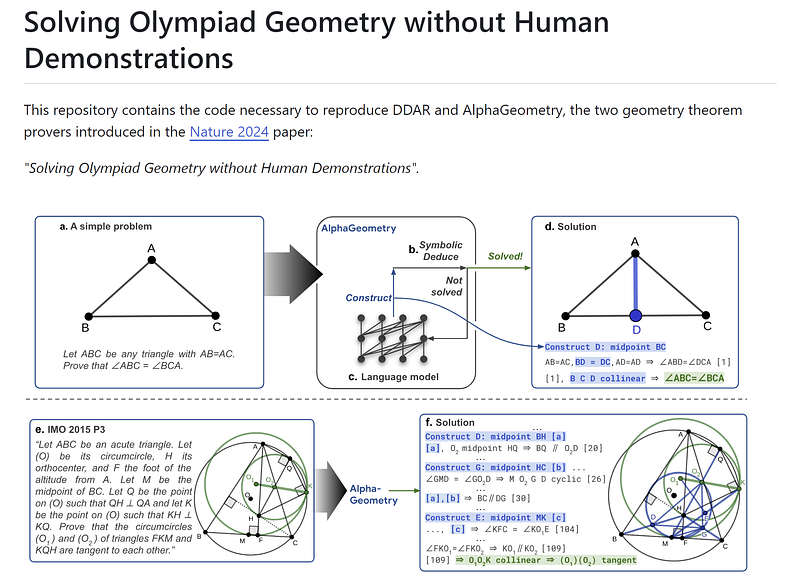
AlphaGeometry’s output is impressive because it’s both verifiable and clean…It uses classical geometry rules with angles and similar triangles just as students do.
EVAN CHEN, MATH COACH AND OLYMPIAD GOLD MEDALIST
What is AlphaGeometry?
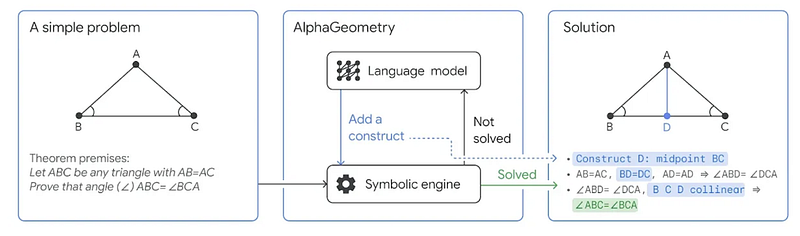
AlphaGeometry is a neuro-symbolic system combining an
- Large Language Model
- with a Symbolic Deduction Engine
Both work together to build an intuition (LLM) and then work on a full fledge proof (Symbolic Deduction Engine).
“Because language models excel at identifying general patterns and relationships in data, they can quickly predict potentially useful constructs, but often lack the ability to reason rigorously or explain their decisions. Symbolic deduction engines, on the other hand, are based on formal logic and use clear rules to arrive at conclusions. They are rational and explainable, but they can be “slow” and inflexible — especially when dealing with large, complex problems on their own.”
AlphaGeometry Tested On Geometry Olympiads
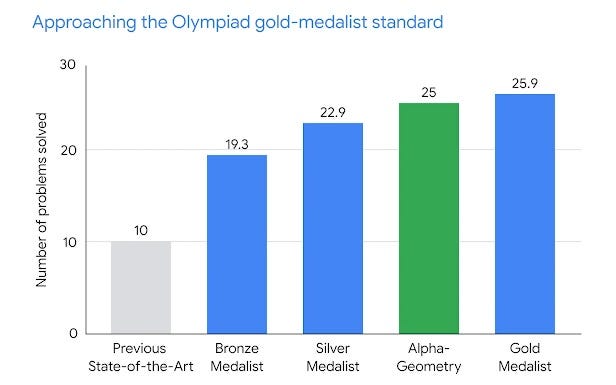
AlphaGeometry’s prowess was demonstrated in a benchmarking test comprising 30 Olympiad geometry problems, where it impressively solved 25 of them within the standard Olympiad time limit.
This performance is notable, especially when contrasted with the previous state-of-the-art system, which solved only 10, and the average human gold medalist, who solved 25.9.
This achievement underscores the system’s advanced reasoning capabilities in mathematics.
What About Training Data?
Probably one of the most fascinating aspect of this research, is it’s approach to training data! A crucial element of AlphaGeometry’s training involved the generation of a vast pool of synthetic data — over 100 million unique examples.
“And by developing a method to generate a vast pool of synthetic training data — 100 million unique examples — we can train AlphaGeometry without any human demonstrations, sidestepping the data bottleneck.”
Data Generation Process
- Random Diagram Generation: The system started by creating one billion random diagrams featuring various geometric objects.
- Deriving Relationships: For each diagram, AlphaGeometry exhaustively identified all the relationships between points and lines present.
- Finding Proofs: The system then discovered all possible geometric proofs that could be derived from each diagram.
- Symbolic Deduction and Traceback: This involved working backwards from the identified proofs to determine what additional geometric constructs (like extra lines or points) were needed to arrive at these proofs.
- Filtering for Uniqueness: The vast pool of data was refined by removing similar examples, leaving 100 million unique examples of varying complexity.
- Adding Constructs: Out of these, nine million examples were further enhanced with added geometric constructs.
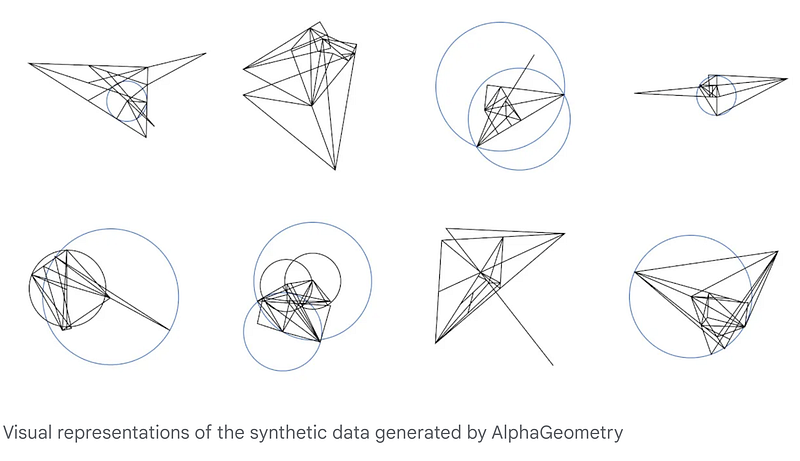
Finally, Training the Language Model: Using this extensive and varied dataset, the AlphaGeometry system trained its language model to better suggest new constructs for solving complex geometry problems, such as those found in Olympiad geometry challenges.
A First Milestone, Open Sourced Code + Model
AlphaGeometry not only represents a milestone in solving Olympiad-level geometry problems but also illustrates the potential of AI in enhancing logical reasoning and discovering new knowledge.
The system’s solutions are both machine-verifiable and human-readable, a balance between accuracy and comprehension that sets it apart from previous AI solutions.
AlphaGeometry’s output is impressive because it’s both verifiable and clean…It uses classical geometry rules with angles and similar triangles just as students do.
EVAN CHEN, MATH COACH AND OLYMPIAD GOLD MEDALIST
Moreover, AlphaGeometry’s success in geometry is just the beginning. Its underlying approach has broader implications for AI development in various mathematical fields. By pioneering methods to train AI systems from scratch using large-scale synthetic data, DeepMind is paving the way for future AI systems that can generalize across mathematical disciplines and enhance human knowledge.
The model & Code were open sourced! You can check them out here.
If you like this kind of news, here are some recommendations. Don’t forget to 🔔 clap & follow 🔔


