Deconstructing My Own Privilege
Do those of us with privilege in our lives ever stop to think about how good we have it?

Yes, I have many good things in my life, and I am grateful for all of them.
I am one of those people who has always thought that in life, there are many times that we have to pull ourselves up by the bootstraps in order to survive, much less thrive.
A couple of months ago, I saw an article about how being able to heal from your trauma is a privilege. When I first saw it, I was mad. Seeing ‘trauma’ and ‘privilege’ together in the same sentence made me cringe.
But, is that because there is something true in that statement?
In order to deconstruct my own privilege, I am going to first take a dive into defining what ‘privilege’ actually is.
Privilege Defined
Privilege, loosely defined, means that you have an unfair advantage over someone else in society just by virtue of being who you are. You didn’t have to do anything special to ‘get’ privilege, you just have it.
According to the United Way,
Privilege is unearned access or advantages granted to specific groups of people because of their membership in a social group. Privilege can be based on a variety of social identities such as race, gender, religion, socioeconomic status, ability status, sexuality, age, education level and more.
Privilege can be experienced on personal, interpersonal and institutional levels. The social, economic, political and psychological unearned advantages that privileged groups hold come at the expense of marginalized groups. Within the United States, members of social groups that hold privileges (white, male, wealthy, able-bodied, etc.) have historically held dominance and power over targeted groups.
So let’s break it down a little bit. How do you know if you have privilege? Is there anything about you that is on that list?
As far as it goes for myself, I am privileged because I am white and educated.
Therefore, I would have more privilege than someone who is non-white and non-educated. But, I would be less privileged than a man who is also white and educated.
Privilege comes in many shapes and forms. Most people will have some degree of privilege. But, rich, white, Christian males who are educated will have the most.
Those of us living in developed countries will have more privilege than those in developing countries.
Being able to read creates privilege.
Having money creates privilege.
Not ever having to worry about where your next meal is coming from.
Not being hated for your religion, the color of your skin, your gender.
Being an able-bodied person.
Having the ‘socially normal’ gender and sexual identity.
Speaking the dominant language of the country where you live.
When you have privilege, essentially you are the definition of ‘normal’ within your culture and social group. What you are is what others aspire to be. They want the rights that you have. They want to be ‘normal’ and accepted too.
Privilege is not ever having to question your safety or your acceptance within your society.
When you have privilege, you are part of the ‘in-group’ that all the other ‘out-groups’ are measured against. You are the advantaged vs. the disadvantaged.
Creating Discourse Around Privilege
With the rise of Black Lives Matter, and other similar movements to promote diversity, equity and inclusion the discourse around privilege has become louder. There are more voices joining the discussion.
Once we understand and deconstruct our own privilege, then we are open and ready to listen to the experiences of other people. Those that don’t have the same privileges that we have grown up with.
It is important to listen to these voices. To let them tell their own stories.
When we are the privileged in a conversation about what it is like to live without, it is our job to listen with an open mind and heart, above all else.
This discourse isn’t about us.
The discourse is meant to raise the voices of those who have been marginalized and unheard. It is ours to listen before we speak.
According to Forbes,
With the new decade upon us, more and more people are on a quest to become “woke” and understand how privilege and power manifests in society. Within the last few years books like How to Be an Antiracist, White Fragility, and So You Want to Talk About Race have reached the New York Times best seller list exposing the public’s increased desire to better understand the experiences of the marginalized. It is no longer a requirement to be a celebrity or be famous to have your voice heard and make an impact. The advent of social media has increased our interconnectedness, allowing us to gain a deeper appreciation of other people’s experiences. Each of us has the power to create changes that can reverberate beyond our own spheres of influence. What are some things we can all do to deconstruct oppressive systems and amplify the voices of the marginalized?
When we are in spaces that are all-white, or all-privileged in some other way and we hear someone saying something that takes away from inclusion, then it is time for us to speak up. To speak for those who can’t speak for themselves.
Also, as allies it is important to create safe spaces that allow all voices to be heard. That way, we move a step forward towards inclusion.
I didn’t start writing this because it is Pride Month, but it is important to note that June is LGBTQ+ pride month, and this is a community that is marginalized and suffering at the hands of the US government right now.
Speaking up for those who are being persecuted is important, and we should use our privileged voices to speak for those who are going unheard.
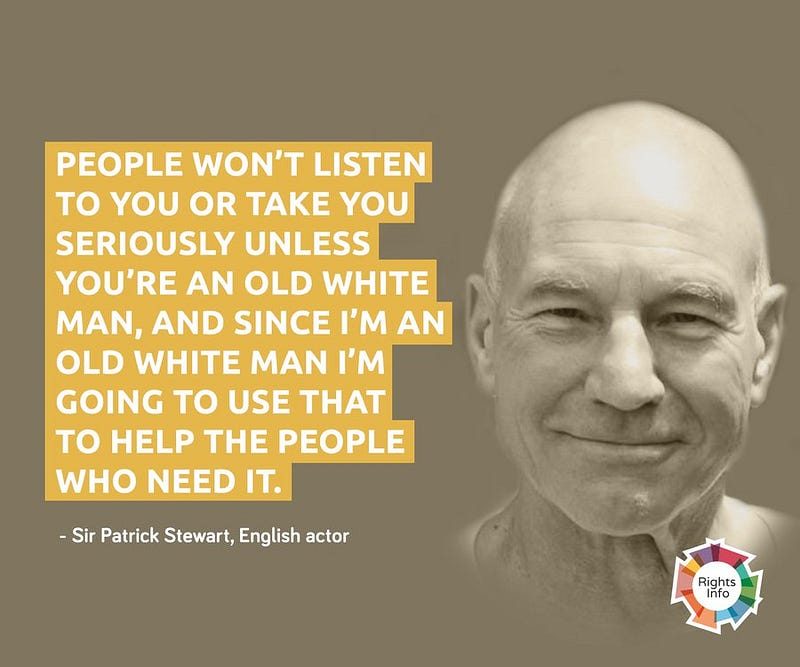
Let’s be more like Patrick Stewart and speak up to help people that are in need of our help.
Facebook | Instagram | Twitter | YouTube | Blog
You can also become a Medium member with my link for only $5 per month.