
Decision Modelling — From Indecisive to Infallible
The Secret Weapon to Avoiding Regrettable Haircuts and Questionable Fashion Choices

Hey, welcome to my blog! Today I want to talk to you about decision modelling, a cool technique in Business Analysis Techniques that can help to make better choices in the professional or personal life.
As a business analyst, we are often faced with complex and challenging decisions that can have a significant impact on the success of your projects and the organization as a whole.
But how do we ensure that we make the best possible choices, considering all the relevant factors, data, and uncertainties? How do we communicate our decisions to stakeholders and justify your rationale? How do we automate and optimize our decision-making processes to increase efficiency and effectiveness?
This is where decision modelling comes in handy.
What is Decision Modelling?
Within any organization, there are dozens of critical decisions made on a daily basis. Most of these decisions need to be made quickly and accurately, as they will often determine how profitable a certain business operation will be and contribute to its overall success.
Decision modelling is a systematic and visual approach that helps to create a clear representation of how decisions are made within the organization. It helps to break down complex decisions into manageable components, identify the criteria for evaluating options, and map out potential outcomes and consequences of the choices. It also helps to capture the logic behind the choices, improve transparency, consistency, and collaboration in the decision-making process, and automate the entire process.
Sounds pretty cool, right? But wait, there’s more!
Decision models created through this process serve as visual aids that help all involved stakeholders, including analysts and key decision-makers, to comprehend all the important factors, business rules, and considerations that impact choices within an organization.
Decision modelling also helps to forecast the potential outcomes of different actions by using tools such as flowcharts or decision trees. These tools show how various variables interact and affect the final result. By using decision analysis techniques, alternatives can be effectively analyse based on multiple criteria and constraints. This enables to evaluate different scenarios and understand the potential impact of the choices before making final decisions.
One key aspect of decision modelling is considering both quantitative data (such as financial figures) and qualitative factors (such as customer satisfaction or market trends). This holistic approach allows to weigh all relevant factors accurately and avoid biases or errors.
By using this technique, we can capture the logic behind the choices that affect your business operations, such as:
- The Decision: The specific choice or action that needs to be made or taken.
- The Alternatives: The different options or scenarios that are available for the decision.
- The Criteria: The factors or measures that are used to evaluate the alternatives.
- The Rules: The logic or conditions that determine which alternative is selected based on the criteria.
- The Outcomes: The results or consequences of selecting each alternative.
- The Risk and Uncertainties: The uncertainties or risks involved in the decision.
Decision Trees
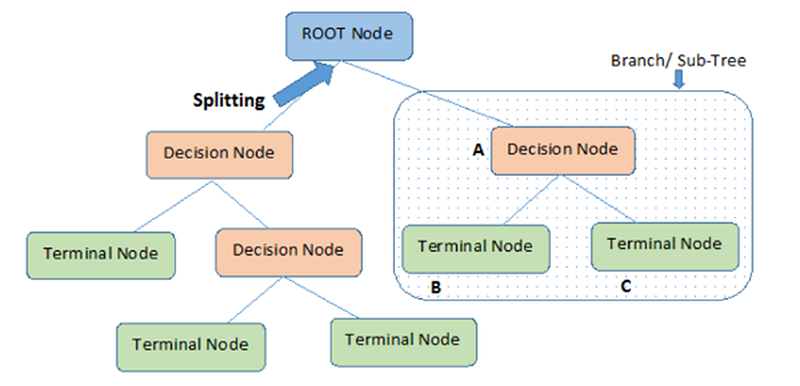
One of the most common tools for decision modelling is a decision tree, which is a diagram that shows the branching structure of a decision.
A decision tree starts with a root node, which represents the initial situation or problem. Then, it branches out into different nodes, which represent the possible choices or actions that you can take.
Each node can have one or more outcomes, which are the results or consequences of your choice. The outcomes can be either terminal nodes, which end the decision tree, or intermediate nodes, which lead to further choices or actions.
Here’s an example of a simple decision tree:
This decision tree shows whether we should buy a new car or not, based on two factors: budget and preference.
The root node is the question “Should I buy a new car?”
The first branch is based on budget.
With enough money, we can choose between buying a new car or saving it. With having no enough money, we can choose between borrowing money or keeping the old car.
The second branch is based on your preference.
Having a new car will get more satisfaction but also more depreciation. But, saving money will get less satisfaction but also less depreciation.
The terminal nodes show the final outcomes of your decision, in terms of satisfaction and depreciation.
As we have seen, a decision tree can help to visualize the structure and logic of decision, and compare different options based on their expected outcomes.
We can also assign probabilities and values to each outcome, and calculate the expected value of each choice. This way, we can quantify the trade-offs and risks involved in the decision, and choose the option that maximizes the expected value.
Of course, decision trees are not the only tool for decision modelling. There are many other techniques and methods that can be used to represent and analyze decisions, such as flowcharts, influence diagrams, payoff matrices, utility functions, sensitivity analysis, Monte Carlo simulation, and more. Each technique has its own advantages and disadvantages, depending on the type and complexity of the decision problem.
How to Use Decision Modelling?
Decision modelling can be applied to various types of decisions, such as strategic, tactical, or operational decisions. It can also be used for different purposes, such as:
- Designing new products or services
- Defining business requirements
- Optimizing business processes or workflows
- Selecting vendors or suppliers
- Allocating resources or budgets
- Managing risks or uncertainties
- Resolving conflicts or disputes
Now let’s see how we can do it in practice. Here are some steps to follow:
1. Define the Decision Problem
What is the goal or objective of the decision? What are the alternatives or options available? What are the constraints or limitations?
2. Identify the Decision Criteria
What are the factors or attributes that matter for your decision? How will you measure or evaluate them?
3. Gather Relevant Data and Information
What are the sources of data or information that can help you assess your options? How reliable and accurate are they?
4. Construct the Decision Model
What tool or format will we use to represent the decision problem? How to structure the model? How to incorporate data and information into the model?
5. Analyse the Model
What insights can be gained from the model? How do different options compare based on the criteria? What are the trade-offs or risks involved?
6. Make the Decision
Based on the analysis of model, what is the best option that meets the objective? How confident are we about our choice? How will we implement it?
7. Review and Refine
Test the model for validity and reliability by checking for errors, inconsistencies, or assumptions. Revise the model as needed based on feedback, new information, or changing conditions.
That’s it! You’ve just learned how to do decision modelling like a pro!
Strengths of Decision Modelling
Decision modelling is not just a fancy term for drawing diagrams. It’s a powerful technique that can help to make better decisions at work.
Here are some of the benefits of using decision modelling:
- It provides a clear and logical framework for making complex decisions.
- It is flexible and adaptable to different types of decisions, domains, and contexts.
- It is transparent and consistent in showing how decisions are made and why.
- It reduces bias, errors, and ambiguity in decision-making.
- It increases confidence, trust, and satisfaction in decision-making.
- It is intuitive and easy to understand for both analysts and stakeholders.
- It is rigorous and analytical in evaluating alternatives based on multiple criteria and constraints.
Limitations of Decision Modelling
Some of the weaknesses of Decision Modelling are:
- It can be time-consuming and resource-intensive to create and maintain a comprehensive and accurate decision model.
- It can be difficult to capture all the nuances and details of real-world situations in decision models.
- It can be challenging to deal with dynamic and changing environments that affect decision-making.
- It can be influenced by subjective judgments, biases, or assumptions that may affect the quality of the decision model.
- It can be limited by the availability and reliability of data or information that may affect the validity of the decision model.
Real-Life Examples of Decision Modelling
Decision modelling can be used in various domains and contexts where complex decisions need to be made.
Here are some examples of how decision modelling can be applied in practice:
Finance
A bank uses decision modelling to assess the creditworthiness of its customers and determine whether to approve or reject their loan applications. The decision model considers factors such as income, expenses, assets, liabilities, credit history, etc., as well as business rules such as interest rates, loan terms, etc., to calculate the expected value and risk of each loan option.
Healthcare
A healthcare provider wants to decide which treatment option to prescribe to a patient. He uses decision modelling to compare different treatment options based on their effectiveness, side effects, costs, and patient satisfaction. He also considers the patient’s medical history, condition, and preferences in his analysis.
Retail
A retailer uses decision modelling to optimize its inventory management and replenishment. The decision model analyzes factors such as demand patterns, sales trends, customer preferences, etc., as well as operational constraints such as storage capacity, lead time, etc., to determine the optimal quantity and timing of ordering and stocking each product.
Marketing
A marketing manager wants to decide which marketing campaign to launch for a new product. He uses decision modelling to compare different campaigns based on their costs, benefits, risks, and expected returns. He also considers the customer preferences, market trends, and competitor actions in his analysis.
Education
Decision modelling can help educators make optimal curriculum or pedagogy decisions by comparing different approaches based on criteria such as learning outcomes, student engagement, feedback, etc.
Tips on How to Apply Decision Modelling Effectively
Decision modelling is a powerful technique that can help to make better decisions as a business analyst. However, it also requires some skills and knowledge to apply it correctly and efficiently.
Here are some tips on how to improve the decision modelling skills:
Learn the Basics
Familiarize yourself with the fundamental concepts and principles of decision analysis, such as expected value, utility, risk, uncertainty, sensitivity analysis, etc.
Use the Right Tools
Choose the appropriate tools and software that can help to create and analyze the decision models. Some examples of popular tools are Excel, R, Python, Decision Tree Maker, etc.
Keep it Simple
Avoid making the decision models too complex or detailed. Focus on the essential elements and factors that affect the decisions and eliminate unnecessary or irrelevant information.
Be Objective
Avoid bias or emotion in the decision-making process. Use facts and data to support your decisions and avoid personal opinions or preferences.
Seek Feedback
Involve stakeholders and experts in your decision-making process. Seek their input and feedback on the decision models and incorporate their suggestions or corrections.
Decision modelling is a valuable technique that can help to become a better business analyst. It can help to make well-informed decisions that align with the organization’s goals and objectives by creating a structured and visual representation of how decisions are made within an organization.
I hope you enjoyed this blog post and learned something new about Decision Modelling for business analysts. If you have any questions or comments, please feel free to share them in comments.
Please subscribe to my blog and follow me. Don’t forget to clap (you can clap 50 times) or buy me a coffee!
Until next time, Happy Decision Making and keep watching this space for more Business Analysis Techniques!


