
Decision Makers Need More Math
Rigorous mathematical thinking is missing in most decision making environments

Recently I was having a conversation with a friend who was frustrated with his current situation at work. He was responsible for driving a major software rollout in his sales force, but he didn’t believe in what he was doing. Neither, it turns out, did any of his colleagues. The situation he described sounded really miserable and demotivating.
My natural reaction was to ask how this had all come about. He described how the decision to pursue the rollout stemmed from a ‘killer chart’ that had been circulated among management. The chart had compared the sales output of two groups and concluded that one group was more effective because of their use of a particular software product in the field.
I asked him two questions. First, I asked if they had established that the difference in the two groups was not down to pure chance? Second, I asked if they had established conclusively that the use of the software had caused the difference.
He was dumbfounded. He told me he had no idea that differences can happen by chance, and the whole causality question was not even discussed. He described how the management group simply swallowed the chart and made a decision without further debate about the numbers and their meaning.
The conclusion we came to was that this had all come about because nobody in the group knew any math! A piece of analysis had made its way around the group, and nobody involved had the experience or knowledge to properly critique it.
I fear that this type of situation is growing rapidly, and that millions of dollars worth of erroneous decisions are being made because of it.
Why is math becoming more important?
Put simply, there’s so much more data around. According to IBM, we now create over 2.5 quintillion bytes of data per day. There are various statistics which illustrate how that trend is likely to continue:
- Research by McKinsey has established that nearly 50% of Sales and Marketing functions describe themselves as having been ‘transformed’ by analytics and Big Data.
- Statista reports that the market for Big Data will grow by more than 10% per year for the next ten years
- An executive survey recently revealed that 84% of enterprises have launched advanced analytics and Big Data initiatives to improve decision making.
The clear picture emerges that decision makers will be facing many more data driven documents and charts than they did 10 or 20 years prior. But are those decision makers any better equipped to make accurate decisions in such a data rich environment?
The math bar is being raised, but skills are lacking
The boom in data-driven decision making and analytics requires a commensurate increase in executive math skills. Without the ability to question and critique analytics, decision-makers are at the mercy of sales pitches and biased agendas. Concepts like correlation, regression, significance and predictive accuracy are all getting banded about, but there is no evidence that decision makers are any better equipped to understand them.
- Research by Cambridge Assessment in the UK highlights that employers regard numeracy as important in most roles, even those which are not highly data-driven, but that workforce numeracy is not at the level it should be to satisfy this.
- The US Dept of Labor expects math-related careers to grow at four times the rate of other jobs in the next ten years, but the US ranks 24th out of 30 countries on mean adult numeracy according to the OECD.
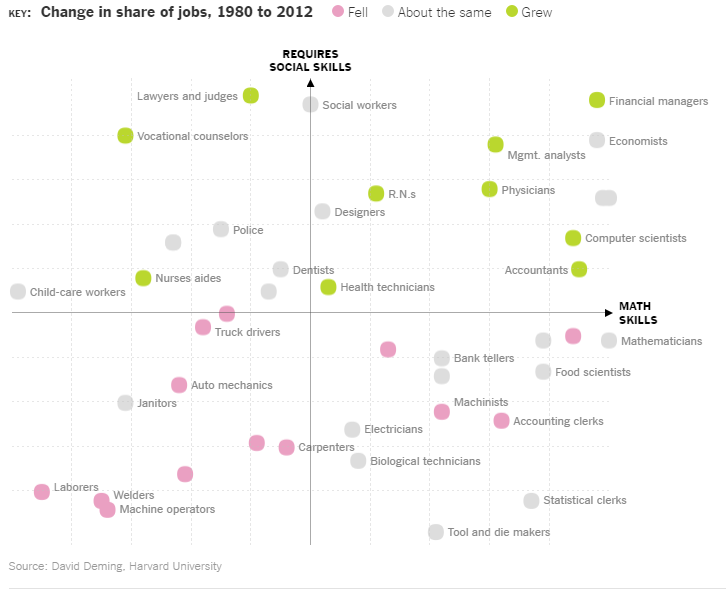
- A recent Harvard Study concludes that mathematics will be one of the most in demand skills for the future workforce, showing that the most substantial recent jobs growth has been heavily weighted towards positions that require math.
What should decision makers know?
In amongst all these macro factors and trends, it strikes me that there are some basic things that decision makers should know in any data driven environment:
- What does correlation mean and how to measure correlation coefficients for different types of data
- What does causation mean, how it is different from correlation, and how to prove causation
- How to statistically test a hypothesis, and the statistical conditions underlying hypothesis testing
If you are working in a data driven environment and you do not feel like you have a good understanding of these things, I encourage you to take action now. If you also feel that your fellow decision makers are in a similar position then the situation is even more urgent.
There is no doubt that math is becoming more critical in the workplace with every year that passes. Whether we like it or not, we need to make efforts to step it up.
How important is math in your work? Feel free to comment.


