Deciphering the Mystical Layers of the Gospel of Thomas
Exploring Sayings Three and Four
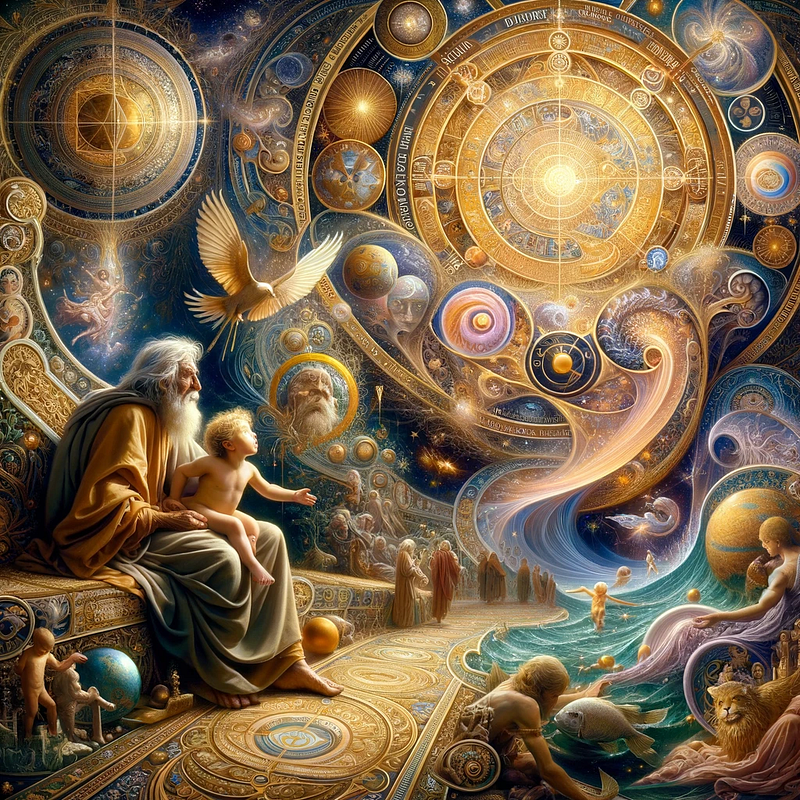
This article is the second in a series dedicated to examining the Gospel of Thomas saying by saying. Actually, by pairs of saying at a time. My method is to move through Thomas two sayings at a time. I also examine the sayings in reverse order.
For example, in this article, we are looking at Sayings Four and Three, in that order. In this way, we make the last first, and the first last.
Saying Four: Wisdom from Innocence
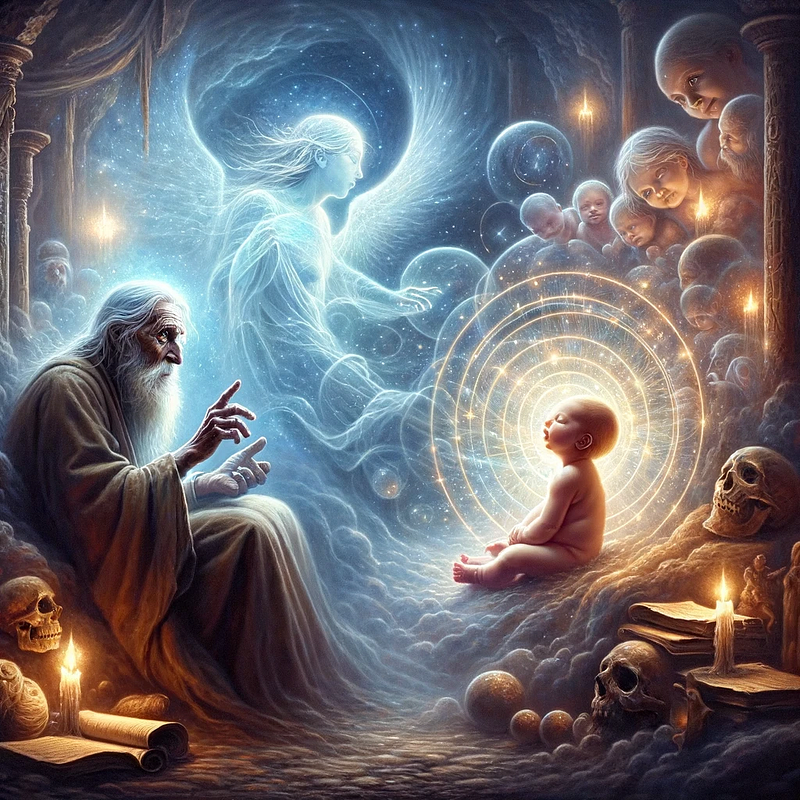
Jesus said, The person old in days won’t hesitate to ask a little child seven days old about the place of life, and that person will live. For many of the first will be last, and will become a single one. (Gospel of Thomas 4)
I am going to break the text down into sections to decipher the surface meaning.
The person old in days won’t hesitate to ask a little child seven days old about the place of life, and that person will live.
This part of the saying emphasizes humility and the willingness to seek wisdom from unexpected sources. In many spiritual traditions, children are seen as embodying purity, innocence, and a direct connection to the divine. The ‘old in days’ person represents experience, knowledge, and perhaps a certain world-weariness. The willingness of such a person to seek wisdom from a newborn suggests an openness to learning and understanding the world in new ways. The phrase ‘about the place of life’ might refer to a deeper understanding of existence, suggesting that true insight can come from a state of innocence and openness represented by the child.
For many of the first will be last, and will become a single one.
This part of the saying could be interpreted as a comment on spiritual hierarchy and the nature of true spiritual attainment. It suggests a reversal of earthly status and expectations: those who are considered ‘first’ in worldly terms (the powerful, the knowledgeable, the respected) might end up ‘last’ in the context of spiritual truth, and vice versa. This reversal challenges conventional ideas of importance and success. The phrase ‘will become a single one’ might imply a state of unity or oneness that transcends conventional distinctions and separations, pointing towards a deeper spiritual unity in the face of divine truth.
Reversing Order, Revealing Meaning
That is all very deep. I should point out that my practice of examining the sayings in reverse order is thanks to the second part of this saying which appears in various forms throughout the synoptic Gospels. For instance:
But many who are first will be last, and many who are last will be first. Matt: 19:30
I, of course, choose to see it as an instruction for how to approach the text. I should say that I see it as both a reversal of earthly status and as an instruction for someone attempting to decode the text.
With that out of the way, let us now continue to Saying Three:
Jesus said, If those who lead you say to you, ‘See, the kingdom is in the sky,’ then the birds of the sky will precede you. If they say to you, ‘It is in the sea,’ then the fish will precede you. Rather, the kingdom is inside of you, and it is outside of you. When you come to know yourselves, then you will be known, and you will understand that it is you who are the sons of the living father. But if you do not know yourselves, then you are in poverty, and you are poverty. (Gospel of Thomas 3)

Once again, I will attempt to put into words what I see as the surface reading of the text by breaking the text into sections and examining each section in turn.
If those who lead you say to you, ‘See, the kingdom is in the sky,’ then the birds of the sky will precede you. If they say to you, ‘It is in the sea,’ then the fish will precede you.
This part of the saying may be interpreted as a critique of externalizing the spiritual realm. It suggests that if you look for the kingdom of God in some external, physical place (‘in the sky’ or ‘in the sea’), you will find that even the simplest creatures (birds, fish) are ahead of you in understanding or reaching it. This seems to be saying that such literal interpretations are simplistic and miss the true nature of the divine.
Rather, the kingdom is inside of you, and it is outside of you.
Here, the saying shifts to a more mystical perspective, emphasizing that the divine realm or ‘kingdom’ is not a physical location but an internal and external reality. This implies that the divine is both a deeply personal, inner experience and something that permeates the entire external world.
When you come to know yourselves, then you will be known, and you will understand that it is you who are the sons of the living father.
This suggests that self-knowledge is key to spiritual understanding and enlightenment. To ‘know oneself’ might mean recognizing one’s divine nature or understanding one’s deeper identity beyond the ego. This self-realization leads to the understanding that one is intrinsically connected to the divine (the ‘living father’), hinting at a non-dualistic view where the individual and the divine are not separate.
But if you do not know yourselves, then you are in poverty, and you are poverty.
The saying concludes by emphasizing the spiritual poverty that comes from a lack of self-awareness. This poverty is not material but existential and spiritual. It implies that without this inner knowledge and connection to the divine, one lives in a state of alienation from the true essence of being.
The Encrypted Readings
Again, really deep stuff. And once again, there doesn’t seem to be much more that can be said. Where can the secret message be hidden?
Please be warned that the following is likely to contradict portions of what was written above.
Saying Four Revisited
Jesus said, The person old in days won’t hesitate to ask a little child seven days old about the place of life, and that person will live. For many of the first will be last, and will become a single one. (Gospel of Thomas 4)
I am going to break it into two sections again:
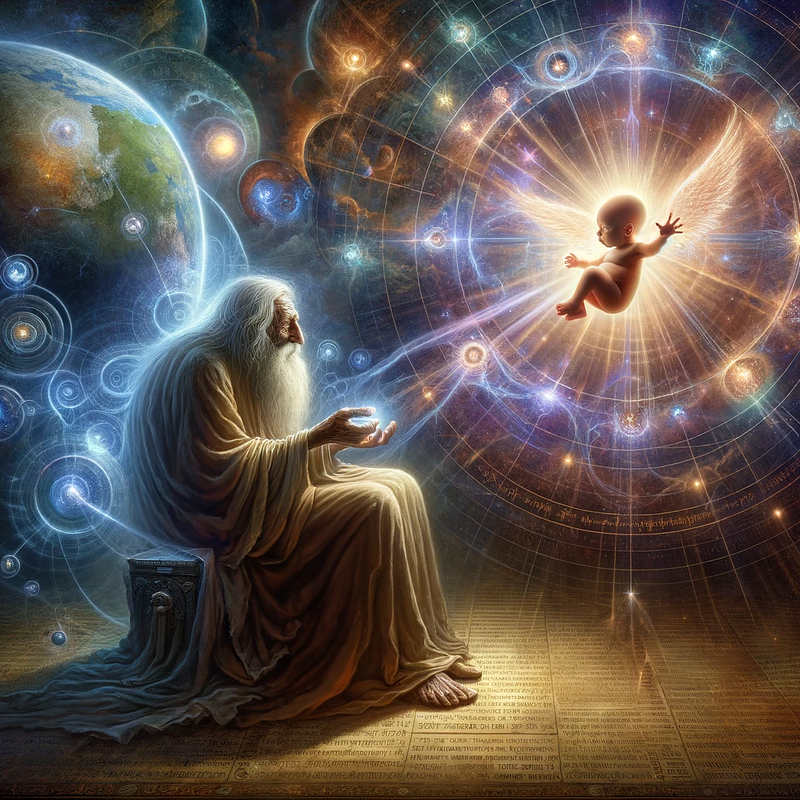
Jesus said, The person old in days won’t hesitate to ask a little child seven days old about the place of life, and that person will live.
I am not going to read this as being esoteric, but rather as being encrypted text. First, there is the closing phrase ‘that person will live’. This phrase indicates that when speaking to the seven-day-old child, the person ‘old in days’ will receive a clue that will enable him to solve the saying. Saying One reveals that the person who solves these sayings will never taste death.
The ‘place of life’ is probably Earth. How can we consult a seven-day-old child about Earth? Suppose that we had access to an ancient text that described the first seven days of Earth, maybe that is what is being referenced here. Perhaps, the seven-day-old talking about Earth is actually talking about itself, it's Genesis.
Then we come to the second section:
For many of the first will be last, and will become a single one.
This refers to the variety of esoteric systems that seem to be derived from a single template including the astrological planets, the trigrams of the I-Ching, and the aggregations of spheres as I have written about in recent articles. These systems all seem to be encrypted within the Genesis creation narrative.
These systems are ancient and primal. And it seems that they are elements of a single overarching system.
So, to recap, as I see it, saying Four’s hidden reading is telling us to consult the seven days of Genesis, and it hints that the seven days of Genesis are encrypted with various esoteric systems which are all facets of a single divine system.
Saying Three Revisited
Jesus said, If those who lead you say to you, ‘See, the kingdom is in the sky,’ then the birds of the sky will precede you. If they say to you, ‘It is in the sea,’ then the fish will precede you. Rather, the kingdom is inside of you, and it is outside of you. When you come to know yourselves, then you will be known, and you will understand that it is you who are the sons of the living father. But if you do not know yourselves, then you are in poverty, and you are poverty. (Gospel of Thomas 3)
This saying breaks into four sections:
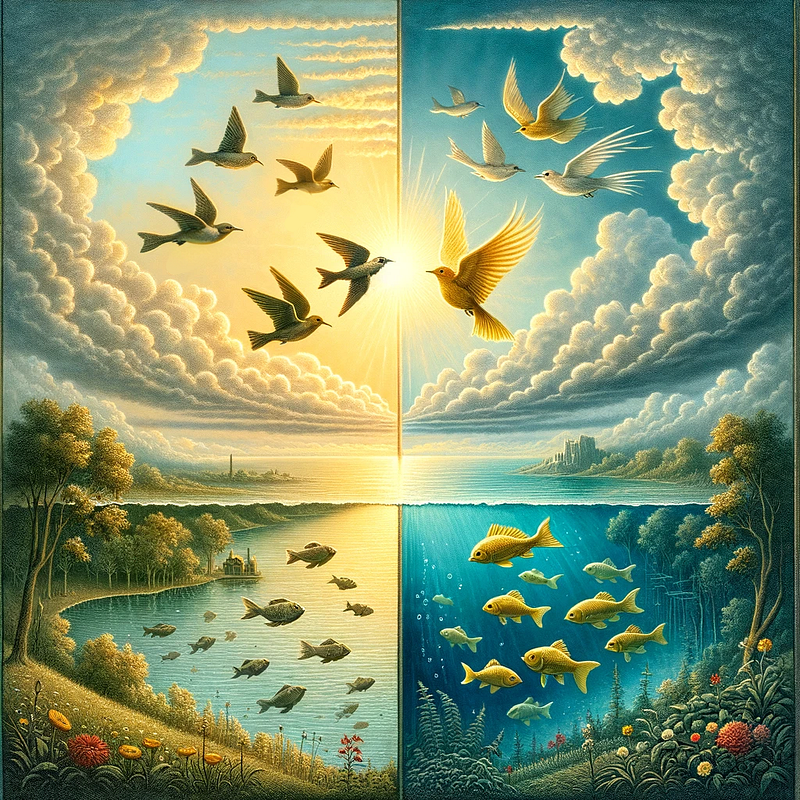
Jesus said, If those who lead you say to you, ‘See, the kingdom is in the sky,’ then the birds of the sky will precede you. If they say to you, ‘It is in the sea,’ then the fish will precede you.
First, something obvious. While there may be some who claim that the kingdom is in the sky, I have never heard the claim being made that the kingdom was in the sea. However, if we take the clue from Saying Four and consult Genesis, we discover that birds and fish were created on the fifth day of creation.
If we count the days of Genesis beginning with light being created on Sunday, then Monday, Tuesday, and Wednesday, with Thursday being the fifth day. Thursday is named after the Norse god Thor who is the equivalent of the Roman god Jupiter (Jove), which is ‘Jovis Dies’ in Latin, Jupiter Day.
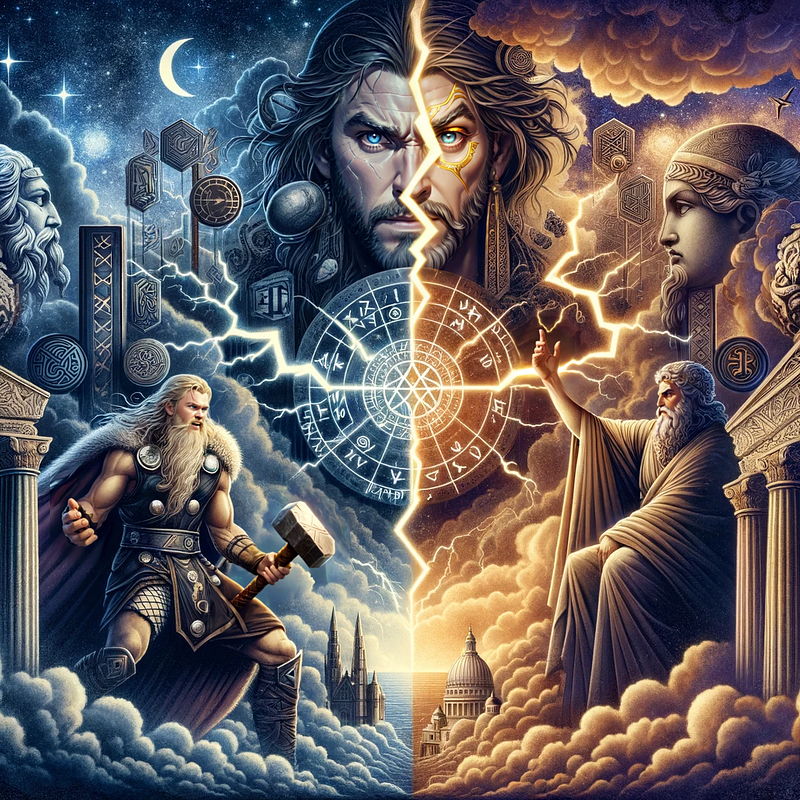
Jupiter is the king of the gods, symbolizing power, authority, and good fortune. In astrology, the planet Jupiter is often associated with expansion, growth, and prosperity.
Jupiter rules the signs of Sagittarius and Pisces. Sagittarius is the archer, his arrows correspond to birds. Pisces is the Latin word for fish.
Rather, the kingdom is inside of you, and it is outside of you.
The realm of Jupiter is inside and outside of you.
When you come to know yourselves, then you will be known, and you will understand that it is you who are the sons of the living father. But if you do not know yourselves, then you are in poverty, and you are poverty.
Jupiter is the planet of wealth and abundance. It also represents fatherhood. And let’s not forget Zeus, the Greek form of Jupiter who was the most famous father in Greek mythology.
Let’s look at how the saying defines poverty and wealth.
The wealthy know themselves, are known by others, and recognize that they are the sons of the living father.
The poor do not know themselves, are not known by others, and do not recognize that they are the sons of the living father.
The secret to this saying is that it is not talking about those who recognize that they are the sons of some spiritual or heavenly father and those who do not. Rather it is distinguishing between those who are sons of an actual living father and those who are not, because their father is dead or missing.
The sons with a living father know who they are because they have a father to follow. They are known by others because others know their father and the kind of man he is. They live in wealth and they are wealthy compared to the fatherless.

Those without a father do not know who they are because their father is not there to provide a role model. Others do not know who they are because they don’t know the child’s father. They live in poverty and are poor because there is no father to support the family.

Unlocking the saying turns its entire meaning upside down.
In this exploration of Sayings Four and Three from the Gospel of Thomas, we have searched through the depths of esoteric wisdom, seeking to unearth hidden meanings and secret messages within these ancient texts.
Our journey through Saying Four led us to contemplate the interaction between wisdom and innocence, symbolized by the dialogue between the old and the newborn. This interaction challenges us to reconsider our perceptions of knowledge and understanding, inviting us to see wisdom in unexpected places. The encrypted message in this saying, as we have interpreted it, points us toward the Genesis narrative, suggesting a cryptic linkage between the creation story and various esoteric systems, all converging into a singular divine template.
In Saying Three, we encountered the metaphorical portrayal of the kingdom of heaven, not as a physical realm but as a sociological truism about fathers and their profound impact on the lives of their children. The saying subtly indicates that the presence or absence of a father figure significantly shapes an individual’s experience of the world. A father, in this context, is more than a parent; he represents guidance, security, and the foundational principles upon which identities are built.
This analysis suggests that these sayings from the Gospel of Thomas are not mere religious texts but are encoded with layers of meaning that intertwine spiritual, astrological, and existential themes. They challenge us to think beyond conventional boundaries and to seek deeper understanding and self-awareness.
The Gospel of Thomas, with its cryptic and mystical sayings, stands as a testament to the rich and complex nature of early Christian thought. It beckons us to embark on a journey of spiritual discovery, where the quest for knowledge and understanding transcends the literal and enters the realm of the mystical. As we continue to explore these ancient sayings, I am reminded of the timeless nature of spiritual inquiry and the endless pursuit of wisdom that defines our human experience.
A heartfelt acknowledgment to these faithful readers:
Brought to you by: