
Debunking “Trans Women Are Not Women” Arguments

I was recently interviewed by the New York Times about my work and writings as a trans feminist. From pre-interview conversations we shared, I knew that my interviewer planned to ask me about Chimamanda Ngozi Adichie’s comments from earlier this year wherein she claimed that trans women are not women. So in preparation for my interview, I decided to revisit my first book Whipping Girl: A Transsexual Woman on Sexism and the Scapegoating of Femininity and create a list of all the arguments that I made there to counter such claims. I would go on to make some of these points during the interview, although only a few were included in the final article (as it was edited for length). But since these trans-women-are-not-women claims recur on a regular basis (and are often forwarded by people who self-identify as feminists), I thought that it would be worthwhile to compile all my relevant counterarguments in one essay.
Preliminaries: regarding the term cisgender
Throughout this essay, I will use the terms cis or cisgender to refer to women who are not trans or transgender. I explain the logic behind this terminology in my FAQ on cis-terminology, and in two additional follow up essays that can be accessed here. Women who insist that trans women are not women often object to being called “cis women” under the false assumption that it somehow undermines their femaleness — this is not at all the purpose of this language. The sole purpose of cis terminology is to name the unmarked majority (similar to how one might refer to white women, or heterosexual women, or able-bodied women, etc.). In other words, referring to someone as “cisgender” simply means that they have not had a transgender experience.
Trans women’s realities
Trans women differ greatly from one another. Perhaps the only thing that we share in common is a self-understanding that there was something wrong with our being assigned a male sex at birth and/or that we should be female instead. While some cisgender people refuse to take our experiences seriously, the fact of the matter is that transgender people can be found in virtually every culture and throughout history; current estimates suggest that we make up 0.2 – 0.3% of the population [or possibly more, see note further down]. In other words, we simply exist.
In my own case, I spent a number of years trying to make sense of the inexplicable and irrepressible feelings that I experienced before finally making the decision to transition seventeen years ago. I have been living as a woman ever since. Every single day of my life, people perceive and treat me as a woman, and I routinely experience sexism as a result. While cis feminists who claim that trans women are not women obsess over questions of identity (“How can a ‘man’ possibly call ‘himself’ a woman?”), they purposefully overlook or play down the fact that we have very real life experiences as women.
Like women more generally, many trans women are feminists. Feminism and transgender activism are not in any way incompatible or mutually exclusive. As feminists who acknowledge intersectionality, we believe that we should be fighting to end all forms of sexism and marginalization — this includes both traditional sexism and transphobia. Forcing trans women into a separate group that is distinct from cis women does not in any way help achieve feminism’s central goal of ending sexism.
The “biological woman” fallacy
Claims that trans women are not women often rely on essentialist (and therefore incorrect) assumptions about biology. For instance, people might argue that trans women are not “genetically female,” despite the fact that we cannot readily ascertain anybody’s sex chromosomes. Indeed, most people have never even had their sex chromosomes examined, and those that do are sometimes surprised by the results.
Other common appeals to biology center on reproduction — e.g., stating that trans women have not experienced menstruation, or cannot become pregnant. This ignores the fact that some cisgender women never menstruate and/or are unable to become pregnant.
Claims about genitals are similarly problematic: Women’s genitals vary greatly, and as with chromosomes and reproductive capabilities, we cannot readily see other people’s genitals in everyday encounters. If you and I were to meet, should I refuse to recognize or refer to you as a woman unless you show me your genitals? And frankly, what could possibly be more sexist than reducing a woman to what’s between her legs? Isn’t that precisely what sexist men have been doing to women for centuries on end?
I would argue that all of these appeals to biology are inherently anti-feminist. Sexists routinely dismiss women by pointing to real or presumed biological differences. Feminists have long challenged the objectification of our bodies, and have argued that we are not limited by our biology. So it is hypocritical for any self-identified feminist to use “biology” and “body parts” arguments in their attempts to dismiss trans women.
[note added 7–17–17: I discuss this particular topic in more depth in a subsequent essay, Transgender People and “Biological Sex” Myths.]
The Caitlyn Jenner fallacy
These days, trans-women-are-not-women arguments invariably cite Caitlyn Jenner, typically making the following claim: “How can someone like Jenner, who lived their entire life as a man and experienced the privilege associated with that, ever possibly claim to be a woman?” There are likely appeals to biology in this particular example, as many people remember Jenner as a physically masculine decathlete. But the main thrust of this assertion is that women are women because of socialization and/or their experiences with sexism.
But what about me then? I have lived more of my adult life as a woman than as someone who was perceived to be a man, and I have experienced plenty of sexism since my transition: street remarks and sexual harassment, attempted date rape, men talking over me or not taking me seriously, and so on. Or what about young trans girls who socially transition early in life, and who never have the experience of being perceived or treated as a man? If you are making the “socialization” or “experiencing sexism” argument, then you have to concede that many trans women have these experiences too, and are therefore women under such criteria. Even older transitioners like Jenner will face sexism once people begin perceiving them as women. And even if the trans woman in question is visibly transgender, she will still experience plenty of sexism in the form of trans-misogyny.
If you happen to be a proponent of the women-are-women-because-of-socialization argument, then I ask you to consider the following scenario: A young girl is forced against her will to live as a boy. Upon reaching adulthood, after years of male socialization and privilege, she comes out about identifying as female and begins to live as a woman. Do you accept her as a woman? If your answer is yes, then it is hypocritical of you to not also accept trans women as women. (Indeed, the “forced against her will into boyhood” scenario is exactly how many trans women describe their childhoods.)
More often than not, people who claim that trans women aren’t women make both the biology and socialization arguments simultaneously, even though they are seemingly contradictory (i.e., if biology is the predominant criteria, then one’s socialization shouldn’t matter, and vice versa). Much like their homophobic counterparts who make appeals to biology (“God made Adam and Eve, not Adam and Steve”) then hypocritically invoke socialization (e.g., claiming that people can be turned gay as a result of gay teachers or the “homosexual agenda”), the trans-women-aren’t-women crowd desperately throws the entire kitchen sink at us rather than attempting to make a coherent argument.
While gender socialization is quite real, all of us are capable of overcoming or transcending the socialization that we experienced as children. And gender socialization doesn’t simply stop when one reaches adulthood: All of us are constantly facing gender-related social pressures, expectations, and obstacles throughout our lives. If you believe that these statements are true for cis women, then they also must be true for trans women.
The “male energy” and “male privilege” fallacies
One offshoot of the socialization argument goes something like this: Despite transitioning to female and moving through the world as women, trans women nevertheless still possess “male privilege” or “male energy.” The “male energy” claim seems especially sexist to me, as it implies that men have some kind of magical or mystical life force that women do not or cannot possess.
These sorts of claims seem to be based on conjecture or projection. For instance, in my many years of being perceived by the world as a cisgender woman, I have never once had anyone claim to detect “male privilege” or “male energy” in me. However, upon learning that I am transgender, some people are likely to read these traits into my behaviors. In fact, if I were to tell you that a particular woman is transgender (even if it was not true), you might be inclined to (re)interpret her in a similar way: reading any tomboyish or butch tendencies she exhibits as manifestations of “male energy,” and assuming that every time she asserts or stands up for herself it must be a sign of her deep-seated “male privilege.”
Male privilege is a very real thing. In my book Whipping Girl, I talk at length about my own personal experiences of having it, and subsequently losing it post-transition. However, not every trans woman experiences male privilege (e.g., younger transitioners). Furthermore, the whole purpose of talking about privilege (whether it be male, white, middle/upper-class, able-bodied, or straight privilege, to name a few) is to raise awareness about the advantages that members of the dominant/majority group experience due to the fact that they do not face a particular type of sexism or marginalization. And the fact that the trans-women-aren’t-women crowd constantly harp about trans women’s real or imagined male privilege, yet refuse to acknowledge or examine their own cisgender privilege, demonstrates that their concerns about privilege are disingenuous, and that they are merely using the concept in order to delegitimize trans women’s identities and lived experiences as women.
[note: I further critique how the concept of “male privilege” is weaponized against trans women in my February 2022 essay, “Why are AMAB trans people denied the closet?”]
The trans-women-as-caricatures-of-women fallacy
This somewhat overlaps with the Caitlyn Jenner fallacy, and it goes something like this: Trans women cannot possibly know what it’s like to be a woman. So therefore, they must be driven to transition by an extremely superficial or stereotypical idea of what it means to be a woman, one based upon conventional feminine ideals that many feminists have rejected. In other words, trans women are not actual women, but rather we merely turn ourselves into “parodies” or “caricatures” of women. People who make this case often additionally invoke male privilege — e.g., insinuating that it must be “male arrogance” or “male entitlement” that leads trans women to presume that we can understand and/or become women ourselves.
There are numerous problems with this line of reasoning:
1) It relies on a highly negative view of feminine gender expression (that I have debunked in my writings) and implies that conventionally feminine cisgender women are also behaving superficially and/or reinforcing stereotypes.
2) It ignores the many trans women who are outspoken feminists and/or not conventionally feminine.
3) Trans women do not transition out of a desire to be feminine; we transition out of a self-understanding that we are or should be female (commonly referred to as gender identity).
4) Trans women who are conventionally feminine are not in any way asserting or insinuating that all women should be conventionally feminine, or that femininity is all there is to being a woman. Like cis women, trans women dress the way we do in order to express ourselves, not to critique or caricature other women.
5) This line of reasoning accuses trans women of arrogantly presuming to know what cis women experience, when we do no such thing. In reality, it’s the cis women who forward this accusation that are the ones arrogantly presuming to know what trans women experience and what motivates us.
As a trans woman, I will be the first to admit that I cannot possibly know what any other woman experiences or feels on the inside. But the thing is, the trans-women-aren’t-women crowd cannot possibly know what any other woman experiences or feels either! Every woman is different. We share some overlapping experiences, but we also differ in every possible way. Every trans woman I know acknowledges this diversity. In contrast, it’s the cis women who attempt to exclude us who seem to have a singular superficial stereotypical notion of what constitutes a woman, or of what women experience.
A final note: The “trans women as caricatures of women” claim is highly related to the “trans women reinforce sexism” trope, which I debunk in the following Twitter thread:
The brain differences fallacy
When you are a trans person (who does not possess cis privilege), people will often compel you to explain or justify your gender identity. One common response is to say something like, “I was born with a female brain despite having a male body.” Many times, this is a purposeful oversimplification on the trans person’s part — an attempt to distill down the complexities of the transgender experience into a sound-bite that the average cisgender person can comprehend. In other instances, the trans person may be referencing research that suggests that, in a few super-tiny gender dimorphic regions of the brain, trans women more closely resemble cis women than cis men. (Trans people differ significantly in whether we believe this research to be preliminary, valid, or invalid.)
However, some cis feminists will extrapolate from this that all trans people must hold highly essentialist beliefs about female-versus-male brains, and therefore that we are an affront to feminism. Often, they will make this case while simultaneously making essentialist claims themselves (e.g., regarding reproductive capacities) in order to undermine our identities (as Elinor Burkett does in her “kitchen sink” trans-women-aren’t-women op-ed; see video of me rebutting her arguments here).
The Rachel Dolezal fallacy
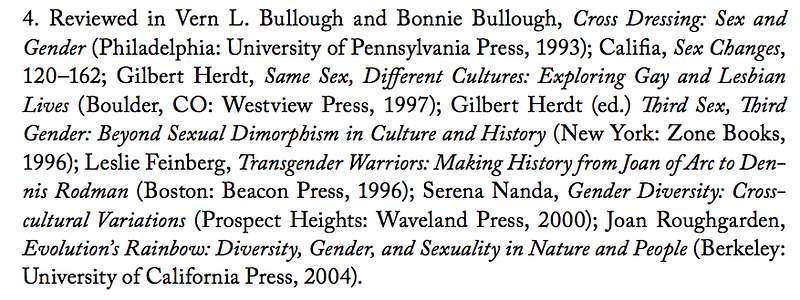
Along with Caitlyn Jenner, contemporary trans-women-aren’t-women arguments almost always namedrop Rachel Dolezal. The implication is that a “man” claiming to be a woman is as ridiculous (and as enabled by privilege) as a white person claiming to be black. But here’s the thing: Rachel Dolezal is one person. In sharp contrast (as I alluded to earlier), transgender people are a pan-cultural and trans-historical phenomenon, and comprise approximately 0.2 – 0.3% of the population. [note: one reader pointed out that more recent studies suggest that it may be 0.6% or higher.] If you are interested in learning more about the existence of gender-variant people, here is an endnote from my book Excluded: Making Feminist and Queer Movements More Inclusive referencing this history and cultural diversity:
The “trans women refuse to acknowledge any distinction” fallacy
People who make the trans-women-aren’t-women case will often insist that there is a distinction between cis women and trans women, yet trans women refuse to acknowledge this distinction. I find such claims endlessly frustrating. I have never once in my life heard a trans woman claim that our experiences are 100 percent identical to those of cis women. Indeed, the very fact that we in the trans community describe people as being “transgender” and “cisgender” points to an acknowledgement of potential differences!
The problem isn’t that we (i.e., trans women) refuse to acknowledge any differences, but rather that the trans-women-aren’t-women crowd refuses to acknowledge our many similarities.
There was a time in the 1960s and 1970s when many heterosexual feminists wanted to similarly exclude lesbians from women’s organizations and from feminism. The justifications that they forwarded were eerily similarly to trans-women-aren’t-women arguments: They accused lesbians of being “oppressively male” and of “reinforcing the sex class system” (see earlier Twitter thread). If you read the Wikipedia article I linked to earlier in this paragraph, you will find that lesbians fought back against such accusations. They didn’t do this because they believed that they were 100 percent identical to heterosexual feminists. They did it because some feminists were attempting to exclude them from feminism and the category of woman. Just like those who forward trans-women-aren’t-women arguments are attempting to do to us now.
Trans women are women. We may not be “exactly like” cis women, but then again, cis women are not all “exactly like” one another either. But what we do share is that we all identify and move through the world as women. And because of this, we all regularly face sexism. That is what we should be focusing on and working together to challenge. And as I said at the outset, forcing trans women into a separate group that is distinct from cis women does not in any way help achieve feminism’s central goal of ending sexism. In fact, it only serves to undermine our collective cause.
This essay was made possible by my Patreon supporters — if you liked this piece and want to see more like it, please consider supporting me there. You can learn more about my writings and activism at juliaserano.com.
Note added 5–27–20: A few commenters over the years have complained that I have not offered a “proper definition” of “woman” in this essay. Anyone who has a passing familiarity with dictionaries can tell you that most words in the English language have multiple (sometimes many!) meanings, and “woman” is no exception. Indeed, this makes “trans women are not women” arguments especially frustrating, because their advocates constantly shift their definition of “woman” (is it biology? socialization? “energy”? experiences with sexism? make up your mind!) in their attempts to exclude trans women. So here, I have attempted to address *all* these potential definitions. If you are curious as to how I might personally define it, this brief excerpt from my book Excluded should provide some insight. If you are interested in how other feminists have defined “woman” over the last half century, I highly encourage you to read Talia Bettcher’s essay “When Tables Speak.”
Further note: Another recurring complaint I have received is that this essay does not address the issue of “women’s safety.” Multiple empirical studies have demonstrated that trans women and trans-inclusion policies pose no danger to anyone in sex-segregated spaces. I review that research, plus provide a historical analysis of claims that minority groups constitute a “threat” to women and children, in the essay Transgender People, Bathrooms, and Sexual Predators: What the Data Say.


