
Debunking 4 Major Myths of an Assault Weapons Ban (Part 2)
What’s wrong with reasonable restrictions to stem the mass shooting epidemic?
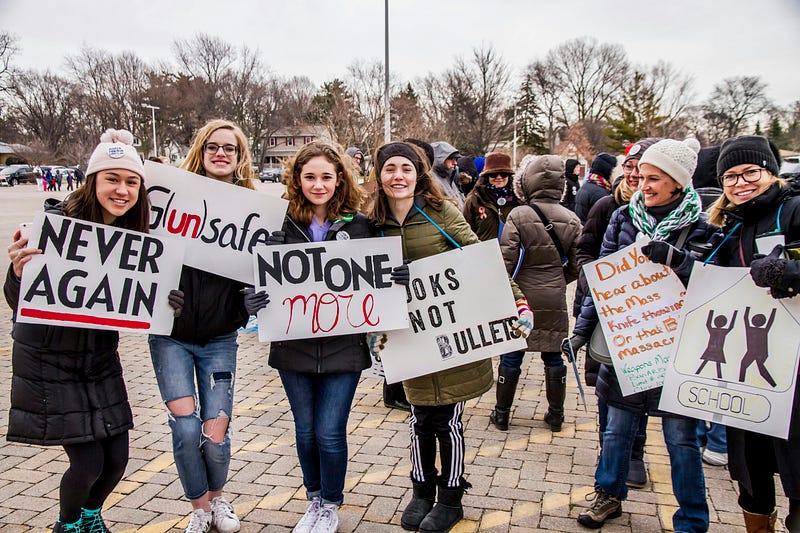
Last week, I queried readers with 10 questions related to the unabated epidemic of mass gun violence in America.
I also called on President Biden to leverage his executive authority by declaring a National Emergency to stem the carnage of mass shootings by prohibiting the selling and manufacturing of assault weapons.
These include AR-15 rifles — the so-called “weapon of choice” for mass shooters — and similar military-style firearms widely considered to be weapons of war by most unbiased people.
As anticipated, several gun proponents responded with strong viewpoints to the contrary (see Part 1 below).
However, I consider many of these pro-gun arguments to be based on myths, fears and stereotypes propagated by the powerful gun lobby in concert with the Republican Party at the national and state levels.
The goal of such a sustained disinformation campaign is to indoctrinate gun owners to oppose any reasonable restrictions on firearms, period — regardless of whether such measures are smart, sensible and consistently supported by majorities of the public (based on national opinion polls).
This gun-related misinformation is primarily being peddled by the formidable National Rifle Association. The NRA has Republicans in Congress squarely secured in its back pocket due to large campaign contributions and voter sentiment in conservative rural states.
The goal of such disinformation by the gun lobby is to effectively negate and demonize any restrictions on firearms ever, regardless of reasonability and rationality.
This pro-gun propaganda needs to be demystified and debunked.
It’s a vast understatement that the proliferation and use of firearms among the public remains a colossal problem in the USA, especially compared to all other countries worldwide.
Shocking Statistics
Before addressing specific pro-gun myths, it’s worth reiterating some key data about firearms in America (some of which was noted in Part 1):
- There are more firearms among the American civilian population than people — over 400 million according to a global ranking by the Small Arms Survey.
- “No other country has more than 46 million guns or 18 mass shooters — the U.S. is way worse than the Philippines, Russia, China or India.”
- Americans alone own 40% of all guns in the world, more than all civilians combined in 25 other countries.
- A survey by the Graduate Institute of International and Development Studies in Geneva found the gun ownership rate for Americans is 120 firearms per every 100 people.
- For comparison, the rate of firearms ownership for Japan and Indonesia is about one gun per every 100 people.
There have been more mass shootings thus far in 2024 than the number of days in the year, according to the National Gun Archive.
Below are four typical myths about banning assault weapons, which only lead to more fear among gun owners by buttressing existing stereotypes.
Myth #1: Banning assault weapons will lead to a national ban on all gun sales.
As everyone knows by now, military-style assault weapons are meant to kill as many people as possible, and as quickly as possible.
That’s why many major law enforcement organizations and police officers support a prohibition on the sale of assault weapons. Fighting crime is difficult and dangerous enough without having to apprehend criminals using military-style weapons of war.
FACT: Banning semi-automatic assault weapons will NOT result in a so-called “slippery slope” leading to the abolition of all guns.
It’s not a binary decision. This is particularly true considering how many handguns and rifles are already on the streets of America, and how easily they are obtained.
It would be impossible to eradicate the huge number of guns already circulating nationwide, not to mention prohibiting all sales of any new guns. Therefore, claiming the opposite is a simple scare tactic.
FACT: banning assault weapons can indeed be accomplished while simultaneously upholding broad Second Amendment gun rights, as history has proven (more below).
Myth #2: Congress and the President could never pass a bipartisan assault weapons ban.
Of course, this would not happen today with all the toxicity and tribalism within the current Congress.
Conservative Republicans, who hold the majority in the House of Representatives, have proven to be nothing more than mindless puppets of Donald Trump and the NRA.
However, who knows how the political landscape will shake out regarding the presidency and Congress after the 2024 elections?
Democrats might retain the White House and further solidify their majority in the Senate, while regaining the majority in the House.
FACT: Congressional sentiment on guns could shift, with a bipartisan compromise possible in the near future.
Although Congress is strongly influenced by public opinion on a macro and micro level, gun reform has been a stubborn exception — even though poll after poll clearly shows the overwhelming majority of Americans favoring smart and sensible gun reforms (about 80% generally, on average).
President Bill Clinton, for whom I once worked, proved successful in supporting and signing the last bipartisan national assault weapons ban in 1994.
But the NRA and congressional Republicans made sure there were loopholes to weaken the legislative intent of this reasonable restriction. Provisions inserted by conservative Republicans at the behest of the gun lobby let the law lapse after a decade.
Fast forward to 2004: President George W. Bush failed to advocate for a renewal of the assault weapons ban when it expired, leaving these weapons of war to once again proliferate unchecked in the public domain.
What was the predictable result?
America today is a nation incessantly on edge, a country which has lost its moral compass due to a seemingly never-ending epidemic of mass gun violence.
Myth #3: The framers of the Constitution wanted the Second Amendment to be absolute, meaning no restrictions or limitations on gun ownership whatsoever at any future time.
It’s worth pointing out that when the Founding Fathers penned the Second Amendment to the Constitution, the weapons of choice were muskets — which fired one shot at a time and needed constant reloading.
Did the framers of the Constitution really anticipate citizens of the future arming themselves with the deadliest high-tech military-style firearms which can kill and maim dozens of people in a minute or less?
It should be noted that there’s a significant difference between the “right to keep and bear arms” and arming oneself with the most lethal types of firearms. This should be a simple question of common sense to any rational-minded person.
Are citizens able to purchase tanks at the local car dealership or shoulder-fired missiles at the neighborhood Walmart?
It’s instructive that a leading fixture of the conservative movement (now deceased) had expressed doubts about keeping assault weapons in the hands of the general public.
FACT: The late Supreme Court Justice, conservative icon Antonin Scalia, inferred that the Second Amendment right “to keep and bear arms” is NOT necessarily ironclad and could include limitations.
Scalia made this assertion during an interview in 2012 on Fox News Sunday with Chris Wallace (well before the increasing mass shooting epidemic of the past decade).
- “They had some limitations on the nature of arms that could be borne,” Scalia said regarding the context of the Founding Fathers’ original intent during the 18th century.
- When asked about how the modern-day Supreme Court might rule in a case involving the legality of assault weapons in the public sphere, Scalia offered a tepid reply: “We’ll see…It will have to be decided.”
- He emphasized the “bear arms” point to say that while owning a gun is perfectly legal, owning a cannon is a different story.
- He said that if and when such a case comes before the Supreme Court, he would have to make a legal call based on what were understood limitations.
FACT: Although the Supreme Court has consistently upheld gun rights, it has also stated that — in certain circumstances — reasonable restrictions on firearms are consistent with the Constitution per the 2009 ruling in United States v. Hayes.
Myth #4: Guns don’t kill people; people kill people.
The often-cited NRA mantra is a misnomer.
The gun lobby and its accomplices in Congress continue saying things like, “Mental illness and hatred pull the trigger, not the gun.”
Of course there is a mental health crisis in America, but allowing the use of assault weapons only makes a bad problem much worse.
- “At the end of the day, the problem is the human heart. It’s not guns. It’s not the weapons.”
FACT: While guns technically don’t kill on their own, assault weapons are a deadly means to that end on a mass scale.
Facts are facts no matter how the Republicans and the NRA spin it.
FACT: There’s a major distinction between pulling the trigger of a handgun or hunting rifle versus that of an AR-15 or similar type of assault weapon.
FACT: Again, the only purpose of military-style assault weapons is to kill as many people as possible, and as quickly as possible.
The Takeaway
You can support reasonable gun reforms without supporting the abolition of all guns. Don’t let the NRA and Republicans brainwash you into equating one with the other.
This is not a mutually exclusive matter.
Having control over weapons of mass murder is a good thing, whereas total loss of control to mass murders is not.
Every legitimate national public opinion survey shows that Americans overwhelmingly support reasonable restrictions on firearms, usually by upwards of 80%.
It’s apparent by now that a comprehensive multi-pronged approach is needed by the public and private sectors to address a broad range of issues related to firearms, including (but not limited to) the following:
- Stronger and sustained enforcement of all current gun laws.
- Closing legal loopholes, such as no background checks at gun shows.
- Studying the relationship between mental health, age and gun violence.
- Regulating industries which desensitize young people to gun violence.
- Leveraging Big Data to improve background checks and gun tracking systems.
- Enacting stronger deterrents and harsher penalties for those who violate gun laws, including juveniles.
- Increasing strategic communication and citizen engagement through enhanced public education, outreach and awareness campaigns.
- Fostering non-partisan partnerships to promote smart and sensible gun laws.
- Mandating national red flag laws, which are currently under different official names in different states. The most common name is, “Extreme Risk Protection Orders” (to allow state courts to temporarily remove firearms from the homes of those who may pose a threat to themselves or others).
- Instituting mandatory national background checks for all gun sales (per points 2 and 5 above).
The first reasonable restriction which the federal government should immediately implement is a more stringent version of the prior assault weapons ban.
And if Congress can’t or won’t do it, then President Biden must act solo.
ABOUT THE AUTHOR: I’m a former White House political appointee for President Bill Clinton. I also worked in Congress and federal government agencies. You can learn more about me here.


