
Debt Actually Creates New Money — This Is the Bizarre Process That Shapes Your Financial Future
You must understand this so the value of your work isn’t eroded away.
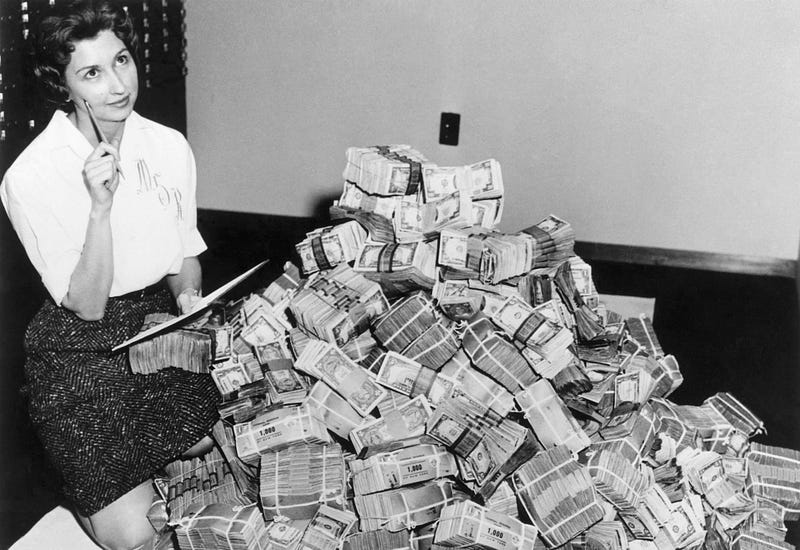
The financial system is basically nothing more than a series of IOUs.
This idea shook me up when I first heard it. A friend was explaining a bank transfer and said “the IOU appears on your mobile banking app straight away, but the actual value of your money doesn’t transfer until later.”
The currency your country issues is the same. Currency is no longer pegged to a hard asset like gold. This means in really simple terms that currency is like a promise or a glorified IOU.
I was at a live event last year to watch a well-know entrepreneur give a speech. Halfway through, he pulled out a wad of one-hundred-dollar bills in front of the Australian audience and started throwing them all over the stage. Surprisingly, nobody from the audience went to pick up his money. He said “cash is trash.” I didn’t quite get what he meant at the time.
Then the IOU concept was introduced to me by my friend and it all finally clicked.
There are two ways money (currency) is created:
- Money is printed out of thin by governments and given fancy labels like stimulus or quantitive easing. This idea is becoming more and more mainstream. Money printing creates inflation and that means the value of your money is worth less.
- The second way money is created is a concept almost nobody I know in finance understands. When a loan is given to a business or an individual, money is created out of thin air as part of the process.
I had no idea that a loan being issued created money out of thin air. Financial expert, Mike Maloney, has spent years researching and speaking about how money is created. I don’t recommend following him anymore because he spreads too much fear and predicts the end of the world (frequently).
The way he explains the creation of money is pure brilliance, though. I am going to further simplify how money is created for you based on the US system.
- Politicians promise to give people free stuff. The country spends more than its income, referred to as deficit spending.
- The Treasury then has to pay for that deficit by borrowing money, which involves issuing a financial instrument known as a bond. A bond is nothing more than an IOU to repay the money, with interest.
- Treasury bonds are a nation’s debt. (US treasury bonds are the US’s debt, as an example.) Treasury bonds are paid back by the citizens of a country through taxation. This often results in borrowing money from the future to pay for the present, which can be tempting and dangerous.
- The banks then step in and buy and sell these bonds to the Federal Reserve. The Fed pays for these bonds using metaphorical paper checks that draw on a bank account that doesn’t have enough money in it. Pay attention to this: When the Federal Reserve writes a check to buy bonds, it’s creating money out of thin air.
- The Fed then hands those checks (a check is also an IOU for cash) to the banks. The banks then convert those checks to currency (creating money) and hand that currency to the Treasury. This currency is referred to as base currency. So the Federal Reserve is left with lots of bonds (IOUs) and the Treasury is left with a huge pile of cash which they then can give to the government to use in its deficit spending
That’s the first way debt creates money out of nowhere. There is another way money is created. Stay with me.
- The Government spends the money they have been given by the Treasury on infrastructure, social programs, and wars. This creates government jobs.
- Those workers then deposit their salary into their bank. When you put your money in the bank you’re actually loaning it to them.
- The bank can then loan out your money or use your money to buy and sell stocks, or invest in complex financial assets known as derivatives. This process is referred to as Fractional Reserve Lending. It’s where the bank stores a fraction of your original deposit in your bank account (say 20%) and then loans out the other 80% to its customers who want loans to buy homes, cars, and consumer goods.
- Your bank balance still shows the original amount you deposited (say $1000) but the reality is the bank left IOUs in place of the $800 they gave to a customer who needed a loan using your deposit. The math here is simple: you deposited $1000, the bank then lent out $800 of your money and replaced your deposit with IOUs. Your $1000 has now become $1800 of currency. Therefore, more money has been created from nothing.
- The borrower of your money then takes that currency and pays the seller of the car, as an example, who then deposits that $800 into their bank. Their bank then keeps back 20% and loans out 80% of the $800. This process keeps repeating and leaving a trail of money created in its path.
This process of creating money might look harmless — it’s not. The more currency that is created out of thin air the more prices of goods and services increase, leading to inflation. Mike says:
“The true definition of inflation is an expansion of the currency supply. Rising prices are merely the symptom.”
How Money Creation Affects You
You now understand the two ways money is created. But what does all of this mean for you? You’re probably not going to become a banker — so who cares, right? Think about it like this:
True wealth is your time.
Each day you go to work to earn money or start a business to earn money. It’s humans that give money its value through the work we do.
You pay tax so the Treasury can pay the principal plus interest on that original bond the Fed bought at the start of this process. In other words, your tax is mostly used to pay principal and interest on bonds.
All of this means there is interest due on every dollar in existence, an important lesson from Mike.
Coming full circle, there is never enough currency in existence to pay the debt — making the system finite. This explains why the US Debt Clock is hurtling towards $26 Trillion (check it out for yourself here).
This is why Warren Buffet recently interrupted financial history with this staggering realization:
“The [US] debt isn’t going to be repaid; it’s going to be refunded.” Followed by “You better own something other than debt.”
Tieing it all together, how money is created affects the value you get from the work you do. By not understanding how money is created you force yourself to have the dollars you earn eroded away by many different forces, including inflation (the hidden tax).
Money creation causes systemic risk
Why should you care about how money is created? This whole system you’ve just learned about is built on systemic risk. It’s all good when everybody is earning money, putting it in the bank, or paying their debts.
But what happens when a system that uses debt to create money, that can never be paid back, experiences a once-in-a-hundred-year event? Like, say… a global health crisis no one saw coming? Well, risk is introduced. Nobody really knows what’s going to happen. We’re in unprecedented territory.
If loans issues by banks default then that creates a problem for us all.
There is only so far deposit insurance and bailouts from the government can go. Remember: the financial system is a series of glorified IOUs. There is an endpoint and many people do not understand that. It is my sincere hope that we don’t test the system and realize it’s going to break.
Takeaway
This article is designed to teach you how money is created, not instill fear into you. The idea of governments printing trillions of dollars is becoming widespread but that’s only one way money is created.
You work your entire life for money, so it pays to understand how it really works. Unfortunately, there are not a lot of places you can go to learn about money in really simple terms.
The question you want to ask yourself is how much do I really know about money? Financial education is the solution to the cracks that are appearing in the financial system. There are stocks, bonds, gold, digital currencies, banks, and debt that all play a major role in your financial future. Understand how they work and force yourself to figure out which assets make sense for you.
Take an insurance policy against the future by choosing to understand how money works. You’ve worked too damn hard to turn a blind eye to the process of money creation.
This article is for informational purposes only, it should not be considered Financial or Legal Advice. Consult a financial professional before making any major financial decisions.


