Deborama’s Books — Some books I’ve read lately
The Mirror and the Light by Hilary Mantel (5 stars) This book, being the long-awaited third in a trilogy, the first two volumes of which won enormous acclaim, needs no explanation for why I read it. I was one of that adoring throng. I waited over a year on the library hold, mostly due to COVID.
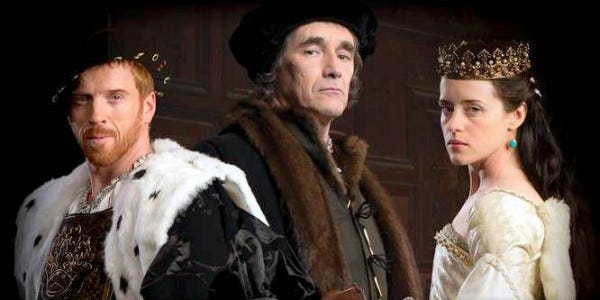
An excellent multipart series, called Wolf Hall after the title of the first book, but also including the material from the second, Bring Up the Bodies, was shown a few years ago on Masterpiece Theatre, and starred the incomparable Mark Rylance as Thomas Cromwell, the main character. It also starred Damien Lewis, in impeccable sleazy-Damien mode, as Henry VIII, a casting which must have seemed counterintuitive to those who think Henry always looked like the Holbein portrait of him in his declining years. He was once a slim, active, domineering, charismatic stud.
Which is why the poor man was so baffled at his inability to father a legitimate male progeny, a problem which becomes even more acute in this book when his illegitimate son and ace-in-the-hole dies unexpectedly. In fact, it turns positively homicidal. I won’t tell you who else dies in this book, in case you don’t know English royal history that well and it’s a spoiler for you. (There are actually several people who die in this book, including two of Henry’s queens, but I am referring to the climactic last death that closes the cycle.)
I am one of many people who can’t decide whether the TV series or the book is better, and it’s not because there is anything wrong with the books, of which each is one of those heady, exhilarating peak reading experiences. But I also can’t remember whether I saw the show before reading the first book or vice versa. But to be clear, the show was only the previous two. No word on whether a sequel show will complete the story.
Some of the Yashim the Eunuch Detective series by Jason Goodwin plus Yashim Cooks Istanbul — Culinary Adventures in the Ottoman Kitchen (3.5 to 4.5 stars) It started with The Janissary Tree, which someone put in the “condo library,” a room-size ongoing book sharing that happens in the senior condo where I now reside. My friend Julie read it, and became very enthused about the author, and recommended it to me. I have not read the entire series, but I borrowed a couple more books by the author from the real library, after reading the first one.
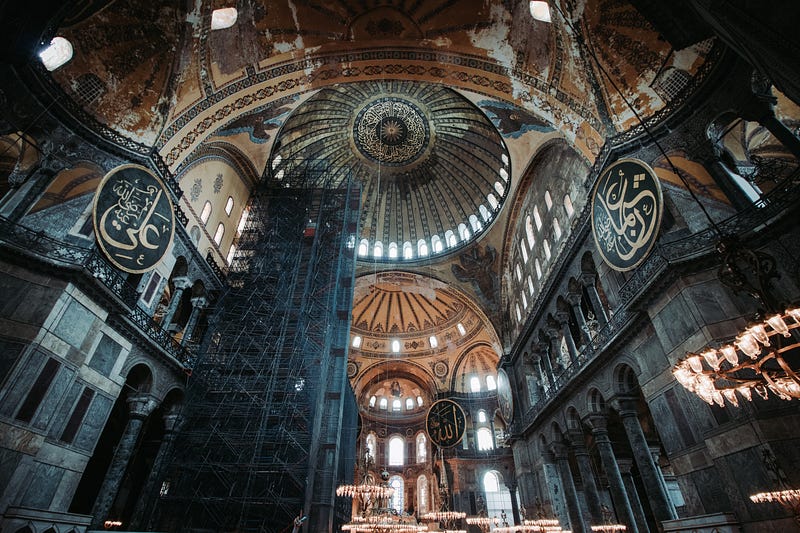
Although Goodwin has written numerous books, the Yashim the Eunuch Detective series, plus what could be considered its prequel, On Foot to the Golden Horn, are what he is best known for. Goodwin is a British historian (by which I mean he is an historian as well as a fiction author, and he is British, not that he studies or writes British history.) On Foot to the Golden Horn is nonfiction, and ends at the gates of Istanbul, while the Yashim books are broadly speaking mystery novels, and take place in the Istanbul of the early 19th century, at a peak period of the Ottoman Empire.
Yashim Cooks Istanbul, although less well-known, is also an adjunct to the Yashim novels, in that in addition to being a “detective” (actually a deputized agent of the head eunuch at the Sultan’s palace, a position that was equivalent to national security officer in modern states) Yashim is also a keen cook, and the cookbook covers all the dishes that Yashim or others are depicted as cooking, eating, or serving in the novels. For instance, in The Janissary Tree, an ex-Janissary is a cook in a soup factory / restaurant specializing in tripe soup, which is one of the cookbook’s more challenging recipes.
Another character is a late middle-aged Creole woman who came to Europe as a teenager on the same boat as (and as a friend of) the woman who would become Napoleon’s Josephine, but who was kidnapped by pirates and sold to the Sultan’s harem. She ended up being the Sultan’s favorite consort, and most importantly, the mother of the current Sultan, which gave her the title of “the valide,” a position of great power within the palace. She is something of a mentor or oracle to Yashim and they share various loves, such as French romance novels and English tea. Some of the recipes are the elegant dishes she serves him in his visits to the harem.
As a eunuch, Yashim is considered not a threat to the virtue of the Sultan’s women. Eunuchs were by and large allowed access to the palace women who never saw another male except the Sultan or, almost as rarely, their own relatives. (Indeed, the Sultan had so many women in his harem that many of them never saw him at all!) But anyway, one of the charms of these novels resides in the way eunuchs had power as a liminal force in the empire, having access to both halves of the strictly gender-divided world. This combined with Yashim’s intelligence makes him supremely suitable as a secret agent.
Here is a list of the entire Yashim the Detective series, plus its prequel, with an * by the ones I have read so far. I mean to read them all, but I’m in no rush. - On Foot to the Golden Horn (1993 — nonfiction) - The Janissary Tree (2006)* - The Snake Stone (2007) - The Bellini Card (2008) - An Evil Eye (2011)* - The Baklava Club (2014)* - Yashim Cooks Istanbul (2016 — nonfiction)*

Murder in Malmö by Torquil MacLeod (3.5 stars) with a HUGE digression on The Bridge I recently picked this up on impulse at the library and read it in a couple of days. It’s set in Sweden, as evident by the title. Malmö is the city at the Swedish end of the bridge that connects Denmark and Sweden, which was the site of the first of the popular crime thrillers called The Bridge. Now I shall majorly digress from the title I am reviewing here to delve into that.
The Bridge was a television phenomenon that crested the wave of Nordic noir popularity and became truly global. The original drama was created and written by Swedish writer Hans Rosenfeldt with writing assistance from Camilla Ahlgren. The production was in 2011 by a Danish-Swedish production team and was called Bron in Swedish and Broen in Danish, but it was also picked up very quickly by the BBC and shown with English subtitles in the UK in the spring of 2012.
I lived in the UK all but the last two weeks of 2011. I remember my husband telling me he watched The Bridge in the spring of 2012. I did not have a TV at all until soon after that, and I didn’t buy a digital “smart” TV until maybe 2014, at which time I signed up to Netflix and Amazon Prime with Acorn and MhZ Choice. Mainly this was because I had lost any taste for American TV (with a few exceptions.)
Most good and popular crime dramas from any of the BBC channels or ITV normally made their way to PBS’s Masterpiece Mystery series in the US. However since this one was an import from Europe, it was not available on PBS until after two things happened — 1) PBS Masterpiece became a streaming channel, available on Amazon Prime and other services, and 2) in 2018, PBS Masterpiece picked up a Eurozone service called Walter Presents… For several years before this, American TV viewers could stream The Bridge using MhZ Choice, which is how I saw it sometime between 2014 and 2016.
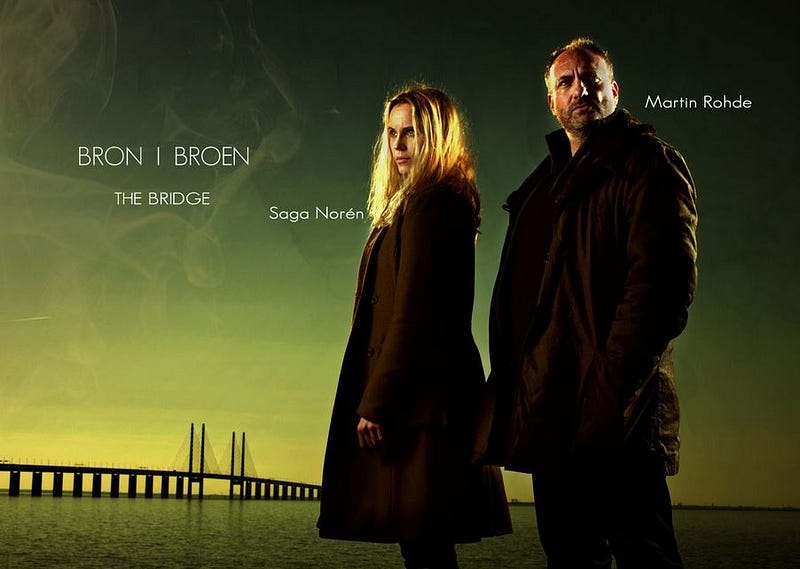
So before I get into the wild story of how global this show became, I have to explain why it’s Swedish-Danish and not just one or the other, and why all the other shows are also produced by, or at least in, two countries in tandem. The main driver of the plot opens in the first 20 minutes of the show. A body, severed in half at the waist, is discovered in the middle of a busy bridge connecting one country to another. Obviously, this requires a joint and cooperative investigation into the murder, especially when it turns out … no wait, that would be a spoiler and there might be someone on the planet who still has not seen even one of these dramas. There are a lot of surprise plot twists in all the dramas, but they are not all exactly the same. Some parts are the same and some different.
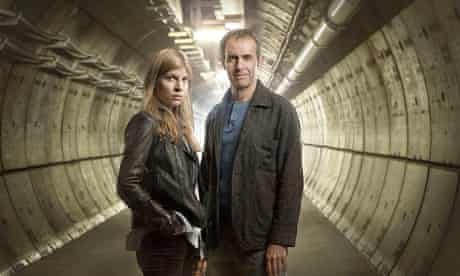
The one slightly anomalous production was the second European one to be produced. Not satisfied with just showing a Swedish-Danish show, the UK wanted to get together with a European neighbor and produce their own version. Not having a bridge to Europe, they used the Channel Tunnel, and made the production in partnership with France. So it was called The Tunnel. This was produced by Sky TV in the UK, a commercial channel, and Canal+ in France. In my opinion it was the best one, but I am very biased toward British and French TV shows.
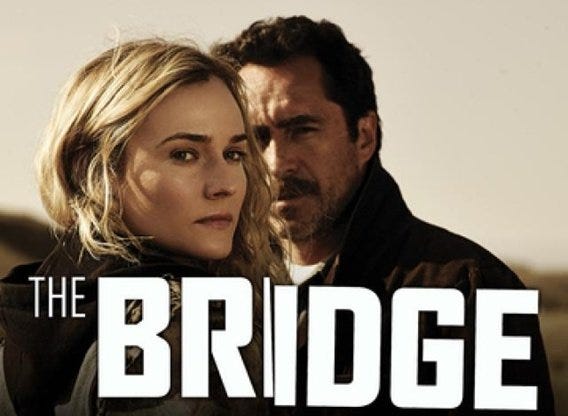
The second production overall was my second favorite. Rather than being a joint production between Mexico and the US, as it should have been, it was produced solely in the US by FX, a cable and streaming channel. Not even all the actors portraying Mexicans are Mexican. I hope Mexico at least got some consulting fees out of it. The male costar is Mexican actor Demián Bichir and he and the female co-star Diane Kruger were probably the best actors in terms of performance of all three of the versions I saw. (And the fact that the Swedish-Danish one was my third favorite despite being the original is not a non-recommendation. All three of these productions are top-flight TV crime drama.)
There are, as I said, some plot differences. Denmark and Sweden don’t really have any major disputes or international crises between them, so the political tensions in Bron-Broen are both more tame and generic, and a little bit artificial in feeling. In contrast, pre-Brexit (before the vote even) tensions between France and the UK over immigration and the volatile nature of their joint management of the Channel Tunnel made a great backdrop for the crime drama.

In the case of The Bridge (US), instead of a severed body on the bridge, we have the police already trying to cooperate to find a serial killer who operates on both sides of the border, and then the body of an anti-immigration US judge is found on the Bridge of the Americas, which connects Ciudad Juarez, Chihuahua, Mexico to El Paso, Texas, USA. We also have secondary but vital plotline involving two journalists cooperating on a blockbuster story for the main El Paso newspaper. The underlying tensions include the US’s fluctuating opposition to, along with its dependence on, immigration from Mexico, the power imbalance between the two countries, the tensions between the police and investigative journalists, and of course, the cartels and corruption in Mexico.
There are two other productions of The Bridge that I have not seen. The first is a joint Russian-Estonian production, and the second is from HBO-Asia and involves Singapore and Malaysia. Here is a little table I made showing the year and nationalities (with a * if one was not a producer), title, relevant bridge and the two cities on either end of it.
Bron-Broen+2011+Danish-Swedish+Øresund Bridge+Copenhagen-Malmö The Bridge+2013+US-Mexico*+Br-of-the-Americas+Juarez-El Paso The Tunnel+2013+UK-France+Channel Tunnel+Folkestone-Calais Most+2018+Russia-Estonia+Friendship Bridge+Narva-Ivangorod The Bridge+2018+List*+Tuas 2nd Link+Johor, MY-Singapore *Although based on Malaysia and Singapore, the show was released there plus Spain, France, Italy, India and Japan, and the languages used are English and Spanish. The producer, Viu for HBO-Asia, is transnational.
Anyway, back to Murder in Malmö. This is the middle book in a three-part series. It concerns a young female Swedish detective, and is written by a middle-aged male Scottish writer who has never been a detective. Sometimes these things work and sometimes they don’t, so I had low expectations. They were exceeded, but I’m not raving about it. It was … interesting. If you like Nordic Noir but feel like it’s a) a bit too awash in testosterone, and b) a bit too alien feeling, you would probably like this. It has all the popular good bits about Nordic crime drama, and has a fairly relatable protagonist. I may try to bag books one and three just for that all-important sense of completeness.


