Deborama’s Books — A couple of books by a Native American author
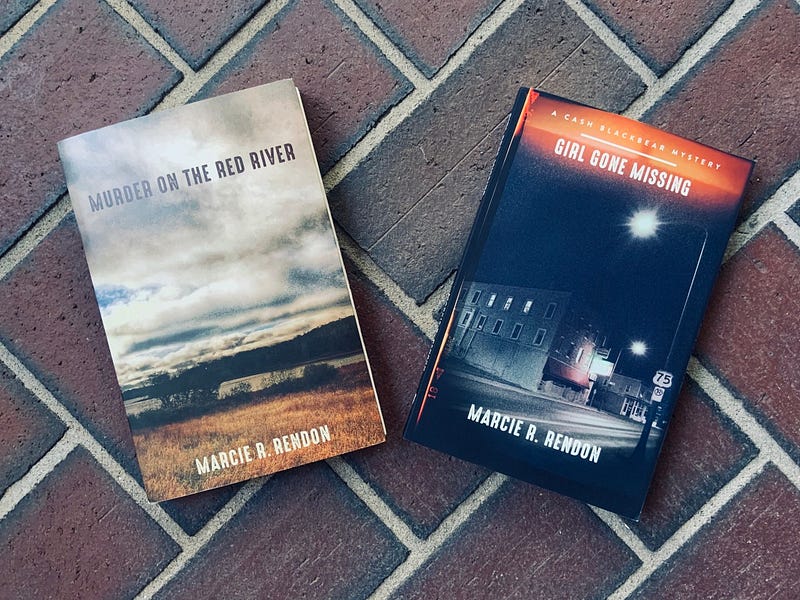
Marcie Rendon’s Murder on the Red River and Girl Gone Missing I read the first book in this series, which is currently only these two, as a library book. (According to Goodreads.com, I finished it exactly two years ago, 11/11/2019.) Then I bought the second one when I went to a Native American farmers’ market in my town (Minneapolis) run by a group called Dream of Wild Health, to pick up some food I had pre-ordered. How does one buy a book at a farmers’ market? Well, Marcie Rendon herself had a booth there, sitting in the shade of a canopy with a table and a few copies of her books, because why not? Then I decided, since I owned the second one and am trying to get rid of books (even good ones, yes, that’s pretty much all I have; bad ones I don’t hang on to) that I would have to go and buy the first one so I could give the pair as a gift.
This gave me an excuse to visit Birchbark Books and Native Arts, one of the few independent bookstores in the Twin Cities I had not visited yet. So that’s what I did. I still haven’t gifted them, but I’m going to.
The series centers on a young woman living in Fargo, the North Dakota town across the Red River from Moorhead, Minnesota. These two are often referred to as one, Fargo-Moorhead, and are largest towns in an area called the Red River Valley, an area known mainly for agriculture. It’s not an area I am very familiar with, and from the book, feels nothing like the Twin Cities, and a bit more like my hazy memories of a week spent in Bozeman Montana, but without the mountains, and producing grain and sugar beets on huge farms rather than beef on huge ranches. And indeed, that might be due to time rather than place. The setting of the stories is the early 1970s, and my trip to Montana was in 1974.
The protagonist’s legal name is Renee Blackbear but she goes by Cash. She is an Ojibwe and her life was shaped by her dreadful, but unfortunately quite typical, childhood. Taken from her single mother at age three, she spent her youth being moved from one white foster family to another, losing touch with her two siblings and mother, and suffering various forms of casual abuse, racism, and exploitation.
Cash is somewhat lucky to have a kind “father figure,” Sheriff Wheaton, who happens to be the one who pulled her 3-year old self out of her mother’s wrecked car. He stayed in her life, and was who she ran to when she ran away from foster homes. He helped her to become prematurely independent when she was a mere teenager. She is not really close to him, but she doesn’t trust anyone else, with pretty good reason.
In the first book, we meet Cash at 19, having “driven truck” for several years to make a living. Now legal to go to bars, she has discovered pool and hustles games for free beer. She wears nothing but blue denim, smokes Marlboros, drinks Bud longnecks, and packs PB&J sandwiches and a thermos of black coffee to her truck driving jobs at the sugar beet farms. She lives in an apartment over a Maytag appliance store, buys her clothes in the boys section of JC Penney, and has all the old white guys at the Casbah, her chosen bar, in thrall to her butt length hair. She occasionally has casual sex with a pool buddy.
Murder on the Red River concerns Cash’s first foray into crime-solving, when the body of a native man is discovered in a field. Cash discovers that she has another gift besides pool talent and resilience: standing close to the man’s body, she sees visions of his home and flashes from his life. So with Sheriff Wheaton’s blessing, she goes to the victim’s reservation, Red Lake, and finds his widowed wife and numerous children, with the mother in the throes of alcoholism.
This isn’t really a “whodunit” and the tale of the murder is more of a hook to hang the story of Cash and Sheriff Wheaton on. And their story is a story of the broken system of relationships between the Native American and white populations of the rural upper Midwest, which led to the huge practice of white farm families “fostering” (and ruthlessly exploiting) Native children.
Girl Gone Missing tackles another horrible side effect of poverty that Native women are disproportionately subject to, but does so in an oblique way, by focusing on the historically true story of this same horror — sex trafficking — when it was happening here in Minnesota to mostly white girls, with fictional Cash getting swept up into it. This novel is set a few years later, and Cash has given into Sheriff Wheaton’s pleas that she go to college. She is a student at Moorhead and wins a writing competition that takes her to the Twin Cities to receive a prize.
I won’t do spoilers and say what happens next, but I will note that the clairvoyance shows up again. At some point, this story gets quite brutal, so trigger warning on that. Girl Gone Missing also includes a side story about Cash’s long-lost brother showing up in her life, and it’s a pretty heartbreaking tale. I do hope Marcie Rendon is able to pen a few more stories about Cash and her world.