
Debate: Can We Call It The “Chinese Virus”?
An Arc Digital edition of Point/Counterpoint with Nicholas Clairmont and Alan Levinovitz
What follows is a debate between Arc associate editor Nicholas Clairmont and James Madison University professor of religion Alan Levinovitz, whose forthcoming book Natural: How Faith in Nature’s Goodness Leads to Harmful Fads, Unjust Laws, and Flawed Science is available for pre-order. Levinovitz tweeted about this topic on March 14, and as the subject became a bigger debate among politicians and online, the two decided to have it out at greater length.

Alan Levinovitz: Before explaining why “China virus” or “Wuhan virus” are bad names for the coronavirus, I should start with what I won’t argue.
I won’t be arguing that the names are inherently racist or that using them makes you racist. There are obviously well-intentioned reasons for linking the virus to China, employed by journalists abroad and at home.
Critics of the Chinese Communist Party point out, rightly, that the CCP stifled early warnings from physicians in Wuhan, and continues to churn out false conspiracy theories about the “American coronavirus.” Others may wish to emphasize the risks associated with killing wildlife for traditional Chinese medicine and the unhygienic “wet markets” that thrive in China, both of which are linked to the coronavirus.
Instead, I’ll start with the fact that not using the names “China virus” or “Wuhan virus” indicates deference to expertise. The epidemiologists, virologists, and public health experts whose advice needs to be heeded right now call it COVID-19 or the coronavirus, or, simply, “the virus.”
Their practice follows the World Health Organization’s 2015 guidance for naming diseases, which warns against all designations that refer to people, places, occupations, species/class of animal or food. Avoiding these protects against stigma and irrational assumptions that aren’t biologically accurate. And it is not, despite what some might say, the product of wild-eyed PC language police who see racism wherever they look. Their guidance, after all, is not restricted to racial designations.
Nevertheless, the WHO understands that discrimination against groups of people — racism, homophobia, sexism, etc. — can and does result from misguided disease naming policies, even those that are well-intentioned. Academics who study rhetoric have long known that the language of disease is especially useful for demonizing people. Disease activates a sense of visceral disgust, fear, and repulsion. It is the reason we fear vermin, another powerful rhetorical trope for those seeking to stigmatize a particular group.
Likewise, names are powerful symbols, which means we should be very careful when thinking about how to designate diseases, particularly those that loom large in the public consciousness. Is the China virus scaring you? The one started by Chinese people, who, as Fox News host Jesse Watters’ pointed out, are “eating raw bats and snakes”? I’m not racist, but I’m also not confident I can resist reflexive disgust or irrational associations with Chinese people.
“Everyone knows Chinese people are disgusting. They’ll eat any type of animal. They’re dirty.”
That’s what a classmate of Katherine Oung, an 11th grade Chinese-American teenager, told her, not long after the coronavirus outbreak began. Others have reported similar encounters. And setting these aside, just think what it would be like to hear your country of origin repeatedly tied to a terrifying pandemic. For those of us who aren’t Chinese-American, it might be hard to imagine what it’s like to hear people call the virus “China virus,” just as if you weren’t gay, it might have been hard to imagine what it was like to hear about GRID — “gay-related immune deficiency,” a name eventually replaced by HIV.
At this point it is also clear that “China virus” and “Wuhan virus” are the preferred designation, in the U.S., of those with a conservative political leaning, for the obvious reason that a nationalist America First agenda is helped by associating our international rivals with a disease. It’s beyond plausibility to argue that the conservative media’s fondness for “Wuhan virus” and “China virus” is entirely separate from their desire to make China look bad, that it’s merely a geographic designation. When President Trump declares we are fighting a “foreign virus,” it’s not unreasonable to read a little something into his words.
Which brings me to the final reason using these names is counterproductive. Fighting a pandemic should be a bipartisan affair, one that unites us all. The terms we use should be politically neutral, and we have perfectly good neutral terms for the virus, approved and used by the very experts we need to be listening to: corona, coronavirus, COVID-19. It’s not as if these are progressive terms. No one is saying we should call it “capitalism virus.”
It therefore falls on those who favor “China virus” or “Wuhan virus” to explain why people should prefer these names. Why should we flout the wisdom of the WHO on naming diseases, which in turn undermines their authority more generally at a time when we should be respecting it? Why insist on what are clearly partisan names at a time when neutrality and bipartisanship is incredibly important? Why risk the kind of irrational disgust and stigma reported by Katherine Oung, the kind that motivated the WHO’s best practices document? We know exactly what there is to lose with these names. What is there to gain?
Nicholas Clairmont: The problem with PC language police isn’t that they are, as you say, wild-eyed. It’s that they’re dead-eyed.
The PC folx think that it’s a major priority to install “signaling deference to authority” as a habit of thought. And they think habits of thought can be installed by using social stigma and social praise to control language while denying that’s what they’re doing. This always carries the quality of a threat or of a bribe or both — “talk like so, or else you won’t be cool, or you’ll be regarded as outre,” or whatever it may be.
That’s why the charge of racism has expanded so much, and why “white supremacy” has gone from a tangible, meaningful concept for David Duke fans a few years ago to a totalizing discourse that can be used for the term China Virus today: “White supremacy can be a factor even in the way that we name viruses — such as when the language around it, purportedly objective and scientific, stems from a white-centered, xenophobic perspective,” the celebrated author Marie Myung-Ok Lee wrote in Salon recently.
This was in response to a grisly episode in which my friend and former boss was denounced by the Chinese Communist Party for the title of a Wall Street Journal column about the virus. China kicked out several of that paper’s reporters, had its foreign ministry call him a racist for the headline (which he didn’t write), and unleashed the trolls to claim that the Chinese people were deeply hurt by reading it, despite the fact that the government censors the Journal and Twitter in China.
What happened next? Did PEN, the Committee to Protect Journalists, and all the rest of them, mobilize? Were the consciences of free intellectuals everywhere aroused? No. Way, way too much of the American lettered class decided to agree with the authoritarian government instead of standing up for basic common sense against the affront to the freedom of writers and journalists.
So this is where we are. Language policing is such a dominant feature of intellectual culture that we assume it is normal and acceptable, especially surrounding charges of racism, even if they are preposterous ones. This obsession with The Words of Others doesn’t change very much of what it intends to change. But it does impose huge collateral social costs on our ability to have a vivacious and critical culture (and it’s also just lame).
And in this case, it’s worse than normal by a lot. Because it’s “talk like the Chinese Communist Party says, or else.” Beijing managed to hijack the deeply broken and vulnerable state of our racial discourse to its own ends.
One premise of my claim is that it’s annoying and ineffective to use language to “signal” stuff, because ordinary people can see through it and just don’t like it. But another premise of my claim, then, is that deference to authority is actually an extremely unhealthy attitude.
Yes, even in a pandemic, you should think for yourself. This is a great example of why: As it happens, the WHO is run by a guy who’s been lavishing praise on the government of China since it was still barely acknowledging the outbreak. That guy, Tedros Adhanom Ghebreyesus, is a doctor, but he’s also an ambitious career politician from a country whose economy relies significantly on Chinese aid and trade. On February 25, the WHO held a press conference about how “impressive,” “orderly,” and “science-driven” China’s response has been, in which Dr. Bruce Aylward said this: “If I had COVID-19, I’d want to be treated in China.” “Thank you very much, Dr. Aylward. I’d like to be treated in China, too,” replied moderator Margaret Harris.
I did not know the application of a dose of boot to tongue could cure coronavirus!
Keep in mind the official Chinese reports of infections and deaths still do not show any infections in the densely packed concentration camps in which China is keeping over a million Uyghurs and other minorities and dissidents. In December and into January, China was suppressing information about whether the virus was even transmissible.
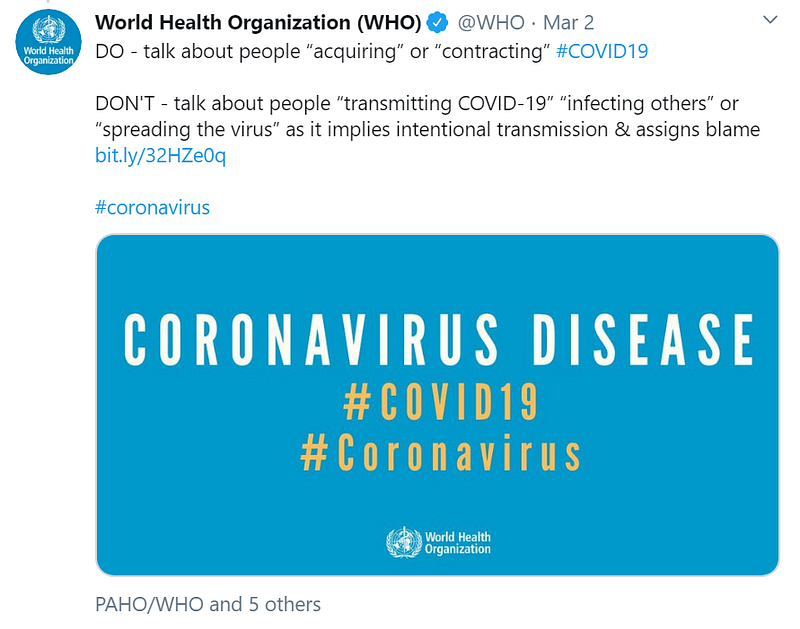
The WHO’s messaging isn’t all about glorifying the government that has been lying about the disease, though. It is also language policing up a storm. The WHO Twitter account is advising that we “don’t talk about anyone transmitting COVID-19” or “spreading the virus.” At best, these are requests not to do something that people are inevitably going to do. At best.
Somehow, during this same period, the magaziney, bloggy, onliney part of the press you and I write in got the message that they should react by writing article after article after article after article after article about how the real virus is racism.
People I know in news organizations told me they went to longer meetings about how to talk about it in a not-racist way than in an epidemiologically responsible way.
People started tweeting pictures of themselves heroically “supporting” local Chinese restaurants during this difficult time by eating delicious food. John Oliver and other late night hosts made “don’t be racist” a major part of how they covered it. And, yeah, don’t! But if I were going to be racist, I wouldn’t stop because I flipped John Oliver on my HBO Now app and decided to heed that warning, you know? It’s more of a big pat on the audience’s own back for how not-racist they all are, and how they all defer to the same authorities. Well, congrats to them I suppose. For my part, I trust people who defer less, not more.
Aaron Blake, in the Washington Post, exemplifies how muddled up with general opposition to Trump all of this has become, such that nobody can quite keep straight whether we care more about stopping Trump, stopping Xi, or stopping coronavirus:
President Trump, the White House and their allies are increasingly on a blame-China footing in the fight against the coronavirus. They’re stoking nationalism by emphasizing the country where the virus originated, calling it the “Wuhan virus,” lodging conspiracy theories about it being deliberately weaponized and accusing the Chinese of a coverup.
What exactly is the theory here? Who is causing what harm and how? So, calling it the “Wuhan Virus” “stokes nationalism.” Does uttering the sentence, “as best anyone can tell, this virus appears to have originated in China” stoke nationalism? Does Blake’s own sentence, which acknowledges the virus’s Chinese origin without stressing it, “stoke nationalism?” Do you have to intend to stoke nationalism to stoke it? The answer is that there is no real causal theory here. The answer is, “don’t think about it too hard.”
I think (and I say this with love and friendship!) that you dip into the worst kind of identity politicking when you write:
For those of us who aren’t Chinese-American, it might be hard to imagine what it’s like to hear people call the virus China virus, just as if you weren’t gay, it might have been hard to imagine what it was like to hear about GRID — ’gay-related immune deficiency,’ a name eventually replaced by HIV.
Well, you seem to be imagining it rather vividly and fantastically! Why, I might ask, must we always be arguing about who has the standing to imagine what based on their skin? I find this idea that we are only capable of empathy with people who have similar looking skin creepy and factually wrong. Here’s gay, HIV+ Andrew Sullivan’s column from this Friday, noting that overconcern about offense was among the things that worsened the early AIDS crisis:
Randy Shilts, in his epic tale of this nightmare, And the Band Played On, relays the first guidance from the American Association of Physicians for Human Rights: “Sensitive to concerns that the group not be ‘sex-negative,’ the guidelines assured gay men that there was nothing wrong with having sex, but they should check their partners for KS lesions, swollen lymph nodes, and overt symptoms of AIDS.”
Everything you say is bad is bad. It just has nothing to do with words. In the absence of calling it “China virus,” the same xenophobes would call it by its expertly-designated SARS-CoV-2 moniker, while glancing warily towards the young Chinese-American teenagers who spoke to the Times in the story you link. What difference would that make?
People feel weird about a virus from China, and angry at China, and stupidly nasty towards things they illegitimately associate with China because a deadly virus just came from China. What’s behind that is the fact pattern, not the name. The WHO and you are wrong that discrimination can “result” from what you say it can.
Look, everyone thinks that when the disease vector hits the air-vents, things should default to their idea of nonpartisanship. The trouble is, we don’t agree on what nonpartisanship is. Sorry, I don’t think letting the most thoughtless people dictate language is the safe, default setting for a society under the temporary guidance of the Epidemiological Subcommittee for Public Safety.
What, to use the quote that really sums up my whole objection to this entire line of concern, is in a name?
It would be fine to call it Capitalism Virus (or, more accurately, Market Virus)! Or White People Overconcerned about China Virus! For god’s sake, it’s just a name. The problem is the thing the name refers to, and how we feel about it really has little to do with that.
I still buy the old line about sticks and stones, I guess. As for Fox News? I don’t know man, do what I and 324 million other Americans do and just don’t watch it.
Alan Levinovitz: Thanks for this perspective, which makes a number of points I agree with, and it’s worth starting with those.
I agree that language policing — and “symbol” policing more broadly — frequently goes too far, and the political left in the United States is trigger-happy with accusations of racism that relate to the supposedly harmful use of symbols — see: the kimono debate and the guy who was fired, then re-hired, over using “niggardly.”
Still worse, the minorities supposedly being rescued from racism by the largely white, highly educated language-police often reject the policing, which can come off as a sort of anti-colonial-colonialism. (Use “Latinx” to avoid the inherent racism of the Spanish language is a perfect example, since the vast majority of native Spanish speakers would bristle at the (colonialist?) attack on their language and never say “Latinx.”)
I also agree that holding China accountable for its ongoing disinformation campaign and egregious political failings is essential. If the WHO seems to be lavishing praise on China’s leadership, and if there are reasons to suspect the political motivations of the WHO’s own leadership, then we should call those out.
But a reasonable concern with overreaching language norms shouldn’t turn into reflexive suspicion of expert guidance and a dogmatic rejection of authority. You say that “deference to authority is an extremely unhealthy attitude.” Unhealthy is an opportune description, since when it comes to public health, it’s hard to think of a more dangerous generalization for people to embrace right now.
The public safety measures necessary for stemming the pandemic are already difficult to enforce. Given an excuse to reject the guidelines of our authorities, to reject deference, we may have more Patient 31s walking the streets. (Like this guy.) Perhaps later they will reject the vaccine developed by experts and recommended by authorities — vaccine rejection is, after all, the product of a healthy skepticism of our authorities and a principled emphasis on individual liberty.
Through the suspicious eyes of someone who rejects all authority, everything looks like a conspiracy. The WHO’s language-policing? Maybe it’s because, as you suggest, the director-general of the WHO is an ambitious career politician seeking to improve his country’s relationship with China. Can we really trust him and the organization he leads?
Of course, the best practices for naming diseases were developed by the WHO in 2015, two years before Tedros Adhanom headed the organization, “in close collaboration with the World Organization for Animal Health and the Food and Agriculture Organization of the United Nations, and in consultation with experts leading the International Classification of Diseases.” They are not a conspiracy to lavish praise on China. They weren’t the product of progressive thought-police pushing their agenda. Just international organizations of experts collaborating on a better way to name diseases — based on the near-universal consensus of historians of medicine and public health that disease names can lead to irrational panics (the needless slaughter of 300,000 Egyptian pigs because of “swine flu”) and stigma.
You argue for paying attention to the proverb, “Sticks and stones may break my bones, but names will never hurt me.” The WHO is wrong, you assert, about its causal theory of the relationship between names and stigma. If Trump, last night, hoped to cause or reinforce nationalism and xenophobia by referring to coronavirus as “Chinese virus,” he was making a mistake. The WHO, historians of medicine, and the reigning master of nationalist rhetoric all just don’t get it: names don’t have any power.
Maybe you’re right. Maybe names don’t have power. But given that there’s disagreement on this point, why insist on flouting the guidelines issued by the WHO, and embracing a name that is clearly politicized? It’s not just Fox News talking heads who favor it — it’s the president of the United States and other prominent politicians, for whom the name functions as a political cudgel. To them the name matters a great deal. And it matters to China — another authority on the power of language — which is why they are spewing disinformation in response.
To this, your answer is that there is no such thing as political neutrality. What’s in a name anyways? Why let the most “thoughtless” people dictate what we call a disease?
Here’s why. Because in this case, the “thoughtless” people are actually multiple groups of international experts, who came together years ago to address what they perceived as a serious problem. Because in a pandemic, I don’t think it’s a good rule of thumb to trust people who, as you say, “defer less, not more.” Because, if nothing else, the names “China virus” and “Wuhan virus” have become politically weighted terms, divisive symbols at a time when we should be trying to come together.
It is good to question authority — to think hard about the importance of names handed down from on high by facially neutral organizations that may have ulterior motives. But it is even more important not to allow the questioning of authority to become a monomaniacal obsession, a guiding principle for one’s life.
Rejecting authority is a cost/benefit proposition. Like any action, the wisdom of it depends on context, timing, and intention. And right now, rejecting the names for this virus that have been recommended by authorities does not strike me as wise. That rejection is not, I believe, the thoughtful product of reflection on dominant socio-linguistic theories. It foments partisan disagreement and encourages an ideology of rejecting authority at precisely the worst time. It is all cost and no benefit — except the benefit of signaling one’s iconoclasm, politics, and unwillingness to bend the knee to the PC police.
I’m not in favor of the Chinese government’s approach to language. People should be free to use whatever names they want for the virus. I’m just saying that the wiser course of action is to resist anti-authoritarian signals until the authorities and experts trying to unite us behind life-saving collective actions have finished their job.
Nicholas Clairmont: Thanks, Alan.
As a news update, as I write this, Twitter has exploded with fights over our chosen subject of debate. Meanwhile, Chinese officials are now expelling all American journalists from the big three newspapers, including from Hong Kong and Macau. China claimed that, as of yesterday, there had been no infections transmitted anywhere else in China outside of Hubei for 11 days.
Anyway, back to whether we can trust authorities to tell us what to say!
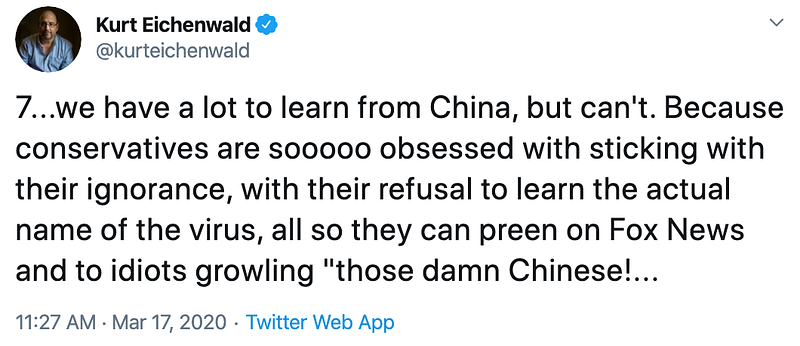
Of course names have power. I think we should get away from any arguments over whether words and names have either no power or total power in determining the direction of human thought. We agree too much to bother disagreeing over it. You and I both think words have some power. What I don’t know is where in the middle you are.
My view is that rhetoric and word choices have the power to move us towards xenophobia, or towards responsible public response to a health crisis, or in any number of other directions. But words move us like a sail, not an engine. We can hoist them up, but they’ll only do anything if there are existing prevailing cultural winds. Ideas and attitudes are what really move us. Words just catch them.
You quote me saying that “deference to authority is an extremely unhealthy attitude.” You reply, “Unhealthy is an opportune description, since when it comes to public health, I can’t imagine a more dangerous generalization for people to embrace right now.” What you’d like, as a generalization, is for people to defer to authority. Later, you allude to this being a sort of temporary emergency epistemology: “I’m just saying that the wiser course of action is to resist anti-authoritarian signals until the authorities and experts trying to unite us behind life-saving collective actions have finished their job.”
Do you notice how we have now mixed up and stopped distinguishing expert medical and epidemiological advice about disease transmission with expert guidance on stigmatic vocabulary and sociolinguistics? Do you notice how quickly this has become a debate about authority in general? Isn’t that weird?
Can’t you be in favor of the medical authorities and against the language authorities? I think you can. And I think this is a really good reason for the medical authorities to stop tweeting facially stupid things like “don’t talk about spreading the disease.”
You’re treating the question of deferring over the name as a proxy for the question of deferring over how to be medically safe. It’s sort of like if I said that not going with the Obama Administration’s preferred “ISIL” because regular people said “ISIS” means that I am enabling terrorism. After all, official organizations of counterterrorism experts decided to use the L. What kind of asshole would I be if I flouted their guidance?
Answer: I’d just be an ordinary person, with my own sense of how words work, who doesn’t think expertise about one dangerous area of life means you get to force everyone else to follow your choices and speak your bureaucratic expertise on pain of being regarded as one of Those People. And as it happened, I’d also be most experts.
Almost everybody in counterterrorism, academia, journalism, and really any place that wasn’t the Obama executive branch, flouted “ISIL,” because it was dumb and awkward. That’s how language works. It wasn’t a grander referendum on whether words have any power at all, or whether authority should generally be deferred to as a “rule of thumb;” it was just one case in which one claim about language seemed wrong. And so we decided to ignore the person chiefly responsible for fighting the thing being named.
Similarly, Spanish Flu is named after the place people thought it was from, even though they were wrong. Just like Panama hats are named after a place Panama hats aren’t from, and Shetland ponies are named after a place Shetland ponies are from. It’s a totally normal linguistic convention to name stuff after its place of origin. Mutatis mutandis, “Chinese coronavirus.”
The official name in common usage for the virus has already changed several times, with the “novel” falling off the “coronavirus,” and the “19” falling off the “COVID” in the vernacular. You can see why these unstable, handed-down linguistic orders might be worth resisting. Common sense is among the types of authority we should listen to, after we think skeptically about it. Common sense tells me that Donald Trump is gleefully saying “Chinese virus” for reasons of xenophobic political rhetoric, just as common sense tells me the long freakout over whether stigma is the real contagion here was missing the point. Why not leave other people out of it and make up my own mind about how to talk?
There is a strain of very black and white thinking running through your argument that presents a false binary: You say in order to seem like someone who listens to the WHO medical guidelines, you can’t be a person who thinks the language guidance is almost entirely irrelevant bullshit.
I have a counterexample to this: myself.
Notice that you haven’t actually argued “against China virus.” You have argued that to obey a 2015 WHO whitepaper commits you to endorsing all kinds of other crazy stuff, and that stuff is bad. According to you, using any words but the ones experts say to use means you have to argue that Fox News propagandists are good. Or that every single thing the WHO has ever said is incorrect. Look at the speculations you make about a future that doesn’t exist: “We may have more Patient 31s walking the streets.” “They will reject the vaccine.” “Through the suspicious eyes of someone who rejects all authority, everything looks like a conspiracy.”
This is a lot of causal speculation about what will happen if you use the wrong words! Do you see how far away you are from your original thesis of “‘China virus’ or ‘Wuhan virus’ are bad names for the coronavirus”? Do you see how quickly you got down the slippery slope? You started out demanding we listen to a 2015 whitepaper on which word choices may reduce stigma. Soon you were implying that anyone who doesn’t listen to that whitepaper may cause thousands of people to be infected and possibly die, saying they are morally allying with conspiracists, and predicting they might stop favoring vaccination?
Those theoretical consequences of using the wrong words are bad, Alan. But they’re theoretical. Your whole argument is a sort of “be one of these types of people, so that you won’t be one of those types of people.” And you are simply wrong that these two choices exhaust the options for which type of person to be. This is my problem with language policing, and it’s what I meant in my above post about “it has the quality of a threat.” All of this is a fancy way of using social pressure to make sure there’s only one way to say anything. You don’t want to be one of those people.
Do you think I am going to join the anti-vaxxer movement because I think it’s silly to obsess over whether a direct descriptor is stigmatizing? The theory of causality from using the wrong word choice to a world of superspreading conspiracy theorist anti-vaxxers is… well, it’s a little bit fearmongering.
A pandemic is no time for fearmongering.
Alan Levinovitz: I think you’re right to point out that not everyone who dismisses the WHO’s guidance on naming will also reject their medical guidance. Of course they won’t! I never said they would. Rather, I suggested that if just a tiny minority of people associate rejecting one kind of advice with rejecting the WHO’s authority more generally — if they suspect that the “career politician” running the WHO, as you described him, simply can’t be trusted — that’s a risk we shouldn’t be taking, given the potential consequences when it comes to public health. Is it outlandish to think that’s a possibility?
More importantly, catastrophes like a Patient 31 or people rejecting vaccines aren’t the only potential negative consequences — or even the most likely ones. As I emphasized, the main problem with calling the virus “China virus” or “Wuhan virus” is that those terms are divisive and highly politicized. As the WHO states in its best practices guidelines, one reason to avoid such names is that they might cause offense. China just kicked out American reporters at a time when global cooperation and information exchange is crucial.
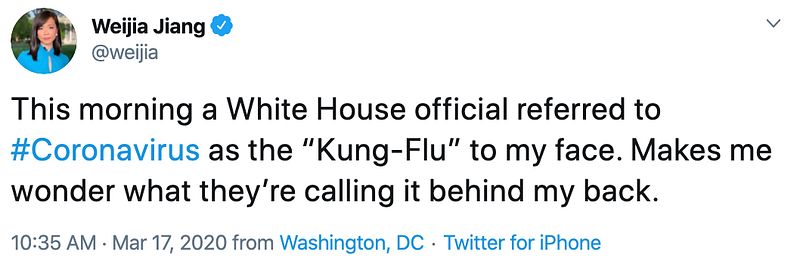
Is the CCP responsible for this? Absolutely. Is there a chance that Trump’s insistence on using “Chinese virus” might have exacerbated the CCP’s need to save face? Might his word choice have made the situation more volatile than it would have been if he — and the constituency he’s trying to please (#KungFlu for the lulz!) — had gone with the WHO’s naming guidelines instead?
I think it might — and that’s why I believe that erring on the side of diplomacy, not divisiveness, is the right course when choosing our words, whether as citizens or politicians. We are individuals, yes, but as the coronavirus has made clear, we are also members of a community. When we decide how to speak, the right thing to do is consider the effects our words might have on others.
That’s not fearmongering — that’s common sense and a desire for unity in a time when both are sorely needed.
Nicholas Clairmont: I don’t know if we’ll settle this in any satisfying way, because we seem to be disagreeing not about what’s true, but about that much slipperier issue of what’s relevant.
A high priority for you right now is making sure we not act politically divisively, including divisively with China.
Earlier you wrote:
It’s not just Fox News talking heads who favor it — it’s the president of the United States and other prominent politicians, for whom the name functions as a political cudgel. To them the name matters a great deal. And it matters to China — another authority on the power of language — which is why they are spewing disinformation in response.
No, that’s not why. It is not even barely plausible China is spewing this disinformation “in response” to word choices. The CPP is spewing disinformation not out of hurt feelings, but because this is how power politics is played. China has used the claim of offense brilliantly, because it knows the existing faultlines in our politics.
Anyway, what seriously offends China is not racial insensitivity; it’s questioning the stability of its regime and its prospects for longterm economic growth and social stability. As Dean of the College of International and Security Studies at the Marshall Center Andrew Michta wrote in The American Interest yesterday in an article titled “The Wuhan Virus and The Imperative of Hard Decoupling”:
The question about assigning agency and blame is pretty straightforward to answer: The communist Chinese state, which for more than three decades has been draining capital and knowledge from the West, benefiting from our greed and myopia, has just let loose a virus that in the coming months is about to effectively paralyze Europe and the United States and bring severe pain, both human and economic on the world.
I think Michta’s conclusions in the piece go too far, but at least he can see this issue in terms of economics and geopolitical power, not language and offense. Everyone who can’t just seems lost in irrelevance to me.
Xi and co are on my and Michta’s side of things, for what it’s worth. I promise you offense at the microaggression of the name used by our politicians is not what Beijing is responding to. Yet linguistic correctness is what occupied the American intellectual conversation about this virus for over a month before anyone you cite used any of the terms you oppose.
Some linguistic correctness-minded subject occupies us every month. It’s exhausting, and it’s part of why it has edgy power when somebody “flouts” the ever-growing number of people who claim to be experts on names by just coming out and saying the forbidden thing.
The best reason not to take such pains to hector people about adding a moral valence to saying “Chinese virus” or “Wuhan virus” is still just that it’s a virus from Wuhan, China.