
Death Portraits: A Celebration of Life
Why do we capture loved ones in life but not death?
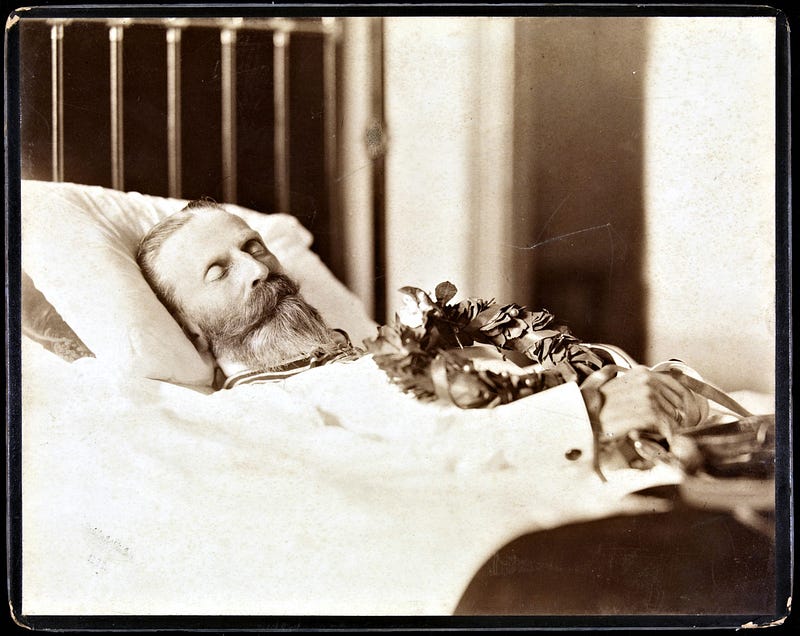
My sister almost got kicked out of my aunt’s funeral. She did something that most people would find offensive.
She took a picture of my aunt in her casket.
At the time, I was in the hospital and couldn’t go to the funeral, but my sister knew I wanted to be there. So she sent me a picture of my deceased aunt to give me closure.
Her text read, “Doesn’t she look beautiful?”
She did. My aunt’s translucent skin, as delicate as a moth’s wings, glowed against her coal-black hair. Her marble hands were folded obediently over her barrel chest, but her mouth still had the hard straight line of a woman who played by her own rules. This is how I wanted to remember her.
But while I appreciated my sister sending me the photo, not everyone felt the same. My mother tsk-tsked. My father glared. The funeral director strutted catlike over to my sister and hissed like she had doomed her immortal soul.
“Ma’am…Please, no pictures.”
I understood why he admonished her. Death is the only life-altering event never captured in photos. We snap away at weddings and births, but no one dares take out a camera at a funeral. But why do we pose for a selfie with a loved one in life and not death?
You might think I am quite mad for suggesting it, but there’s always some curiosity in madness. And I was curious. I asked my sister to take more pictures.
In one of those photos, her flash went off. The funeral director flew across the room toward the offending light.
“Ma’am, I asked you to PLEASE not take pictures!”
My sister raised her chin defiantly and asked a perfectly logical question — Why?
He snapped back, “It is disrespectful to the family.”
There was that word. Disrespect. Disrespect is often the handmaid to death. There is no Good Death. It steals your breath like a greedy robber baron and charges you a toll to get it back. Most never do. One minute the person you loved is laughing for the camera, and the next minute, the blood freezes in their veins, and the pale, blue-grey veil of death shrouds their eyes.
Do you remember the last picture you took of someone you lost?
The last picture is the one you always remember.
I once sketched an ex-boyfriend while he was sleeping. I knew I would be breaking up with him in the morning, and I wanted one last memory. I suppose I could have taken a photo, but I wasn’t craving realism. Art captures both the beauty and the lies. Our relationship had contained both.
Before photography became popular, artists often turned to their canvas to record the last moments of life. When Monet’s cherished wife Camille lay dying, he painted her last fleeting breaths with the same swirling brushstrokes he used for his landscapes.
The painting is a bit creepier than his water lilies.
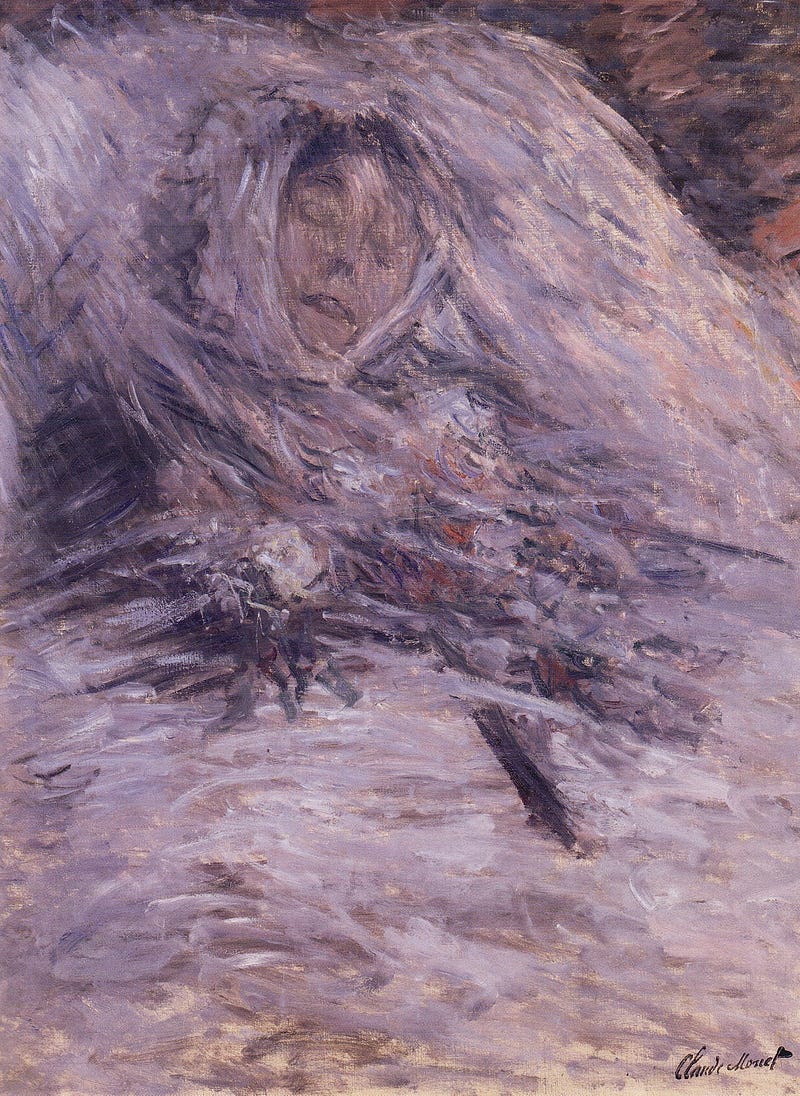
Notice the contrast between Camille’s tranquil face and the slashed brushstrokes that storm around her. Was Monet capturing the feverish torment that surrounds even the most peaceful death?
Other artists created equally poignant death scenes. Dr. Gachet sketched his friend Vincent van Gogh as the life drained out of his self-inflicted bullet wound.
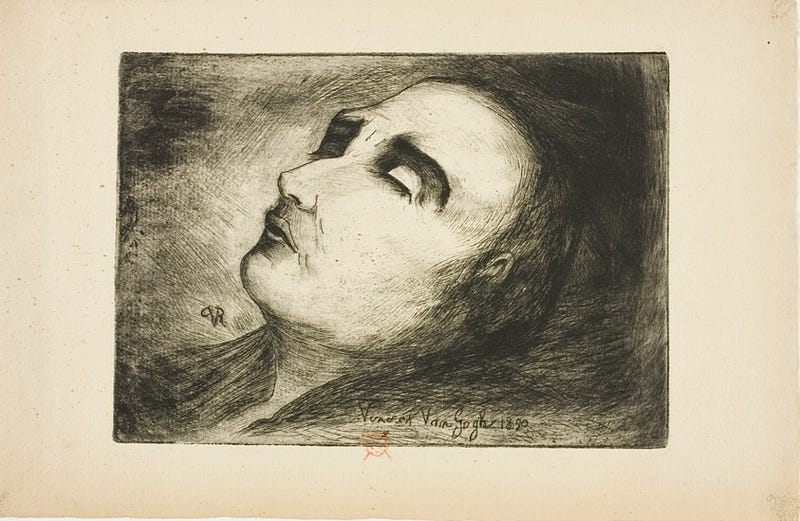
Like Monet’s painting, van Gogh’s placid countenance contrasts with the frenzied crosshatching around his face. Death might be quiet for the person dying but not for the person witnessing it.
Dr. Gachet gave the above sketch to van Gogh’s brother, Theo. Theo was not at his brother’s bedside when he died, so the sketch must have given him a thin piece of comfort. At the very least, seeing someone’s death makes death more real.
But there was another art form that did capture the realism of death. And it would change the way people mourned.
Mirrors with Memories
Only the very wealthy commissioned a painting of a family member. But by the 1860s and 1870s, capturing a loved one’s likeness became more affordable with the invention of the daguerreotype.
Today, we take thousands of photographs of our loved ones. But in the Victorian period, most people could only afford one photo. These first death portraits were called “mirrors with memories.”
Many superstitions surrounded these magical mirrors called photography. Some people were reluctant to take life photos because they believed the camera stole your soul. So they waited for death.
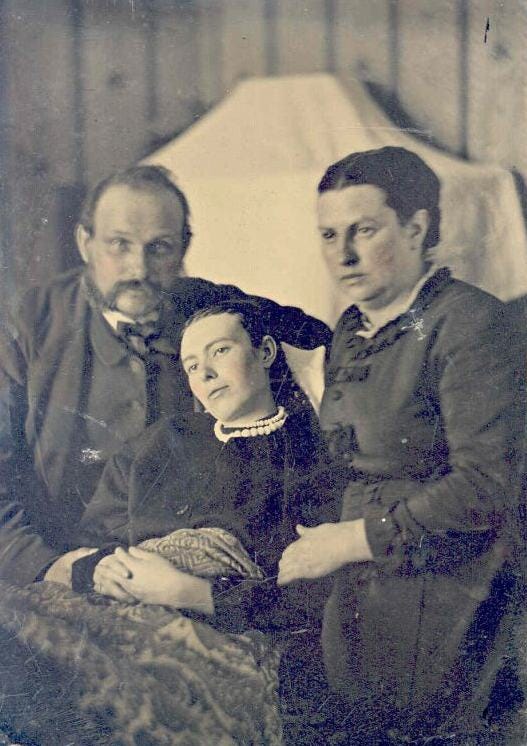
Post-mortem vs. Pre-mortem Photography
In many death portraits, the living posed with the dead. This practice makes it difficult to know who is dead and who is alive in post-mortem photography.
One clue is the sharpness of the subject. In the above picture, the mother and father are slightly blurred while the daughter is sharp. Most likely, the parents moved during the photo’s exposure, and the daughter obviously could not.
Other signs of death are a dark liquid at the corners of the mouth called purge fluid. (It looks like blood, but it is not.) And if a photograph was taken too late after death, the subject’s fingers are darker because the blood pools in a corpse’s extremities.
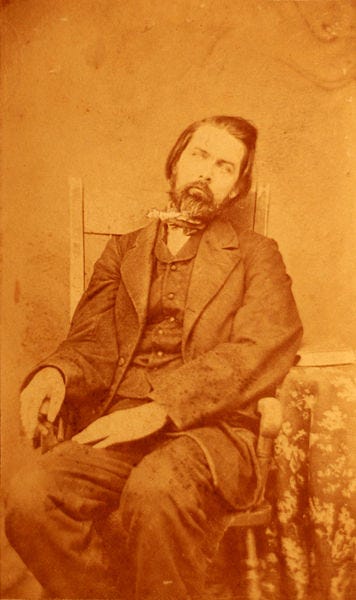
Another sign is the eyes. When a person dies, a bluish-grey film covers the eyes called corneal clouding. You can see it in the post-mortem picture above.
Sometimes, photographers would color in the open eyes of the deceased to make them appear more lifelike. In most of these photos, their eyes look unnaturally black.
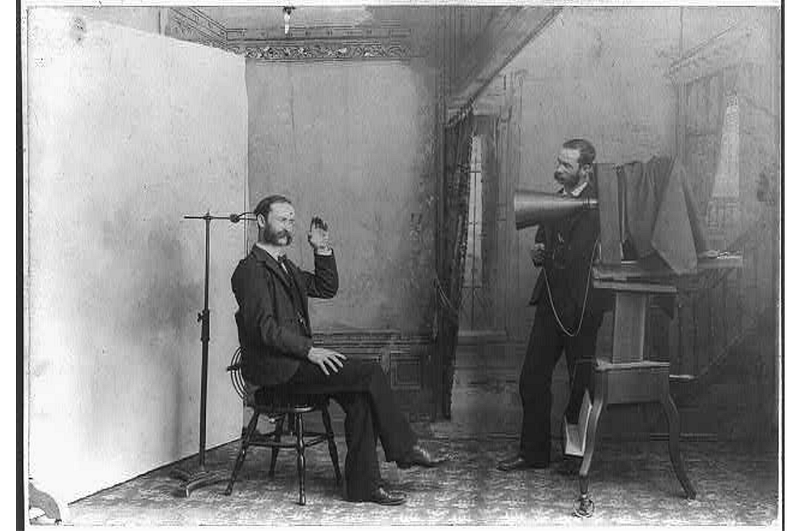
A less conclusive sign of a post-mortem photograph is the stands (sometimes referred to as a Brady stand). Photographers used these stands with clamps to prop up the deceased. But the stands also kept squirming children and fidgeting adults still.
The Good Death
To the Victorians, death lurked in every shadow. Death crept out of sewers and cloaked people with cholera. It hid in the handkerchiefs of young maidens dying from tuberculosis. And it hung over babies’ cribs and carried them away on the backs of winged seraphs. Most Victorian mothers didn’t even bother naming their child until they reached the age of one.
Death was everywhere.
Today, death visits us far less frequently. Perhaps that is why photographing the dead has become taboo. But a death portrait feels disturbing not because we fear death. Most people don’t fear dying. They fear disappearing. They fear being forgotten.
It takes a certain blend of courage and acceptance to document someone’s death as carefully as we document their life. Death portraits are our sacred memory keepers.
Our memento mori.
We always forget the English translation for those words, but the Victorians never forgot — “remember you will die.”
But death also reminds us to love. To cherish our friends and family as if we won’t have a tomorrow. And to celebrate each mirrored memory.
“People living deeply have no fear of death.” — Anaïs Nin
To read more and support The Grim Historian, please visit my affiliate link and become a Medium Member. A portion of your subscription supports my writing.


