
Death is Final — Or Is It?
Finding Ways to Reckon with the Mystery and Make Loss a Bit More Bearable
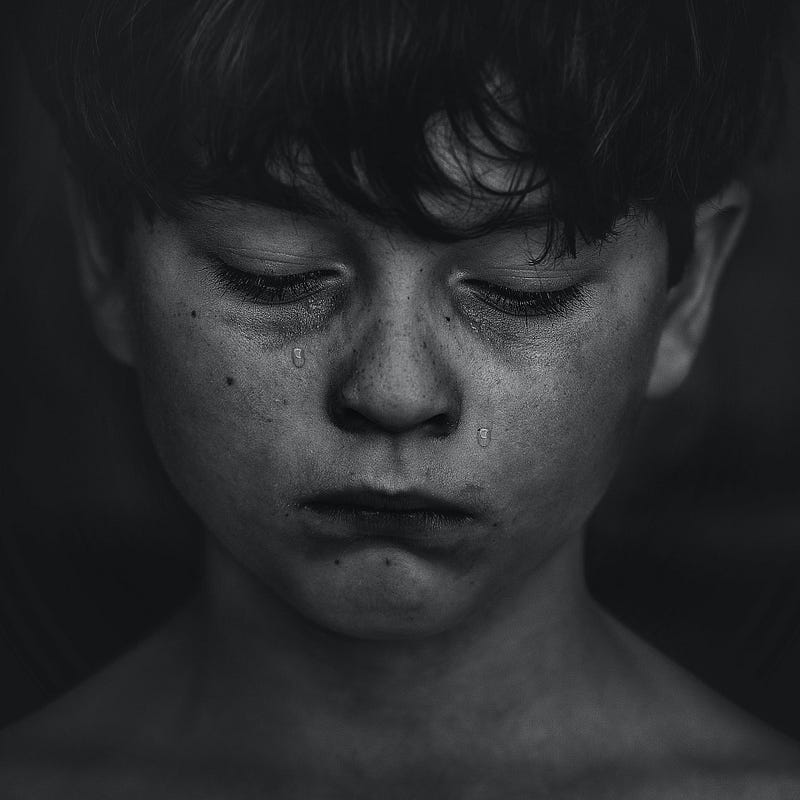
Yesterday, I wrote a piece about the importance of laughter. Today, I’m pondering Death. No surprise. The world is tuned into The Funeral. As an old friend, an aging suburban hippie I met in the early 70s after she’s discovered the spiritual guru Ram Dass, might have said, “Death is heavy, man. We need to talk about it.” As it happens, over these last many months, I’ve been visited by both joy and grief. And it is heavy.
The Power of Death
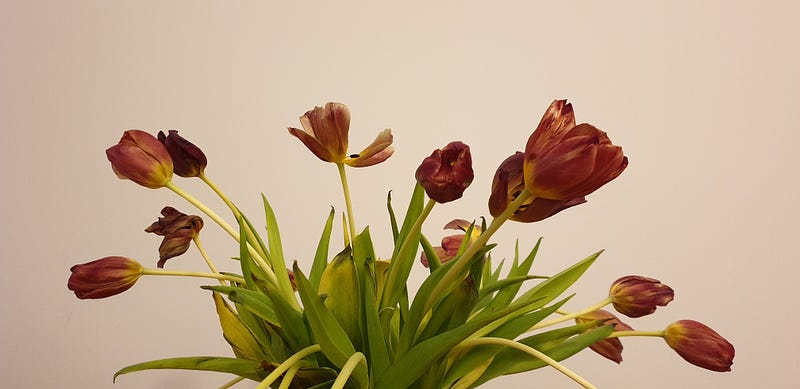
When her mother was brought home from the hospital after a diagnosis of terminal cancer, my partner put a dozen roses in her room, because she knew how much her mother loved them.
At first, the roses were replaced weekly. In time, the flowers began to die before the week was over. Eventually, they had to be replaced every two days.
Shortly before her mother passed, roses left in the room wilted within a few hours.
“Death energy is very powerful,” my partner said as a way of helping me understand how drained I felt after visiting a close dying family member. Following a series of medical dips, he was diagnosed last year with cancer and this past summer took a turn for the worst. One good day, one bad day.
Whether the disease overpowered him or he no longer wanted to be here — or, most likely, a combination of the two — his essence seemed to be slipping away. He died within the month.
The Presence of Absence
No matter how much you expect Death, the frustrating, frightening slipping-away is inevitably followed by shock. Where has the person gone?
I still feel him, says the wife.
But he is gone. Absent. No, not just missing. His absence — the lack of him — fills the room, the whole house.
Einstein said, “Energy cannot be created or destroyed, it can only be changed from one form to another.” Why wouldn’t human energy work the same way?
If we knew this to be true, wouldn’t it alleviate the suffering of the Ones Who Go On— the survivors?
Indeed, most ancient and Eastern philosophies believe that only the corporal body dies. New Age philosophers (whose assertions by now are anything but “new”) and a growing body of practitioners and scientific researchers accept that every sentient being has an aura, an energy field that surrounds the physical body.
Your aura changes, depending on what comes at you and what’s going on inside you. We can’t see it, but that doesn’t mean it’s not there.
Something in my partner’s mother’s room was powerful enough to make those roses die.
Explaining the cosmos is above my pay grade. Still, I am convinced that someday we will learn more about the bridge between life and death.
Let’s not forget, humans didn’t always know that disease is caused by microscopic organisms. And for better and worse, look how far we’ve come. We’ve practically obliterated the difference between “here” and “there.” Even Dick Tracy with his 1950s two-way wrist radio wouldn’t have imagined that someday we could “be” in two places at once.
The human species, no matter how selfish and wrong-headed it can be, hasn’t stopped learning. And who knows? If unknown laws of the Universe allow me to keep an eye on the physical plane long after I’m “gone,” maybe some day I’ll see my grandsons’ children “beamed up” to other planets. (Thanks for the preview, Gene Roddenberry.)
Can We Be Alive After Death?
Alas, we’re here now, dealing with the reality most people accept: when you die, you’re gone.
Losing people you love or care about is a bitch. So we have to ask, “Is it possible to somehow keep them alive?”
The short answer is “yes” — admittedly, not a wholly-satisfying “yes.” There’s a rub. Let me explain:
People leave behind their essences, and we store them in our minds, not necessarily the most reliable of vaults for precious memories. Thus, it’s harder to access the smiles and the sayings of long-dead loved ones — in my case, my mother who died nearly 50 years ago, my grandparents.
However, those who passed over the last ten years — at least given my memory—are very much alive. Alive. They are not breathing, not here physically, but alive fits.
- The close family member who died six weeks ago.
- My eleven-years-older sister.
- Both of my “wives” — female friends who earned the title by taking such good care of me whenever I visited Manhattan from Massachusetts.
- My beloved aunt Ruth and my old ladies, all in their 90s and beyond, who passed somewhat recently.
- Colleagues — an editor, a boss, a mentor who’s no longer here to cheer me on.
All still alive. They talk to me, counsel me, and, in the best of times, remind me of how much I have to be grateful for. I might be taking a walk or reading or watching TV. Suddenly, out of the blue, something in a split-second moment snatches my attention. It feels like one of them, reaching out.
I’m not alone in such experiences. Fellow writer Patricia Ross—an extremely wise and, I dare say, grounded woman — is more than willing to accept that the husband who died in 2011 has since reached out to her. During his illness, when they discussed his impending death, he promised Patricia he’d try.
Patricia writes about several unexplained experiences and the conclusions she’s drawn as a result:
So I’ve made up a story that satisfies me and very few others: It is Ed. Tapping me on the shoulder, getting my attention. As a friend of mine who is open to these sorts of things said: “How else is he going to contact you?” It makes sense in light (pun intended) of how he always believed me when I had extraordinary experiences, blew out light bulbs, etc. He was always validating my experience, and it would make perfect sense that, if there is such a thing as an existence after this life that he would contact me, as he had promised he’d try, in a way that I would recognize, in a way that we had shared experience.
After experiencing many so-called paranormal experiences myself, I agree with Patricia on what it all means:
What this experience has given me is not a religious belief nor do I take it as proof or evidence of anything . . . but what I do seem to have, now, is a sense that there is a continuity of some kind: before we’re born, during our physical lives, and afterward. More than that I don’t know (I actually don’t “know” that either, but it’s a sense and I’ve come to believe it).
But there’s that rub I mentioned earlier:
That person is not here. We miss the corporal being fiercely, not to mention the presence, the warmth, the laughter, all unique to that human. We are not in the same place at the same time. We cannot be here and there — wherever there is.
But until those mysteries are solved, until death is no longer a given, I’ll take what I can get.
If you like to read me, thanks. You also might want to…
Click here to get an email when I publish. Even better, join Medium by clicking here (or on my photo below). Tell ’em I sent you!
Follow me on social media via LinkTree.


