
Death Desecrates the Only Holy Aberration
The conscious self is the familiar underpinning of all sacred places
As Britannica points out, the Holy of Holies is “the innermost and most sacred area of the ancient Temple of Jerusalem, accessible only to the Israelite high priest.” It’s taboo for anyone else to go near that spot. Indeed, only once a year, on the Day of Atonement, was the high priest himself allowed to enter that “windowless enclosure to burn incense and sprinkle sacrificial animal blood.”
Temples, altars, scriptures, and the like are treated as holy or sacred. They’re meant to be inviolable since they’re deemed closest to God or to some supernatural power that would bring us to our knees if it were revealed in all its transcendent fullness.
Yet temples can be desecrated.
The Book of Daniel, for instance, speaks of the “abomination of desolation,” when the second century BCE Greek king Antiochus IV Epiphanes replaced the offerings in the Jewish Temple with pagan sacrifices. For ancient Jews, outsiders had violated the Jewish tradition, broken the taboo and crossed the border between the sacred and the profane, and committed the blasphemy of insulting the one true God.
Then there are the secular equivalents of these holy spaces, such as bank vaults, panic rooms, man caves, tree forts, and movie theaters.
But from a realistic, naturalistic perspective, all of this is absurd. No place in the universe is more objectively sacred than any other. Without the naïve intuitions that personalize everything so that we can socialize with it, and thus without a compelling basis for theism, these judgments of holiness are misleading.
Yet there’s one real anomaly that grounds and explains these superstitions.
As I explain elsewhere, all talk of holiness or of sacredness is indirectly about the personal conscious self, the mind that’s isolated in its skull. That border between the brain’s by-products of self-conscious awareness, qualia, or the subjective contents of thoughts and feelings, through private introspection, on the one hand, and everything else in the world that’s objective or that’s perceived as a projection of conscious processing, on the other, provides all the gravitas of religious discriminations between places.
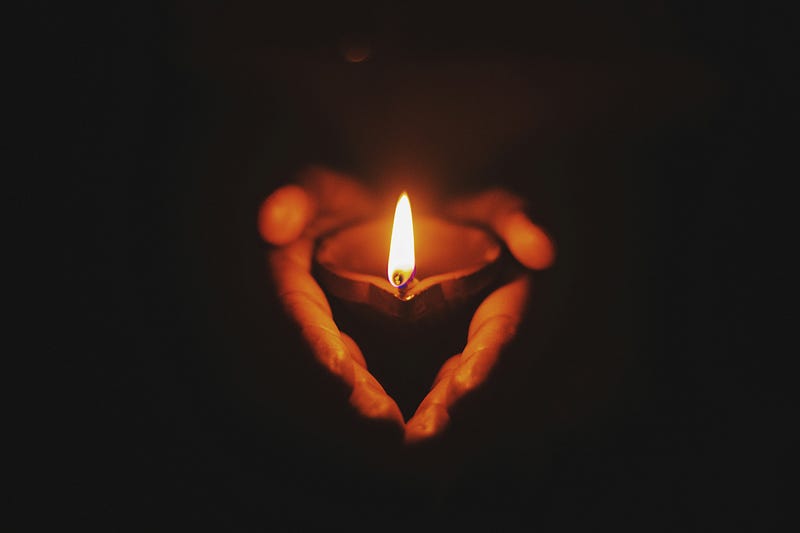
What’s felt to be most sacred is the seeming immateriality of our inner life, which we treasure as our subjective essence, as that which distinguishes us from animals or from lifeless objects. This consciousness has often been called metaphorically an “inner flame,” in that the self is as precious as fire in a wasteland. The awakened human mind is the source of all our progress, the engine of history, the anomaly with the potential to redeem the wild monstrosity of nature.
What, then, would the ultimate desecration of the conscious self look like? We can be humiliated in various ways in social contexts, but the most dreadful humiliation would be a subject’s reduction to the status of an object. Of course, this is just what happens in death when, from the outside, the inner life may seem to flee the dying body. Perhaps even the body’s integrity has been physically violated, and the head lies cracked, or the organs have spilled onto the ground in a pool of blood. Outsiders then look upon what’s implicitly most sacred to each of us: our interiority which sustains that inner flame of creative, intelligent self-awareness and agency.
The personal self is desecrated when it’s objectified, and this is the essence of the self’s death, when the person is revealed to have been an object all along, and the self some magic trick of the brain.
Or imagine the sci-fi scenario in which scientists learn to decode the brain and can view not just our neurons but our private thoughts and feelings, with some technological marvel that replicates our internal states. Scientists would then have a God’s-eye view of our precious interiority, which would necessarily belittle the spied-on self.
Religious folks bow before what they imagine to be God because they fear and loathe the prospect of being on the wrong end of omniscience and omnipotence. But at the heart of that fear is the realization that a god could objectify the human self, could peer into our depths, and compete with our inner sovereignty.
After all, what’s precious about each conscious self is that that mind alone seems all-knowing and all-powerful within that sacred space. We alone access our qualia. Even if neurologists can inspect our brain, they can’t yet experience the subjective aspects of our mental states, how our thoughts feel to us. What was it like to have those eggs for breakfast? We can describe the experience to others, but only we can feel it in the context of our memories and how our brain perceives that environment from our perspective.
Religious sacredness is primarily that inner exclusivity, the privacy of our access to our qualia which makes us the masters of that territory. And when religious individuals abhor the desecration of sacred spaces, they deal in a garbled, indirect way with the existential fear of death. There’s nothing inherently special about the Holy of Holies. It’s just a spot in a building. But what that spot best symbolizes is the real, obvious barrier between subjective experience and the impersonality of nature’s physical foundations.
Most of the universe is not even alive, let alone personal. Personhood as we know it is a by-product of the powerful human brain. The brain is an anomalous object that tricks itself into modelling and experiencing itself as a subject. The powers of personhood include consciousness, intelligence, imagination, autonomy, ambition, language, culture, and the physiological ability to realize the person’s plans with techniques that apply his or her knowledge and terraform the environment.
As persons we’re surrounded by a monstrous cosmos, by nature’s wild, impersonal, indiscriminate evolution. What makes us precious is that our kind of creativity stands as an emphatic challenge to nature’s flow towards entropy. We’re tragic heroes in the epic tale of historic progress. At least, that’s the humanist conceit that might vindicate the injustices of civilization.
But again, when the self is most thoroughly violated in death, when the body is revealed as a lifeless, impersonal thing, as part of nature’s wild evolution, we sense the ultimate desecration. Nature desecrates personhood by ensuring our mortality, and by laying bare our interiority and undermining the brain’s magic trick.
When we’re faced with a dead body, nature seems to be saying to us, “See, there’s nothing special about you after all. All that you hold most sacred, what you cling to despite your pretenses of being higher-minded, is an illusion, a flickering flame that’s all too easily snuffed. There’s your precious interiority, the putrefying remains of that corpse. See how I work my magic even in your eventual decay, and thus how my magic is greater than humanistic progress.”
Death is the primary act of desecration, and it’s undertaken by our one true God, by the natural cosmos at large. The desecration of socially determined sacred spaces, from temples to our pet projects, re-enacts that part of our existential predicament. When a young sister wrecks the elaborate LEGO construct her brother painstakingly built, and the boy feels he’s the victim of an ultimate violation, this, too, is an echo of the primary sacrilege.
We cherish our privacy and our personal possessions because they’re so many extensions of the one real quasi-miracle, and that anomaly of the inner self is precious because it’s so fragile and because it’s vastly outnumbered by its negations in nature.
I collect my Medium writings in paperback and eBook forms, and I put them up on Amazon. Check them out if you’d like to have them handy and to support my writing. Some recent ones are Our Oddity in Deep Time, Aristocrats in the Wild, and Questing for Epiphanies in a Haunted House, each of which is over 500 pages and is filled with my articles on philosophy, religion, or politics.