
Death Cat
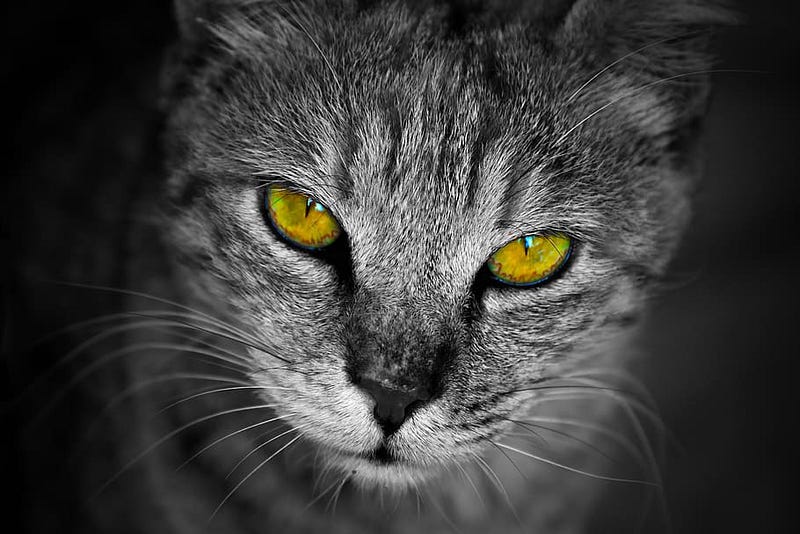
The death cat of my father’s nursing home approached me directly, sat just out of my reach, and studied me. The cat was well known for its ability to forecast death. Whenever it began to sleep on a resident’s bed, that resident would expire within a week. Scientists and newspaper writers came to learn from and report on the cat, showing far more interest in its activities than the humans of the nursing home, though the oldsters often surrounded the visitors with their wheelchairs and pulled at their sleeves. The cat, for her part, couldn’t care less about all the attention, possessing a haughty disregard for anything that fell short of eternal.
The scientists hypothesized that the cat had an extraordinary sense of smell and was able to detect the scent of death approaching. Moreover, being a cat and not subject to the same social concerns as people, it didn’t care how the residents felt about being singled out for demise. It didn’t skirt the issue, as folks will often do with the terminally ill; contributing not only to its uncanny ability, but its willingness to use it. None of the scientists shared the convictions of the ancient Egyptians who believed that cats were well connected spiritually. Though I was not an ancient Egyptian, I thought as they did about cats and believed that all the investigations into its sense of smell were just a misguided attempt by the proponents of the physical to discredit the metaphysical.
The death cat examined my spirit for a minute and began to wash itself. I had decided that if the cat sat on my father’s lap, I would follow through with my plan to smother him with a pillow. My father had lived too long. Everyone knew it, but no one wanted to say. I would be doing him and everyone he had contact with a favor, for he was a miserable son-of-a-bitch. On the other hand, if the cat curled up on myself, I would execute my alternate plan to commit suicide, for I was also a miserable son-of-a-son-of-a-bitch and nobody minded saying it. I would be doing everyone a favor, me most of all. However, I wished to avoid both aborted suicide attempt and failed patricide. I depended on the cat to forecast success. As my father always said, if you’re going to do a job, then you should do it well.
I told myself I didn’t care about the cat’s decision one way or another, but my central nervous system was not in agreement. The cat was more interested in me than my father. My heart began to pummel the inside of my chest with apprehension that it might select me. My survival instinct was as strong as ever, despite my wanting to die. The body goes on with life; it will hunger and crave, digest and beat, metabolize and sweat no matter what the mind thinks. Indeed, it’s almost as if my body and mind never spoke to each other; like an estranged couple, living in the same house, but sleeping in separate bedrooms.
The cat may have sensed a powerful heartbeat from me, because it stopped its licking and sauntered over to my father. Dread surprisingly mixed with adrenaline the creature leaned into a full body massage on the old man’s chair leg. I had to acknowledge that I no more wanted to kill my father than I wanted to kill myself.
Oh, he was still a miserable son-of-a-bitch and would silence that snoring mouth in a minute if I could just walk away and be done with it all, but I didn’t want to have to plan a funeral. More to the point, I didn’t want to have to sit there at the service with the knowledge that I had killed my father and listen to eulogies about what a good man he was, even when he’d been a son-of-a-bitch. I didn’t want to have to give a eulogy and deny how I really felt. I wanted to testify to the truth and call things as I saw them no matter the consequences. Just like the cat.
I might’ve considered a murder-suicide combination, but I didn’t know how the cat could confirm that choice. It’s not like the creature could sit on two laps at once.
I began to wonder why I was leaving such important matters up to the cat, as if a rural community were to give up voting and institute cow chip bingo to select its mayor. I was a human, after all, and possessed all the pride of species that you might expect of a living thing that went on about being created in the image of God.
On the other hand, if the Egyptians were right, the cat was only a conduit of information from the spirit world, a kind of Associated Press office, stationed in heaven; Reuters for the seraphim. The cat wasn’t making the decision; it was simply reporting the news. Even the son-of-a-bitch himself, a religious man, might agree that one should seek the Eternal for guidance, although he might object to the anointing of a cat. But, why, I argued, is it any less absurd to believe that the divine would take on human form and sacrifice himself, or odd of God to choose the Jews?
I went on to speculate: had the scientists thought to look into other messages the feline might have for us? Could it be consulted regarding the meaning of life? Could we submit all those questions we have of the divine? Could the cat heal the sick? Raise the dead? Measure Karma on a ten point scale? Additionally, could fate be reversed once the cat selected its victim, or would death inexorably arrive no matter what the intervention?
The cat stepped away from the son-of-a-bitch’s chair, circled, and came back around to rub the other side. It caressed the son-of-a-bitch’s leg with its whiskers, stiffening its tail with a kind of orgasmic exclamation. I wanted to avert my eyes. I was certain, at this point, that the cat was preparing to mount my father’s lap. An anticipatory wave of grief washed over me. I tasted the salty brine of regret. I almost drowned in memories, good and bad, wistful and sad, amusing and enlightening of my father at the kitchen table, playing catch, yelling at the ref at my games. They say your life passes before you at your own death; do you review your victim’s life before you commit murder?
The cat circled again and squatted down, preparing to leap. I gasped for air, as if a hundred cats were all sitting on my own chest. My pounding heart spoke all the way to the top of head, as a rock band’s amps will vibrate the floor. At last, the cat made its jump onto the son-of-a-bitch’s lap. The old man startled, grunted, then, recognizing the animal, gave it an eager pet. The feline arched its back into the caress and began to purr. Three more strokes of the cat’s back, a rub of its head, and a half dozen unsheathings of its tail and the old man was asleep once again, smiling.
Just as quickly as all that, the grief that had washed over me was replaced by an abrupt realization of horror. It was I who was the monster, not my father. All my father ever did was to act human, but I was the inhuman. I grasped the arms of the chair, preparing to hoist myself up. I would not murder my father. I would leave the nursing home. I would travel far and never come back, lest I have that impulse again and act on it. I might even kill myself despite the cat’s verdict, for the world would be better off without the likes of me.
I might have departed immediately, but the cat did something unexpected. It did not settle down in my father’s lap. It perched on his thighs and made a second leap onto a nearby table. The cat curled once about, weaving in and out of the picture frames, draped itself over an old-fashioned telephone, and went to sleep.
It was the kind of cat picture one finds on the internet, or on calendars hung in old ladies’ houses: a feline in an awkward, unlikely position, making itself comfortable against all odds. I struggled to compose a caption for the picture, but puzzled over what it meant. Suddenly, with the loud kind of bell that those old fashioned telephones used, it rang. All of us startled, me, my father, and the cat, but especially the cat. My father jerked awake, I jumped out of my chair, and the cat scampered out of the room, tail held high and twitching as it left.
“Who could be calling this time of night?” said his father as he answered the phone to see who it was.
It was someone who wanted to talk to the son-of-a-bitch and wouldn’t have been able to if he was dead.


