
Death
Only Animals and Strangers Die
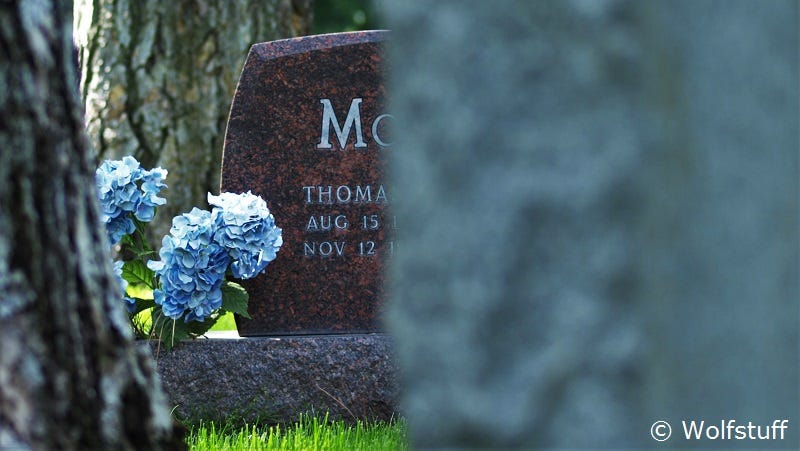
When I was little only animals and strangers passed away
Death. All my family and friends were too alive ever to die.
A small, young boy, eight or nine, slipped on the ice and under the back wheel of the school bus just as it pulled in. The wheel crushed him. He was still alive when the ambulance came, and arrived at the hospital still breathing, but not for long. All life ebbed and he was no more.
There was a rumor, neither verified nor clarified, yet in draft form making all the school rounds, that someone (unspecified and unnamed, but also in the line for the bus) had pushed the small boy out of his or her way and under the wheel. This was never confirmed or denied. No one was accused or blamed, but if this were in fact the case, then someone has lived his or her life with a very heavy heart and a dark conscience. I could muster up some compassion.
Although the young boy went to my small elementary school, I never knew him. I never spoke to him; he was not my family or friend — or he would not have died.
A father mercy-killed his disabled son, then killed himself. He killed the son with an ax then tried to shoot himself with a rifle — unsuccessfully. Wounded and bleeding he made his way to a nearby little stream and, falling forward into it, managed to drown himself.
I never knew the disabled son, nor the mercy-killing father. They were not family, nor were they friends — or they would not have died.
The nearby farmer had an old Ardennais stallion named Storbrun (it means Big Brown in Swedish): huge, brown, strong, kind, and the special darling of the farmer’s housekeeper. Then Storbrun was no longer strong (though still huge, brown, and kind) and after a year of not so strong (useless consumer of hay, in farmers’ terms) the farmer decided to put him down.
We had a photograph of Elsa, the housekeeper, standing by the old horse, just minutes before he was to be put down. You can tell that Elsa had been crying and was soon to resume — while now, for the benefit of the camera and posterity, looking blankly, and tear-free, in the general direction of the photographer.
We never saw the old stallion again, and somehow Elsa was not quite the same after that. Mom told me that she was mad at the farmer for putting Storbrun down, he really didn’t have to do that, not really, was how she felt, and I think Mom agreed.
I got an air rifle for my fourteenth birthday. Not that dangerous of a weapon, although you could put your eye out with it if you planned it well and kept your nerve.
Dad tried to show me how things were done by aiming for some house sparrows in a nearby birch; he did no damage. Well, he said, you give it a go. I did, and missed as well.
A little later, I’m out there aiming at trees (which I manage to hit from several feet away) and leaves and stones, and such, when I spot a great tit, a beautiful, yellow-chested little bird, in the very top of a leaf-less birth (my birthday is late October); oh, what the hell, I gave it a go: and hit him or her squarely in the yellow breast, killing him or her instantly — the beautiful little death fell like a stone out of the tree and thudded into the ground just by my (killer) feet.
I was devastated. Yes, I had aimed at it; yes, I had squeezed the trigger; but what were the chances? I could hardly hit the ground from three feet, and here, an absolute bull’s eye. The bird’s descent and sudden arrival at October earth stayed with me, pursued me, for weeks.
I dug a small grave for the little life I had stolen, and buried him or her in it, and although I didn’t cry, I might as well have. Yes, devastated.
I told no one at first, but this weighed so much on my conscience that I eventually told my mother, admitting to killing the bird but also pleaded that I had not really meant to; felt I was sure to miss, surely.
I didn’t know this bird. He or she was not family, nor friend — or he or she would not have died.
The most horrifying photograph I ever saw was of a Russian peasant husband and wife during the widespread Stalin famines. They had eaten their child. Remnants of the little human lay scattered in front of them where they stood outside their cottage.
I have never seen emptier eyes.
I did not know the little Russian child who became food. He or she was neither family nor friend to me — or he would not have died.
When I found out that my first girlfriend was dead, I lost my mental footing. This was an impossibility that nonetheless had found a way of taking place.
People you once knew and loved cannot die. And yet.
And as the years keep piling on, other family and friends die.
Grandmothers.
Aunts.
Uncles.
Father.
Mother.
Business partner.
Good friends.
There seems no end to dying. For these days I am no longer little, and not only animals and strangers pass away.
© Wolfstuff