
Death at the Grand Canyon
But it would make a great book.
550.
Over 550 people had fallen to their deaths in the Grand Canyon.
At least according to the book prominently displayed inside the South Rim gift shop. After every additional death, a new edition of the book would hit distributors, detailing the life and times of the latest victim.
Death. Terrible for business. Good for book sales.
I decided against buying the book. A bad omen for my trek to the bottom. I’d buy it on the way out of the park. If I made it out, I joked to myself.
The beauty of the Grand Canyon rested at the rim, and at the bottom, where hikers could shake hands with the Colorado River, the artist behind the world wonder. Between rim and river it was mostly a pain-in-the-ass hike. Tightly wound switchbacks clung to canyon walls, the path itself weary of looking too far over the edge to the base nearly 5,000 feet below. Suicidal gravel slipped from the slender walkways, screaming out their demise as they skipped off the canyon wall.
Doing my best to offer the fenceless path edge a wide berth, I imagined the author of the Grand Canyon death book watching trekkers from a far-off point, peering through binoculars while munching on snacks, waiting in anticipation for the next fall and surge in book sale royalties, only to curse under his breath when a tripped up individual regained their balance.
The mouth of the canyon swallowed visitors into its belly, slowly digesting those with determination to make it to the bottom. Most, however, regurgitated back to the rim as they turned around.
A late afternoon sun stained the sky orange by the time I reached the base. Dipping my toes into the turquoise water of the Colorado, I enjoyed a brief snack, when the hands of time slapped me across the face.
The sun would set in only a few hours. And if I took anywhere near as long to get out as I did to climb down, I would do so in complete darkness.
Slipping socks and shoes onto damp feet, I ran. At least as well as I could along the hard canyon floor. Ever not the jogger, I could only run for a few minutes at a time before legs and lungs needed time to recover. And yet time waited for nothing.
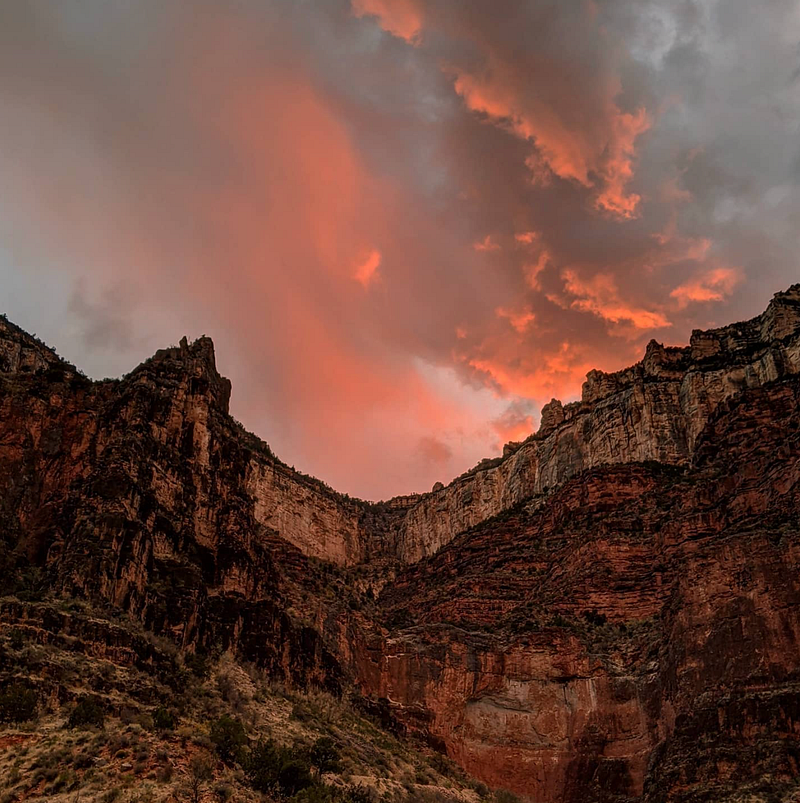
The sun dipped onto the jagged edge of the Canyon, staining the sky red as it bled out. I wanted to stop. To take it in. I managed a single photograph before the cell phone died. The path began its incline, and with it the shedding of hikers, as I saw nobody along the path in front of me, nobody behind me. They all had left long ago. They all had a common sense lost on me. They did not want to become entry 551 into the gift shop’s book.
Continually attempting to steal my attention, the sky shifted from red to lavender to purple. Clouds moving in for the night reflected the colors in their fluffy underbellies. Still, in the stomach of the canyon, I could not see the sun, or its placement in the sky, but with the dropping temperatures and the fading light, I knew I had little time left.
Making it to the switchbacks hugging the side of the canyon wall, a small marker announced the five-mile point. Five miles to the top. Five miles and I could no longer run. My legs, twitching and threatening my progress with dehydration cramps, required the attention of a bored toddler. And even if I could run, visibility diminished by the minute, making it difficult to see whether a left turn meant the next switchback, or immortality as the newest death entry.
Blanketed clouds blotted out whatever light remained, and hid the illumination a moon and stars could offer.
My discovery of the three-mile marker came by feel, not by sight. I touched the wooden spike signaling how much I had left to go. Next to it, a little wooden lookout, which proved little more than a picnic gazebo. Holding the wooden marker, I considered the options. Crawl the final three miles, hand by hand, knee by knee, as I no longer could see where I stepped, or spend the night in the lookout, with plunging sub-freezing temperatures.
Which fate did I want to test?
Working an elbow into a tightening calf muscle to help break up the tired muscle fibers, a little speck of light from down below caught my attention. Like the dancing ball of light used to represent Tinkerbell from an old BBC performance of Peter Pan my parents once owned on VHS. But no stagehand produced that light. It came instead accompanied by voices. A male and a female. Australian by the sound of it. Perhaps New Zealand.
“’Ello there, mate,” the man said when they finally came upon me. “You look as if you’re in a bit of a pickle. Could use a little help?”
“Some light would go a long way. If you don’t mind a little company.”
“The more the merrier we like to say. Welcome aboard.”
I followed them the final three miles. I did my best to keep up, despite seizing muscles and a thirst that would drain what remained of the Colorado. Most of all, I wanted to cling to the presence of those who helped keep me from bringing about another chapter in the book.
The man watching through his binoculars must have been furious.