
Dear White Folks: Stop Feeling Guilty and Defensive about Racism, Practice the Following Instead

I am certain that every one of us People of Color have witnessed the often typical and predictable reactions of whites whenever race and racism surfaces in conversations and discussions. The reactions are, in no particular order: push-back, denial, silence, guilt, tears, anger, and/or defensiveness.
If I bet $5 for every single time I’ve witnessed these predictable reactions I’d be a billionaire. Okay, I admit that’s an exaggeration, but it’s been a lot, too many to count and that’s the honest truth.
Because of my work and educational journey, I’ve constantly been forced into white space (or wait a minute, are they in our space?!). Meaning, spaces and places that are predominately frequented or inhabited by whites. The equation is straight-forward, the more exposure to whites: the more you will observe their predictable reactions when race and racism are discussed.
As someone who has taught and supervised numerous whites over the years, here are my recommendations on what whites can choose to do instead of falling into the typical reaction pattern. Practicing the following will help to become better human beings to Black, Indigenous, and People of Color (BIPOC).
1. Acknowledge and Accept Your Inherent Privilege
The first step to becoming an accomplice and eventually an ally to BIPOC is to accept that the US is fundamentally racist. When whites learn, acknowledge, and accept that the very foundation of society was created to dominate and oppress Others, then there’s a glimmer of hope. But, if whites choose to ascribe to the “pull yourself from your bootstraps” mentality that erroneously teaches folks that life is fair and that everyone is afforded the same opportunity, then becoming an accomplice is almost impossible.
It is vital to understand that the racist foundation of the good ole USA is what created this inequitable societal structure that affords automatic privileges based on the color of one’s skin and familial lines.
Accepting that there exist inherited privileges doesn’t mean that whites need to feel guilty or ashamed and/or debate that they should not be held responsible for their forefathers (and mothers!). When this statement is ignorantly uttered, whites are missing the point that we don’t need or want their shame or guilt, we want them to understand that regardless of what their own ancestors did (or did not do according to them), they have privileges that BIPOC do not have, and many will never have.
When inherent privileges are recognized and understood, it becomes more possible for whites to see how People of Color are not afforded those same privileges.
2. Listen

Once there has been the acknowledgement and the acceptance of the inherent inequity at the core and across all society, then white folks might be ready for the next step and that is to listen to the people who have been most harmed by the racist system.
Listening to us with an authentic heart and mind is not possible if whites have not accepted that there is a skewed racial structure and hierarchy that governs our lives. But, if they have, then it becomes possible for whites to begin to authentically listen to our accounts of how we’ve been harmed by race and racism.
And, when whites are committed to listening, they need to make sure to not interrupt or interpret our stories and experiences, that is truly a disservice and a disrespect. We don’t want to hear whites’ opinions or even their apologies. We just want to be heard and acknowledged.
Maybe what whites can do is at the end of the discussion or meeting, take a moment to thank the individual for sharing. Yes, that’s it, then walk away, go home, and reflect on how society treats you and mistreats others.
3. Continue to Learn
When whites have acknowledged and accepted society is fundamentally racist and that they are born with automatic and inherent privileges, to become an even greater accomplice they must continue learning. This can be accomplished multiple ways:
- Reading books on the history of the US and on the racial hierarchy — The Racial Contract by Charles Mills is a must and other excellent scholars such as Derrick Bell, bell hooks, Eduardo Bonilla-Silva’s Racism Without Racists, Cheryl Harris, Frantz Fanon, and so many others.
- Take classes, listen to podcasts (Scene On Radio), and/or participate in webinars (Under the Blacklight). There are so many free and accessible resources online that focus on race and racism.
- Attend and volunteer at BIPOC-led community meetings and/or circles that are open to the public (and when attending be sure to remember to practice humility and the best listening skills possible).
4. Commit to Disrupt
One of the most important changes whites can make as they continue on their long journey toward equity is committing to calling out race and racism in their own circles and especially finding ways to disrupt white privilege. One of my good friends said the other day, the same way people choose to reinforce racial inequities every single day, they can also commit to disrupting racist systems on the daily.
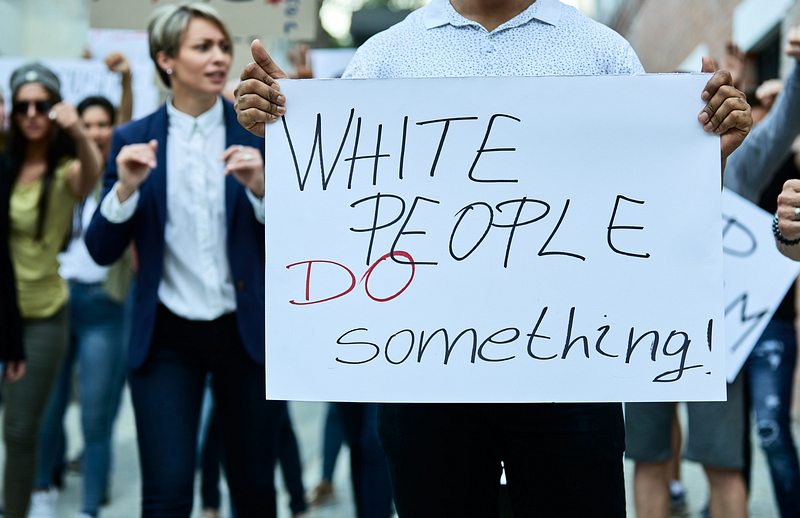
What are some ways whites can disrupt the racial routine?
- Call out your people when they head into racist conversations and statements — e.g. People of Color (POC) are all the same; POC are inherently lazy; POC don’t care about their education; POC are prone to being criminals. It is fundamental that POC are not blamed for the consequences of living in an oppressive society that created the inequities in the first place.
- Encourage your people to better understand the real history of the US, the legacy of colonization, and how your forefathers intentionally created inequity (inequity was built into the very fabric of society).
- Ask your people and family the hard questions — Why do you think there are drastic wealth gaps between whites and BIPOC? Why do you think the majority of professional football coaches and owners are white men? Who holds power in our society? Who holds the least power and why?
- Use your power and privilege to not only speak up for BIPOC and other marginalized groups but use it for action — e.g. make sure that your business, organization, institution, etc. is engaged and committed to equity (and I don’t mean just the one or two BIPOC hires or taking one training on implicit bias!).
- Share your wealth with others and make sure you teach what you know about accumulating wealth
- Invest your money in local BIPOC businesses; use your resources and power to uplift them
I think for a moment what my life and world as a Woman of Color would be like if instead of the typical white racial reactions, whites stopped themselves in their tracks and committed to changed behaviors and responses when race discussions surfaced?
There is no recipe on how to become an accomplice to BIPOC. But, it’s my hope that the suggestions I offered above can help white individuals as they embark on the journey to becoming life-long allies.