
Dear White Allies, Here’s What You Need to Know About Joining the ‘Black Lives Matter’ Movement
Responding to a question asked
A Facebook reader asked a pertinent question in response to an article I wrote a few days ago. He wrote,
If I may ask a question. This line struck me. “Black people did not create this situation we find ourselves in, therefore it cannot be on us to change it.” This makes a lot of sense. I am trying to understand this challenging topic and want to be a part of the solution but often see whites challenged as trying to solve the problem rather than standing back and letting PoCs solve the problem. I think there is some nuance that I”m missing here.
The article he referred to used Bansky’s analogy of the ‘flooded’ apartment as a response to the role of White people in the fight against racism, injustice, and oppression suffered by black people. This article is my attempt to answer his question. I start with a three-part preamble, a bit of background, a three-point answer, some resources, and then ‘ja-ara’. Got it? Let’s begin.
First, analogies
Analogies are not perfect, but they are useful because they engage our imagination and relate things we don’t understand to things that we do understand. It simplifies complex issues without downplaying the complexity or seriousness of the issue being discussed. Bansky’s analogy is described fully in the article that inspired the question, it’s worthwhile reading it first.
Second, definitions
Definitions are pesky. I am a huge believer in one human race. Beneath our skin, our blood runs one color, red. The terms I used to define skin color are meant to help and clarify, not to create any barriers, or cause anyone to feel defensive.
Third, the audience
This question was asked by a white man, so I have written this article assuming my readers to be non-black, anti-racist allies who want to join the fight for justice and equality. I have used ‘we’ in writing these pointers, but I have kept the inquirer foremost in my mind.
Happy? Let’s get started with some background
The analogy depicts two apartments. One with leaking pipes and the other with flooded and damaged items. At first glance, it appears the original article asks ‘white people’ to fix the leak in the apartment, whilst ‘black people’ deal with the repairs to the flood and damage. But life is not that simple. You will need to enter the flooded apartment to investigate the leak and sometimes we have to enter the leaky apartment to confirm the source. We will bump into each other, often crash into each other. There will be arguments, a lack of consensus in solving the problem, some resistance between people working together. That’s life, expect it. But do not let that become a problem in itself, we are on the same side.
Continuing with the analogy, we see the main problem. If the leak is not fixed, the entire apartment block will collapse and we are all screwed. Despite this, people working together to fix the leak may have differing mindsets.
- People enter the flooded apartment thinking ‘I am here to fix their problem, they should be grateful and listen to me.’
- People in the flooded apartment thinking ‘why does he feel he knows more about the leak than I do?’
- People enter the flooded apartment thinking ‘I know where the leaks are, and I’ll show them what they need to do in order to fix the leaks’
- People in the leaky apartment thinking ‘why are they coming here, they must be coming to take what belongs to me or block up my system’
On and on it goes, played out on social media, in corporate organizations, in parliaments, politics, complicated by the diverse viewpoints of people in both apartments.
- Some don’t see a leak
- Some live in the drier parts of the flooded apartment
- Others don’t want the leak fixed.
- Some turn on each other fighting for the best parts of the flooded apartment
- Some put up obstacles motivated by financial gain, power tussles, revenge, anarchy, crime, and more.
- Some blame others in the flooded apartment for causing or worsening the leak
Against this backdrop, the question is asked, ‘How can I, as a white man, join the fight, on what is widely seen as a black problem, without being seen as a white savior?’ The obvious answer given everywhere is ‘educate yourself’ there are several articles, posts, events, and video recommendations all over the internet, I have nothing more to add. Instead here are three useful pointers as you get involved.
1. Expect some discomfort
It’s not going to be an easy nor quick fix. So it’s important that you set your expectations from the start. You will come across situations where you are misunderstood. Either you have not communicated clearly, or the person is not listening. I know, … it does not feel great when your good intentions are challenged. Don’t take it personally, listen, and learn. Really LISTEN to black people when they speak on race, even if it makes you uncomfortable.
As a Product Owner, a key part of my job is knowing when to say ‘no.’ In this fight, a great part of your success is identifying quickly who and what to ignore and how best to ignore them. That’s why I start by listing the different types of people in both apartments. Expect to be challenged. Expect some discomfort. It comes with the territory.
2. Challenge yourself
One thing most of us have to accept is the systematic education that has led us to being unconsciously biased or covertly racist. I’ll give a personal example. Bear with my story in its telling.
As a child growing up in Nigeria following the British system of education. I learned that the British abolished slavery, led by a charismatic and determined politician, William Wilberforce. Somewhere in my little mind, I hailed the British as saviors, a great empire without which I would be a slave today. Coming over to England as an adult I was still entrenched in that way of thinking. At the back of my mind, I knew Britain was involved in the slave trade, I knew black people also fought to end slavery but my mindset still held the British as leading abolitionists, a great and good empire, people to whom I was grateful. Mary Slessor and David Livingstone ranked higher in my consciousness than historical Nigerian heroes and heroines. I was completely indoctrinated as a child.
Arriving in the UK as an educated, articulate, ambitious, confident Nigerian, I did not understand why Caribbean people seemed to have a ‘chip on their shoulder.’ I was not racist towards them, but I had a certain ‘superiority’ in my mindset that was reflected in the way I spoke and the vibes I gave. Non-verbal communication is powerful and reveals our true feeling. Now I look back with an element of shame. It was my colonial mindset that had to be challenged. My history education did not cover the evils of the British empire and their complicity in atrocities. I was taught a whitewashed history, resulting in prejudice against Caribbeans.
That’s my story, and I am Black African! What’s yours? As you read the books and watch documentaries, identify and challenge your preconceived notions, ideas, and judgments.
3. Unlearn behaviors
There is no point in reading books and learning about racism if you continue with the same behavior patterns. I gave a personal story above. Over the years, I have changed my attitude and behavior as a first-generation British -African. Instead of berating my Caribbean brothers and sisters, I listen to them. Instead of being the arrogant articulate African wondering why they do not speak ‘proper’ English, I accept their slangs and do not consider myself better than them. These are behaviors I had to unlearn, what are yours?
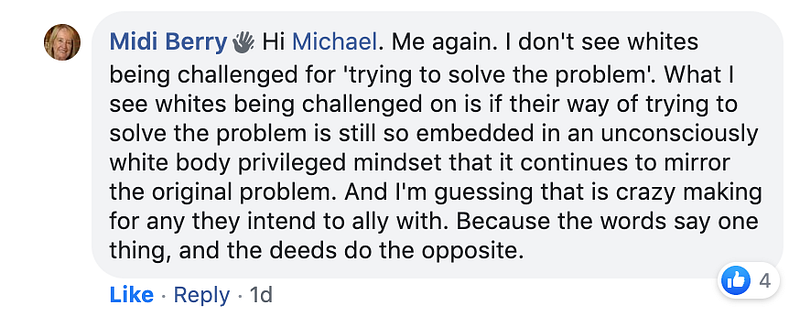
One of the personal battles we all have to fight as ‘good’ people is that we are not as ‘guiltless’ as we think. There are amazing books being recommended that articulate this point better than I ever could and I love this response from another Facebook reader:
Questions answered? Some resources
I know I said I would not share resources, but I can’t help it, here are some links I found helpful.
- A discourse between Akala, Author, Award-winning Rapper and Activist and David Olusoga OBE, Historian and writer.
2. Written by Tim Wise and Inspire Justice (USA)
Here is your ‘Ja-ara’
The work of allyship goes beyond sharing hashtags. It is an ongoing process that will need to continue even after the momentum dies down. So I decided to outline some useful steps culled from the analogy. My ‘ja-ara’. (The concept of ‘Ja-ara’ in Nigeria is giving more than required, similar to a bonus.)
1. Go back upstairs
The single most important action to take after noticing the flooded apartment is to go back upstairs. Rather than inspect the ‘problems faced by black people,’ we ask you to go back in history to the systems and institutions that caused them in the first place. I listened to a podcast by the Hustle is Real crew and they highlighted this point so well in a story.
Five years ago, a white lady had observed racist behavior towards a black colleague but did not do anything about it. In the face of BLM, and plagued with guilt, she recently approached the black colleague and asked for an apology for staying silent. ‘That’s fine, apology accepted,’ the black girl said, ‘but don’t you think it would be more useful to approach the white person and pull them up on their actions?
The visible fallout from the problem is in the black community, but the issue is upstairs.
(Full podcast)
Find the leak
One of the points of contention I find with the ‘passive bystanders’ is the assertion, that we ‘blacks’ want them to do something for us. We want them to give us jobs, give us food, give us validation. No, we do not want anything from you to ‘help’ us. But we ask that you diligently look into, and question the history, the legislation, the decisions, the systems, the politics that have caused the leak. Back to the point everyone makes. Read widely, listen and learn, explore, and uncover. You may need to pull out some cobwebs, rip up floorboards, the bathroom may be out of order for a while. It’s not a walk in the park. But it needs to be done.
Tell others about the leak
There are others in the apartment that do not even know about the leak. They are watching telly and playing cards. Some are eating, others sleeping, some just oblivious to the leak. Not everyone will listen, not everyone cares. But if you believe that the leak is a threat to us as a civilization, then it’s your duty to say something.
You should be prepared to put yourselves out there and to challenge situations where you see injustice or erasure of black people. But it’s not about you or your experience, or your guilt or discomfort, it’s about the flooded apartment and the leaky pipes.
Stop the leak where you have the opportunity
Not everyone has the tools or opportunity to stop the leak. Imagine different sized holes in the pipes. Holes could be issues around police brutality, or how schools teach historical events or pay inequality or racism in football with monkey chants. The inequality and injustice suffered by black people spans from Africa to America, UK, Europe, China, Canada, the Caribbean, and more. It is widespread and complex. Most people are not in a position to tackle some of these ‘bigger’ issues. But you may have an opportunity within your office, your home or your church, or WhatsApp group. Do what you can.
In conclusion
I’ll conclude with the same thought in the first article. The walls in the apartment below are completely soaked. The columns are stressed. If the leak is not stopped, the entire block will come tumbling down. Nuff said.
Notes to the article
Join the discussion on Facebook
Thanks to Race Talk for providing a respectful healthy environment for conversations around race. To Midi Berry, for her insight, Tadiwa Mwamuka and Elo Akin for helping me frame this response. But mostly to Michael for asking the question.
This article was previously published under the title, “Dear Black People, I am Trying to Join in the Fight, but I am Missing Something” I changed it on the 25th of June 2020, to make it clearer to readers.