
De-center Romantic Relationships to Counter the Loneliness Epidemic
Re-centering community is an act of empowerment
Contrary to how films make it look, I don’t want to date someone who says, “you are my world.” This has nothing to do with a fear of commitment, and everything to do with wanting a relationship where we add to each other’s lives without consuming each other’s lives.
We all have those friends who start dating somebody new and suddenly they disappear from the radar. Eventually they begin to show up to the rare thing again, but always with their partner in tow. Sometimes we’re that friend. What modern society has sold us is the idea of a nuclear family, of romance as the centre of our lives, and that romantic love is the most important kind of love.
I cannot help but think that our romantic relationships, and our social relationships in general, have suffered greatly under the negative effects of late-stage capitalism (though this could be said for any economic system that prioritizes labour and social competition). I will discuss late-stage capitalism because that is my context, having only lived in North America. We live in a culture with a scarcity mindset, social isolation, competition, and consumerism as its ideological basis.
What I’m writing about is meant to be a conversational piece. It’s a musing on the state of love and romance in late-stage capitalism, and asks if and how we can benefit from shifting our ways of engaging in relationships of all types.
Social Isolation
The developed world no longer experiences mass famines like throughout history. We are more likely in North America or Europe to die of obesity than starvation, according to prolific scholar Yuval Noah Harari in Homo Deus. But we have overlooked a different type of hunger that is newer and entirely related to the society we have built: the loneliness epidemic.
Majoring in religion and anthropology in university showed me glimpses of cultures and times in history where our social lives looked incredibly different. Throughout history, until the modern era, people tended to live in smaller, more collective communities. We relied on our friends, family, and neighbours more often for help with various things. Churches, mosques, and temples were community centres that played as much of a social function as a spiritual one.
But something intriguing has been happening over the past century. Our social world has steadily shrunk as we imagined the white picket fence home in the suburbs as an ideal to strive for. A married couple and two kids, both parents working and probably having a car. Homes got larger but families got smaller. Young people moved out sooner, and the ideal of a single working career person was to buy a condo and live alone. Work became our social hub, and our reliance upon others shrunk as we bought services from businesses to do more and more for us.
Now we live in a society where the only person many of us truly rely on is our romantic partner, if we have one. Conversations around romantic co-dependency have entered the chat, and though it is anecdotal, I have many friends who struggle to make or maintain friendships when they become partnered.
During the pandemic I lived through lockdown with my ex, who was quickly, albeit unintentionally, becoming “my world.” The fierce Quebec lockdown and curfew meant that we couldn’t have friends over, couldn’t gather socially outside of the home, and were not allowed to leave our homes after 8pm.
We were both fairly introverted, but still struggled. I had maintained a healthy social life until that point, but as I grew restless, my partner and I struggled with being “everything” for one another. There were certain hobbies we didn’t share, shows we would watch with other people, and even friends we relied on for things that we wouldn’t necessarily get from one another. I was in a romantic relationship but I was lonely.
This pandemic microcosm of social isolation served to expose the cultural loneliness that many of us had already been feeling. Others, like me, experienced it for the first time in years. It also showed us how work and romantic relationships had become the centre of our universe.
A lot of people enter romantic relationships because they are lonely, often leading to co-dependence. But how can we be blamed, when our culture has emphasized work identities and idealized romantic love in such a way? We cannot romance our way out of loneliness, we need a community for that.
Scarcity Mindset
I have a few friends who are polyamorous. While it’s not my lifestyle choice (I’m just too lazy, I often joke) I have learned an incredible amount about love and communication from these friends. One of the big premises of polyamory is that our capitalist culture exists in a “scarcity mindset,” meaning that we have even come to view our romantic lives in such a way. There are natural emotions such as jealousy that arise in almost every relationship, but non-monogamous relationships seek to move past the idea that we only have room to love one person, and if they love somebody else there will not be enough love left for us.*
How often do jealous partners not want their partner to spend so much time with friends, on other hobbies, or away from them? As if time spent with others takes away the romantic love they can offer?
Scarcity mindset works in a financial sense by telling us that we can never have too much money and that there are not enough resources for all people. Scarcity mindset pits us in competition with one another, rather than in community. Our environmental destruction sees us pillage resources as if they are unlimited, and sell them at a cost that suggests they are finite.
Have many of us not come to see love in a similar way? We browse dating apps as if there are an endless supply of possible partners, yet when we dive into a romantic relationship we hold that one person tight as if we will lose them.
Consumerism and the Loss of ‘Third Places’
How many places can we go to be social without spending money? Another factor that hurts our social lives is consumerism. We imagine teenagers hanging in mall food courts, adults meetings at pottery classes and yoga, dates happening in restaurants. More and more people struggle to have a social life in the constraints of the increasing costs of living. Salaries are not on par with inflation, so many of us in the working class have had to get more creative with spending social time.
The ‘Third Place’ is a concept used in sociology to explore social settings that are not at work, home, or school. In these spaces, we find our community in casual ways. There is a lot of research that correlates the loss of free (or very cheap) third places to the loneliness epidemic.
It makes sense under certain economic conditions that many people are more lonely. If we are partnered and broke, we might find ourselves spending more time at home with our partner.
Perhaps we don’t mean for our partner to be our world, but our financial situation has made it harder to find and connect with others socially.
Recentering Community
A lot of my friends are trying to make more friends. In a way, this feels like an uphill battle in our modern society. We must navigate building friendships alongside jobs that take up most of our time, juggle romantic partnerships with friendships in a temporal scarcity mindset, and find ways to meet others and build friendships that don’t break the bank. Add in that many people feel too shy/introverted or don’t consider it easy to make new friends (especially for my neurodivergent friends).
Re-centering community is a resistance against the negative effects of late-stage capitalism. We are tired, lonely, and many of us increasingly poor.
What if we had larger social networks that meant we could exchange more of our skills and services, saving money and creating opportunities to build relationships and bond?
What if we intentionally set aside time for friendships like we do for our romantic lives? Or set aside time to try and build new friendships? What if jobs gave us time for this?
What if we invested more time and money in free ‘Third Places,’ such as community centres, co-op organizations, and other grassroots spaces?
In what other ways could re-centering community help us counter our collective loneliness?
We are human beings who have, in the so-called Anthropocene, forgotten how to be social beings. I am convinced that we must begin to engage in a process of un-learning and re-learning healthy community relationships. When we left religious institutions, we did not replace them with other types of third places and intentional community. Even modern new age spirituality is inherently self-focused, with the bulk of books focused on personal growth, enlightenment, and manifesting wealth and health.
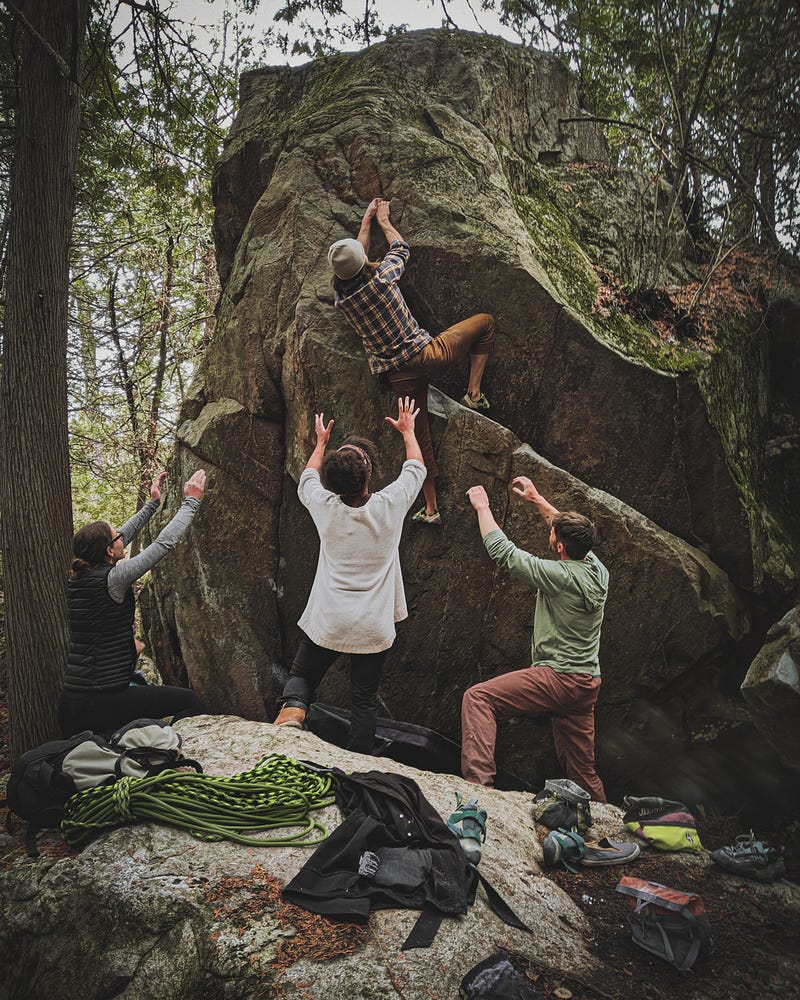
Making a conscious choice to never make my romantic partner “my world” was one of the best decisions I ever made. I volunteered and made friends in those settings. I always kept time for tea with friends. I maintained my own hobbies the best I could, depending on my finances. I have known loneliness and I have known true community.
My whole community is my whole world.
*A lot of people have the misconception that polyamory is just about sleeping with anyone you want. But for my friends who navigate it successfully, it actually takes a lot of communication, care, and self-awareness. You need to consider your feelings, and the needs and feelings of anyone you date. Jealousy is openly discussed, as are the things you need in order to feel loved and valued.