
After My First Hit of Meth: 42nd Street was a Struggle
Slammed: a Memoir — Chapter 2 Part 4
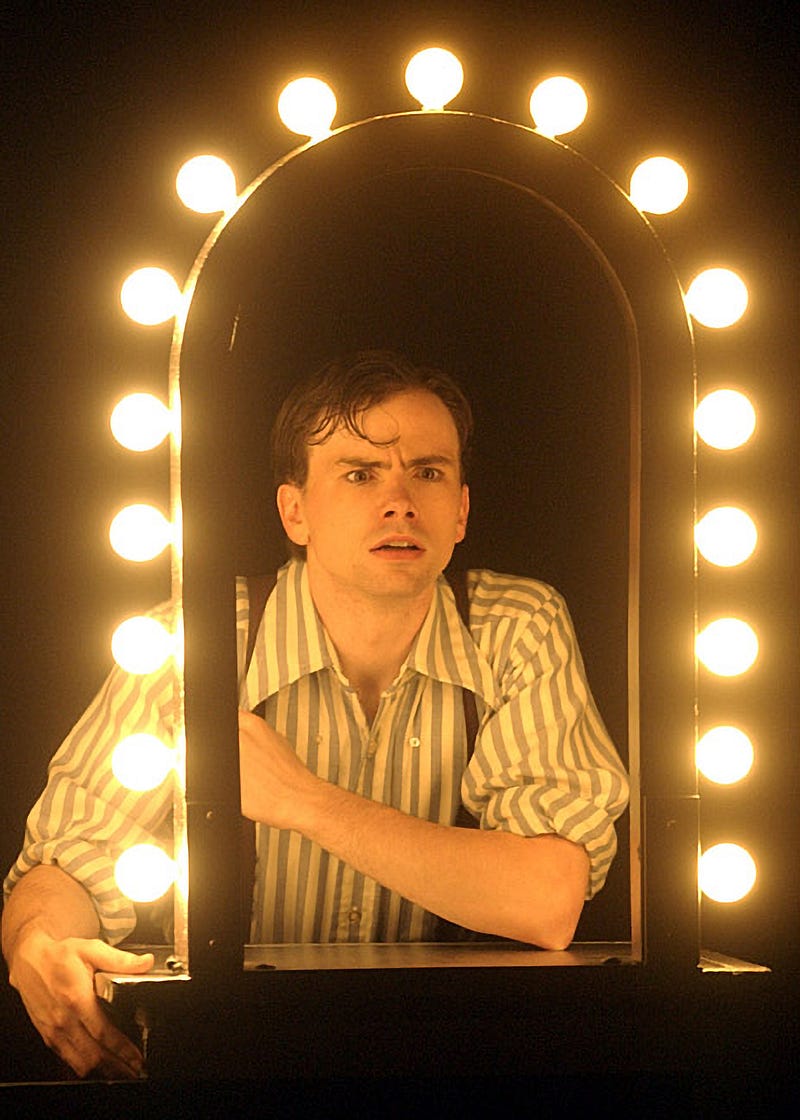
STOMP brush hop falap falap step STOMP brush hop falap falap step.
The company of 42nd Street began the opening number.
It was 10 o’clock in the morning, and we were in the center of a local mall dancing on a raised platform in front of a JC Penney.
STOMP brush hop falap falap step STOMP brush hop falap falap step.
The hollow platform turned the normally sharp, controlled sound of twenty tap dancers into the Overture of 1812.
And I was still a little drunk.
STOMP brush hop shuffle step falap step.
I was hungover and I was still a little drunk.
STOMP brush hop shuffle step falap step.
Opening night the previous evening had been followed by the opening night party, and I got hammered. I mean, I wasn’t the only one. But I was the only one who drunkenly made out with…someone? The music director? Maybe? I got back to cast housing three hours before we had to be up and at ’em for some tap-dancing PR.
Thankfully, I kept up with the rest of the company, though it felt like my blood had been replaced with lead and my head was both in a vise and submerged in a vat of Italian wedding soup.
Finally, step SCUFF step step SCUFF, POSE!
We held our final pose gasping for air through big bright smiles as the crowd applauded around their shopping bags and Orange Julius drinks. When we broke the pose and made our way off the platform I was still holding up my own performance, trying to be light and pleasant while my innards churned and my brain felt like it was sloshing around in motor oil.
I stood next to the show’s director and watched the principals begin their numbers.
He crinkled his nose. “Oh, honey, you smell like booze and sweat,” he said as he gently but purposefully pushed me away. “Go stand over there.”
I had auditioned for 42nd Street thinking I was a pretty sure bet to be cast. The director had been my audition teacher and the choreographer had been my tap teacher at AMDA. Though I wasn’t really a dancer (but you couldn’t tell me that) I was a decent tapper able to pick up tap choreography fairly quickly and cleanly.
I also knew how to turn on that AMDA “light.” That “light” that telegraphs “I am friendly, I am pleasant, I am obedient,” and the director for 42nd Street had been the one who taught me that “light.”
I also knew how to stand out at dance calls. What I lacked in formal training I made up for with character. Doesn’t matter how well you dance the steps if there’s nothing going on on your face. You’re always a character who’s dancing for a reason. In New York City, anyone can dance, just like anyone can sing, but can you tell a story? That I knew how to do. Even if my dancing wasn’t perfect — and it usually wasn’t — it was often good enough to get me asked to stay and sing.
I hardly ever went to singer calls, which, looking back, was ridiculous since I was first and foremost a singer. Yet I believed going to dance calls was a better bet. At a dance call, I spent an hour or more in the room at least. That’s a lot of time to make an impression. For a singer call I got 16 bars of music, maybe a minute, and I didn’t think I was interesting enough to be castable in a minute or less.
But I knew how to work a dance call, especially for a tap show. So I turned on that “light,” played my safe bet, and got the job.
When we all gathered in the rehearsal room for our first choreography rehearsal, I had only just felt back to normal. It had barely been a couple days since I smoked Tina, since Henry had opened and then slammed the door, since Jerry had fed me over and over from his pipe, since 36 hours of fragmented euphoria and a swollen lower lip.
My lip still hurt, but thankfully the swelling had gone down, and my body felt like a Raggedy Anne doll now that it was no longer tense and bracing.
The room was abuzz with the sound of tap shoes, like a ton of small rocks rolling and bouncing downhill. I finished tying my tap shoes and took a spot in the room facing the mirror. I looked down at my feet and scuffed the black marley floor a couple of times.
Suddenly my throat tightened up and my eyes welled. Caught off guard, I pressed my lips together hard, blocking a sob from exploding past my throat. Though I hadn’t realized it, the last few days had really scared me. I hadn’t come close to actually processing everything that happened — I wouldn’t start to do that for a few years yet — but in that moment, standing in that rehearsal room in my tap shoes, the pianist running though music, the company all buzzing and chirping and tapping around me, for the first time in days, I felt safe.
Rather than draw attention by being a blubbering mess, however, I quickly swallowed it down and turned on that AMDA light real fucking bright.
“John, you’re not a dancer.”
It was intermission. We were halfway through the six week run. The stage manager felt inspired to impart this wisdom while we smoked our cigarettes outside the stage door. She was a short woman with a boy cut of jet black hair. Her forearms were sheathed in bracelets, beads, and bangles that clinked and clacked as she dragged on her cigarette. As captain of the ship, she carried the commanding authority all good stage managers have. In this moment she was showing a maternal side as well as she imparted this bit of tough love.
“You work real hard. You’re fun to watch. You’re a great guy, but, my dear, you’re not a dancer.”
This was true, though I couldn’t admit it. Something in my time at AMDA had convinced me that if I wasn’t a Triple Threat — Singer, Actor, Dancer — then I didn’t have a chance. However, I believed since I had been cast in dance shows like Crazy for You and 42nd Street, then I was in fact a dancer and, therefore, a Triple Threat.
But, honestly, I wasn’t. Even in my denial, I could feel it. I wasn’t a capital “D” dancer. I didn’t have the training. I didn’t have the carriage. I didn’t have the air.
Every night as I took my place backstage for the finale, just behind the proscenium curtain of this professional theater, dressed as a soldier on leave in New York City, I was equally excited and scared. Excited to perform a complex and exciting full company number, but scared I would somehow fall out of the choreography and not be able to get back on, sticking out like a sore thumb during the climax.
I never did fall out, thankfully. I never really felt like I nailed it perfectly, but I still believed I was doing at least ok.
Maybe I wasn’t.
I could tell the stage manager was trying to get this message through to me, perhaps so I didn’t waste my career leading with my weakest ability. I thanked her and replied something about “working harder” or some such. I was aware I wasn’t the best dancer, but I believed I was doing my best and executing the job I was hired to do.
Besides, I had other things on my mind.
I had one thing on my mind.
I had Tina, that white smoke, on my mind.
“Anyone going for a drink after the show?” I asked.
Quiet “noes” and shakes of the head came from the few other smokers in the company.
The stage manager finished her cigarette and headed back inside. “Five minutes to places.”
“Thank you five,” we responded in unison.
Next Chapter
Chapter Guide
A lot of heart, time, and work goes into each piece. One way you can support me is by signing up for a $5/month Medium Membership. Use this like and I’ll get a percentage of your subscription fee. Huzzah for supporting artists!
If the spirit moves you, another way you can support me is by leaving me a tip. Thank you for reading!


