
Day in the Life of a CS Major at the University of Washington
All about computer science classes, research opportunities, clubs, and the social scene at UW
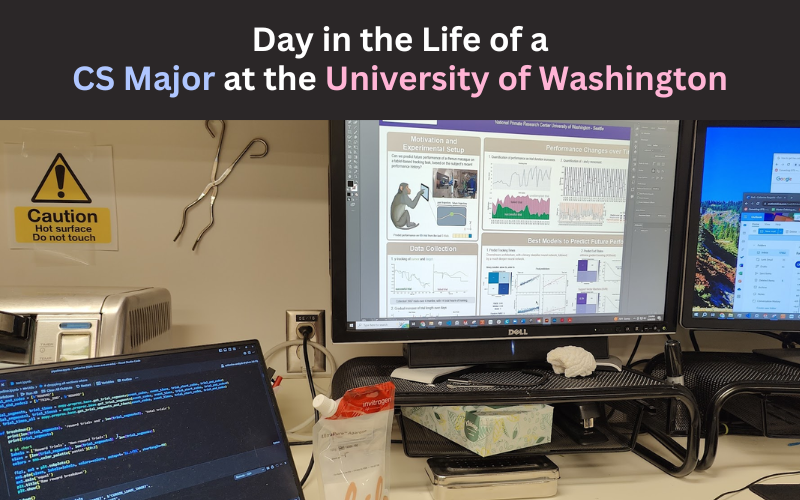
Hey there! I’m Catherine, a Computer Science major at the University of Washington. I just finished my first year at the university, and I thought it would be helpful to document and share my experience! Hopefully, this post will serve as a personal record while also offering valuable insights for prospective students who happen to come across it.
A little context
Prior to UW, I was enrolled in the Running Start program at Highline College. This program allowed me to earn an Associate’s of Science in Computer Science and complete UW’s 12X introductory programming series during high school. Additionally, between all my Running Start credits and AP classes, I was able to finish most of my general education requirements before ever starting at UW.
I mention this because, even though I’m a freshman, I’m actually a senior by credits! This means that my course load may look a little different than what you expect. (On a side note, I had a really great experience with the Running Start program. I would highly recommend the program to any high schoolers planning to go to an in-state school.)
Course load
Here’s what my class schedule looked like:
Autumn 2022:
- CSE 311: Foundations of Computing I
I never considered myself a “math person,” but I really enjoyed this class! It was the first part of a two-part series on discrete math, and it focused on logic and proofs. Our homeworks were just math problems, but I found that I could apply what I was learning to my research work outside of class. For example, I used a finite state machine to model and extract states in a simple “game” for the Orsborn Lab.
I also thought it was really cool that our professors built software tools to run simulations and collect homework answers. For instance, we had a custom site to aid in constructing DFA/NFAs and checking what expressions they accepted.
Thinking about this course brings up another really fond memory. I recall my friends and I sneaking into the main lecture hall sometime after midnight to study for the final exam. We played Kill Bill by SZA on repeat through the speakers, while setting up different questions on the projectors and scribbling proofs on the whiteboards. Afterwards, my friends and I went to Aladdin’s for the first time, a popular gyro place that I’ve visited several times since.
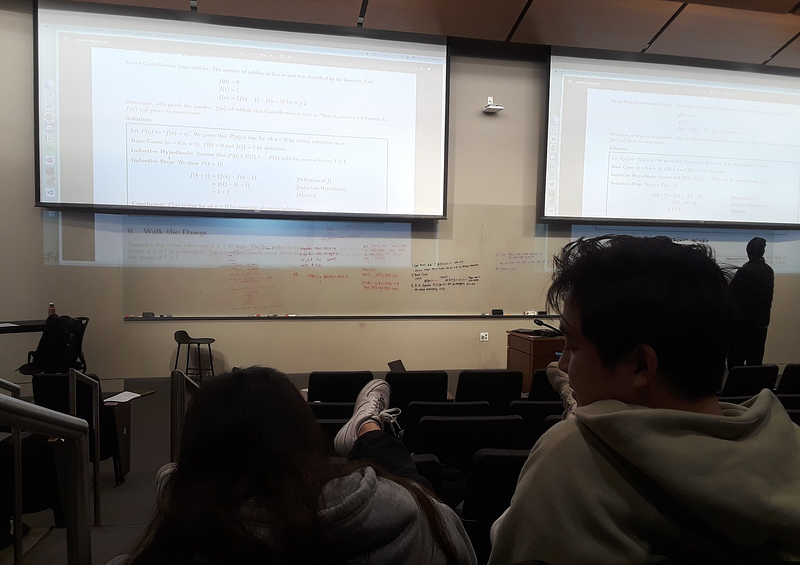
To prepare for the midterm, I also enjoyed writing and recording a rap song all about logical equivalencies and logic gates. (This was just for fun — not an assignment.)
- CSE 351: The Hardware/Software Interface
CSE 351 was not my cup of tea, with its heavy focus on hardware and low-level computer operations. Frankly, these topics have never really interested me. As the quarter progressed, I found myself grappling with the material, seeking frequent one-on-one sessions with the TAs just to keep up. Thankfully, the exams were take-home, which was a welcomed relief!
In terms of workload, it was manageable overall. We had brief fill-in-the-blank homework assignments due every day, along with more substantial programming projects due biweekly. The majority of our work centered around C programming, which was a new experience for me. We dabbled in writing some Assembly code as well.
One memorable project was defusing a “bomb” by performing a few variants of buffer overflow attacks on it. Our last homework assignment, which took an ungodly amount of time to debug, was building a memory allocator in C.
- CSE 190: Current Topics in CSE
This 1-credit, CR/NC class was recommended for all freshmen, but I didn’t find it very beneficial. It met once a week and was graded solely on attendance.
The focus of the class was mostly non-technical, and we discussed topics like imposter syndrome, mental health, and relevant campus resources. I enjoyed hearing more technical lectures from the occasional guest speaker though.
- MUSIC 120: Survey of Music
Unlike my other classes, MUSIC 120 was remote and not related to my major. I prioritized my CSE classes a bit more, and the class was somewhat redundant for me since I had a musical background already.
However, I did get exposed to new types of music that I hadn’t heard before. I think I’ll still stick to my NCT playlists though. 😜
Winter 2023:
- CSE 312: Foundations of Computing II
This was the second part of the discrete math series, and it focused on statistics. I found it much more challenging than 311, but the content was more relevant to my career goals (machine learning!).
Like 311, our homeworks only consisted of math problems with no programming work. However, due to the difficulty of the problems, I spent most of my free afternoons at office hours, sitting on the floor with my laptop. I’m especially thankful to the TAs (again) and all my study buddies! I’m not sure how I would have survived the class otherwise.
On another note, this was the first time I stopped writing my math homework by hand and started using LaTeX/Overleaf, which revolutionized my workflow.
- CSE 332: Data Structures and Parallelism
CSE 332 is a typical Data Structures and Algorithms (DSA) class, with an added focus on parallelism, concurrency, and synchronization. This results in a very fast-paced curriculum, which is why many other universities split the material into two courses.
In addition to lectures, the class included 15 worksheets and 3 large projects — all of which were in Java. I had not used Java in over a year, so I spent some extra time relearning the language.
Notably, both CSE 332 and CSE 312 had a lot of student complaints about the exams. The CSE 312 midterm was graded on a right-or-wrong basis, with no partial credit. This was frustrating for a math class, as it meant that even a small mistake (like a rounding error) could result in a large loss of points. The CSE 332 midterm also had a low median score, suggesting that it might have been too difficult.
Fortunately, once the professors made some much needed adjustments, I managed to do alright!
- ENGL 200: Reading Literary Forms
I found this literature course, which had the theme “Narratives of Madness”, pretty interesting! Regular readers of my blog will know that I am very curious about the human mind and psychology. As such, this class was the perfect avenue for me to explore the world of “madness” more carefully in an academic setting.
We had lectures everyday, which were graded on attendance and participation. In class, we discussed assigned texts or did group work. We also watched the film Girl, Interrupted. This was extremely fitting since, at the time, I was directing my own film, Paranoia, which also commented on madness.
Spring 2023:
- CSE 446: Machine Learning
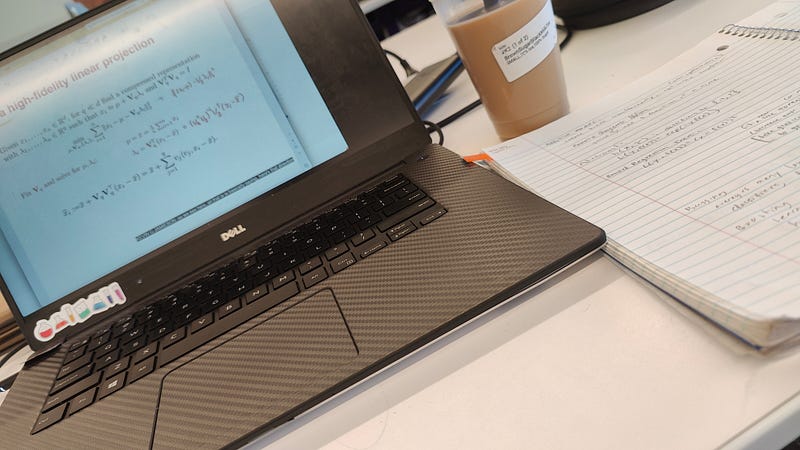
I was super excited for Machine Learning, even though some of my peers dubbed it the “most difficult CS class.” I could see why, with the sheer amount of math involved (calculus, linear algebra, statistics, and even some geometry).
Fortunately, I had a bit of an edge since I was already familiar with a lot of the high-level concepts. I had also used Python and the relevant libraries (numpy, pandas, Pytorch) for personal projects beforehand.
The biweekly problem sets were challenging nonetheless, with both written/math and programming portions. Because of my procrastination habits, I often found myself starting the assignments just a few days before the deadline. This led to countless late nights spent in the Allen basement, where I would fuel my coding sessions with treats from Snack Overflow, the basement’s treasured snack stash.
The content of the homeworks themselves were lengthy, especially the programming parts. We had to develop algorithms like gradient descent, write training and hyperparameter tuning scripts, and build models such as neural networks from scratch. In the last assignment, one problem tasked us with constructing a movie recommendation system, achieving a specific level of accuracy, and plotting the results.
Before the course ended, I asked my professors about other classes I could take to continue exploring this field. Here’s the list I compiled: Artificial Intelligence, Deep Learning, Reinforcement Learning, Convex Optimization, and Natural Language Processing. While looking through the complete CSE course list, I also added AI-based Mobile Robotics to my course wishlist!
- CSE 331: Software Design and Implementation
The curriculum for CSE 331 was brand new this quarter, so I felt a bit like a guinea pig. I had taken CSE 311 with the same professor though, and having enjoyed his teaching style, I was confident that I would be in good hands.
As expected, the content of the class was really interesting. Being a big hackathon enthusiast, I was excited to learn more about building practical software applications.
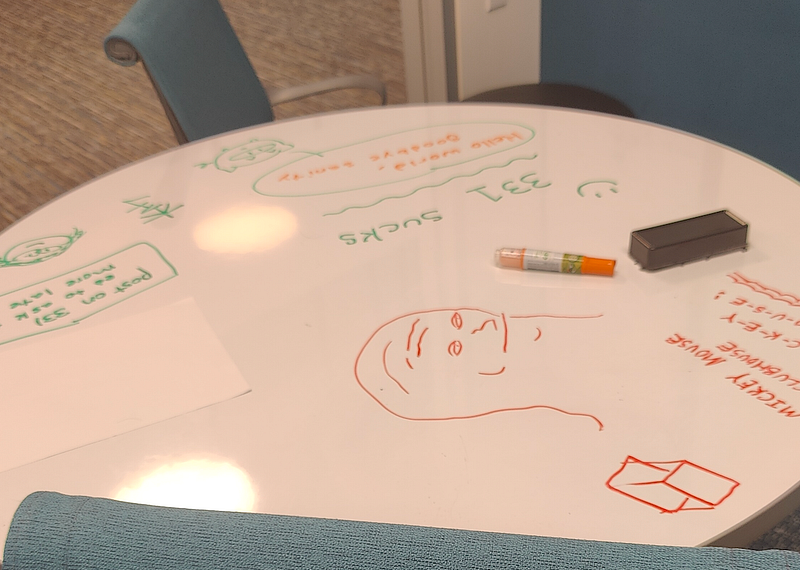
Like CSE 446, our homework had a written portion (mostly proofs) as well as a programming portion! Our last assignment was to build a Fantasy Football app from scratch, just from a short description of the app’s functionality and screenshots of the UI. I worked on it for ~2.5 days straight, save for showering and the occasional Cup of Noodles.
- BIOL 130: Introduction to Neuroscience
I took this class for fun! It didn’t fulfill any credit requirements, but I was inspired by my research work in the Orsborn Lab to learn a bit more about neuroscience.
Our final project was to present a research paper of our choice and connect it to the class material. I chose to present a paper on a novel brain-to-brain interface developed at the University of Washington. The experiment allows three people to collaborate in a game of Tetris, communicating only via neural signals.
Moreover, because of this course and my other extra curriculars, I am now considering a double major in computer science and neuroscience.
Clubs
I don’t spend all my time doing classwork! In fact, the majority of my time is spent doing research or club activities. In order of my involvement, here are the clubs that I dedicate my time to:
#1 Synaptech
Synaptech is a neurotechnology and engineering RSO (registered student organization). We are involved in both theory and hands-on projects, with a focus on neural engineering, computational neuroscience, and neuroethics.
Within the club, I am involved in two different project groups:
a) Smart Music: a NLP based approach to generate original music compositions in a user’s preferred musical style, based on the user’s neural (EEG) feedback
b) fMRI Project: analyzing changes in the default mode network based on a sample population’s fMRI imaging and survey responses
Besides working on these projects, Synaptech hosts journal club meetings where we go over exciting and novel papers. Other fun events include hackathons with the Center for Neurotechnology (I won Best in Technological Innovation this year!) and occasional technical workshops.
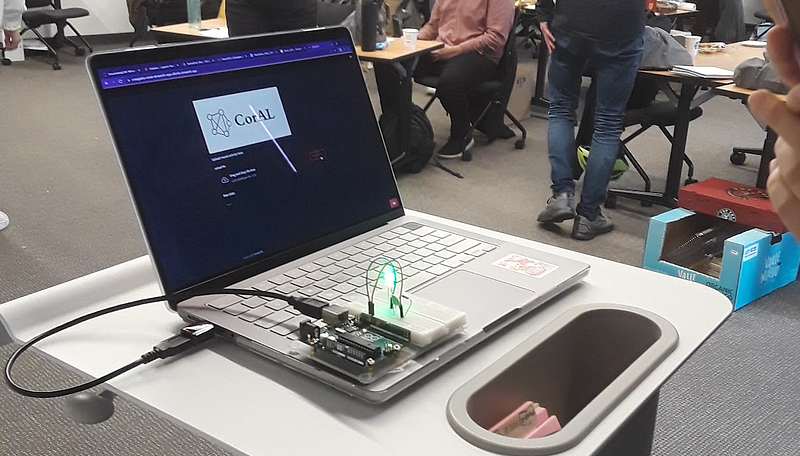
I am especially excited to mention that I was elected as Synaptech’s new President for the 2023–2024 year. During my presidency, I’m hoping to create and teach more tutorial-based meetings about select topics in signal processing, artificial intelligence, and neuroanatomy.
#2 LUX Film Production Club
Next, I am a very active member of LUX, UW’s film production club. Each quarter, I work on developing a new short film. Here’s my current film portfolio:
a) Fall: “Use Case”, Drama, dir. Jonny Kwan
Role: Camera operator
Logline: Although she seems happy to help her friends, Taylor is crumbling under her belief that her friendships are merely transactional relationships.
Notes: This was my first ever production, so it was a super informative experience! I learned a lot about the duties of different crew members, how to operate a camera, and the process of making a film. One of my favorite scenes to shoot was a dolly zoom, which involved a few rolls of duct tape, a table, a couple of mirrors, a tripod on wheels, and a lot of hands!
b) Winter: “Paranoia”, Horror, dir. Catherine Rasgaitis (me)
Role: Director, screenwriter
Logline: A woman becomes increasingly convinced that she is being followed, but her therapist dismisses her claims, concealing his own stalkerish habits.
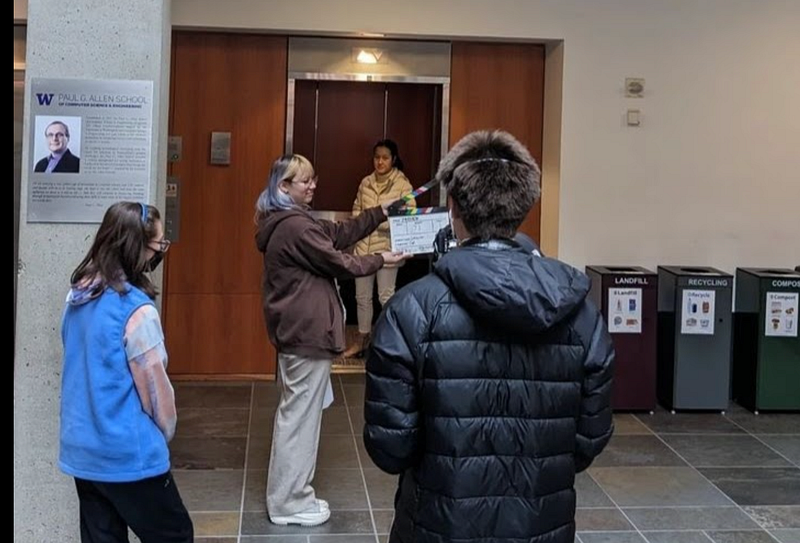
Notes: Writing and directing my second film was a completely new experience for me. Along with other aspiring screenwriters, I had to submit a finished script and pitch my idea to the club. Fortunately, my project was one of the most voted for, and I was able to bring my vision to life.
One of the biggest struggles in actually making the film was gathering all the necessary equipment and finding locations to shoot in. Eventually, I was able to scrape together enough equipment from other LUX members. However, I also had to coordinate shoot times between their availability, the availability of my own cast and crew, and the availability of the locations that I wanted to use.
One of the locations I used was the Allen Building’s “diversity room” (the therapist office). Since it is not possible to reserve the room, I brought a sleeping bag and slept in the room overnight to ensure that I could “mark my territory” and use it to shoot in the following morning.
In fact, during the screening of Paranoia, my sleeping bag made a second appearance. This was because I had to stay up and finish a CSE 312 assignment right after the showing. It was pretty hectic, but a memory I will cherish! It was incredible to watch a simple image in my head evolve into a real, finished film on the big screen.
c) Spring: “From the Depths of Space”, Horror, dir. Adrian Fleuchaus
Role: Gaffer
Logline: When a young woman is invited to a dinner party by old friends, she must navigate a night of manipulation and evil secrets to save herself.
Notes: Between the three films, I think this was the largest-scale production I worked on. We had an entire Airbnb reserved along with some extremely cool special effects, including a moving tentacle!
As a gaffer, one of the most memorable scenes I set up was in a bedroom. I had to black out the windows with black cut-up garbage bags and light the room with multicolored gels, using diffusers in different locations for each shot.
Because of the bright spring weather, another memorable moment was creating a contraption to block unwanted sunlight. Along with the DP (Director of Photography), I used an ensemble of tripods and a boom pole to hang a blanket from. We also propped up a couple of flags on top of this, and successfully prevented any light from streaming in through the window.
More on my LUX involvement…
Besides making new films, I’m a pretty regular attendee at general meetings. At LUX, these meetings take many forms but are always informational! One of my favorite meetings was a cool lighting workshop with a very in depth (and comical!) demo.
Sadly, my attendance dropped a bit during spring quarter when my homework deadlines coincided with meeting times.
#3 SPACE
As a recipient of the Washington NASA Space Grant scholarship, I was invited to join SPACE, a community of astronomy and space science enthusiasts! Most club members are in various engineering disciplines (predominantly aerospace), but there’s a few other CS majors too.
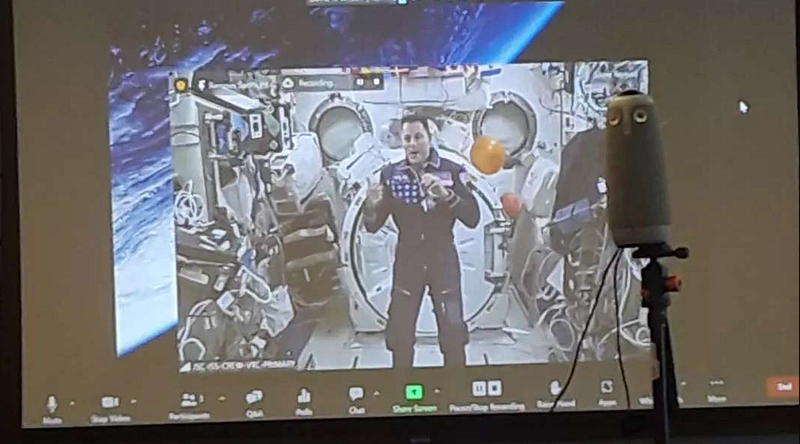
I attend a lot of SPACE’s special events. My favorite event was getting to talk to an astronaut (live) on the ISS. Also, the event had free food!
#4 Interactive Intelligence (I²)
This is a really fun club about all things artificial intelligence. In particular, I² takes an approach of building artificial intelligence that mimics the brain as closely as possible. I used to attend every journal club meeting, but it became tough to stay so consistent once I joined a second research lab.
Next year, I plan to ramp up my involvement! Especially as I’m starting to lead Synaptech, there may be cool opportunities of collaboration between the two clubs!
#5 Computing Community (COM²)
COM² is probably the largest CSE related RSO on campus. They are responsible for keeping the aforementioned Snack Overflow stocked with goodies.
This year, I was a Little in COM²’s Big-Little mentorship program. The mentorship was informal, and it was fun getting to know other students. I also participated in a few of COM²’s social events, such as the Fall Fest party.
Research
I have been a part of two research labs: the Orsborn Lab and the Behavioral Ecophysics Lab. In both groups, I work on data science and machine learning tasks.
a) Orsborn Lab (Fall — present)
I won’t be divulging too many details on my work for the Orsborn Lab, but I can share the gist of it! The Orsborn Lab primarily works on the development of therapeutic neural interfaces. In particular, I have been working on a project to analyze the motor learning of non-human primates (monkeys).
One of my highlights from working in the lab was presenting my work at the Allen School Undergraduate and Master’s Research Showcase. My project, “Using Machine Learning to Forecast Non-Human Primate Motor Performance,” was about automating the training regiment for subjects learning a motor task. My work was met with a lot of interest and I ended up being voted second for the People’s Choice Award. By the end of the event, I actually lost my voice from answering so many questions and explaining my project!
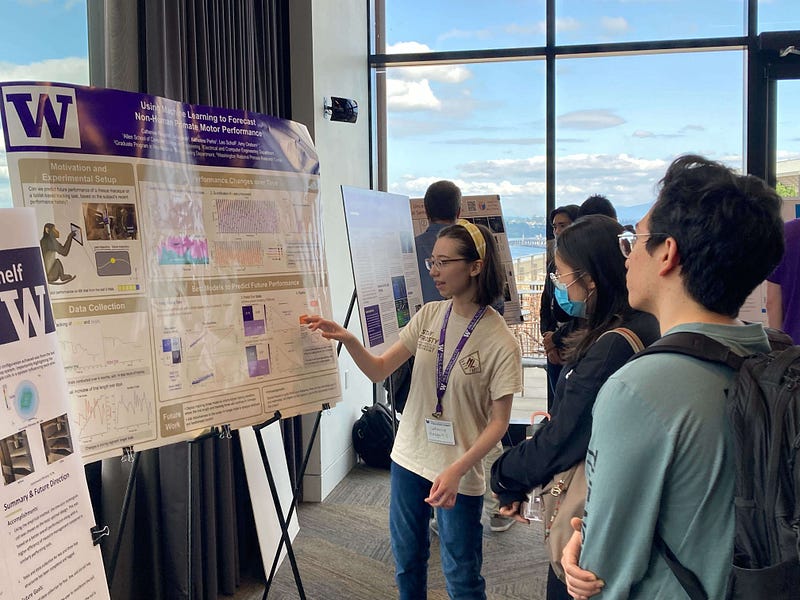
Over the summer, I will be improving and deploying the machine learning model I developed so that it can be used regularly in the lab. I will also be contributing to a paper about the subject’s performance on the task.
b) Behavioral Ecophysics Lab (Spring-present)
I have been working in Behavioral Ecophysics for just over one quarter. Through the lab, I have had the opportunity to explore the world of computer vision within the realm of biology!
The project I have been working on involves a collection of several months’ of GoPro footage. My assignment is to autonomously identify videos containing birds and mark the timestamps of their appearances within the camera’s frame. To do this, I leveraged a motion detection program to find relevant frames in each video clip before manually labelling a dataset (with the help of other students) as having a bird or not.
Once I had a complete dataset, I wrote a script to build a folder system that reorganized the images and generated CSV files with pertinent information and image labels. To address the limited number of frames with birds, I augmented the dataset with synthetic data by extracting and inserting birds into the backgrounds of bird-deficient frames.
Over the summer, I’m working on improving this data augmentation pipeline and looking into how I might count the number of flowers each bird probes within an individual video clip.
Social scene
In terms of the social life at UW, Seattle has a reputation for having fairly antisocial residents. During freshman orientation, I was introduced to the term Seattle Freeze. Wikipedia defines this phenomenon as “a difficulty with making new friends [in Seattle,] particularly for transplants from other areas.”
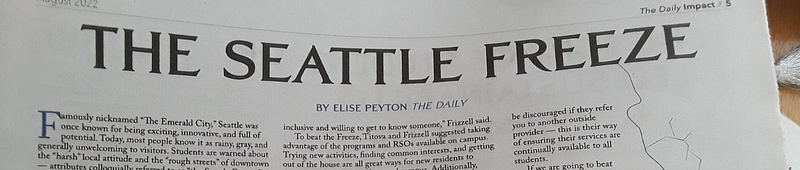
I did not experience the Seattle Freeze personally, thanks in part to my pre-existing friend group from Running Start. We were all in the CS major and taking most of the same classes at UW, so it was easy to socialize and stay connected. Long study sessions and going out to eat on the Ave (a popular stretch of restaurants on University Way) were regular parts of our weekly activities.
All the club activities I mentioned also provided me with another avenue to meet new people and expand my social circles!
Beyond that though, my favorite pastime is attending hackathons. Besides gaining new technical skills and building cool projects, hackathons have a very fun social aspect! Sadly, since college keeps me pretty busy, I can’t attend as many as I used to. Still, I enjoy participating in events whenever I can.
In no particular order, here is my hackathon history (and corresponding projects) from Fall 2022 — Spring 2023:
- Tree Hacks @ Stanford (Pocket Plots)
- Dub Hacks @ UW (AQI Don’t Wanna Die)
- HackSEA @ Amazon Bellevue Offices (Spruced Up)
- NeuroTEC Hackathon @ UW Center for Neurotechnology (CorAL)
- SWE Hacks @ UW (Music Mood)
- Hack Around the World 2 by MLH (Friend Flow)
- Learning Equality — Curriculum Recommendations (this was actually a Kaggle competition)
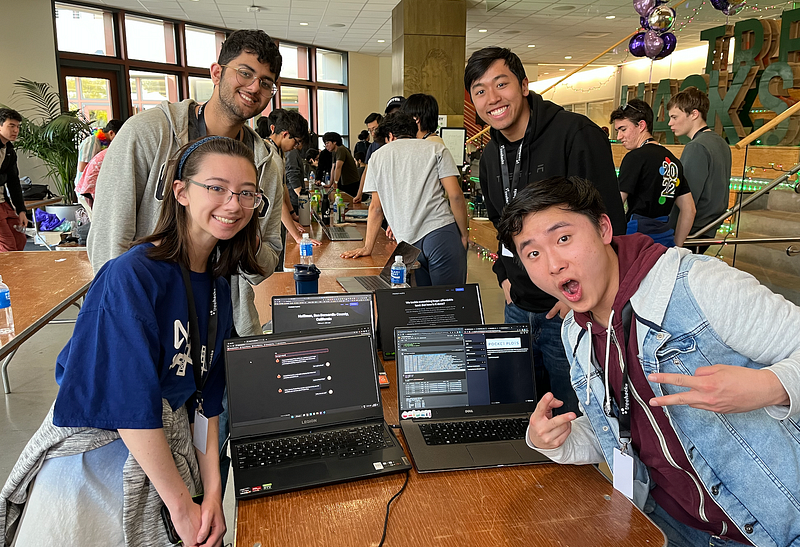
You can read more about my hackathon experiences in an upcoming article!
A day/week in the life
Here’s a sample schedule of one week in my life. It’s somewhat color coded with dark blue for classes and hackathons, green for Orsborn (Monkey) Lab, yellow for Behavioral Ecophysics (Honeyeater) Lab, pink for Synaptech, orange for Interactive Intelligence, light blue for LUX, and gray for miscellaneous events.
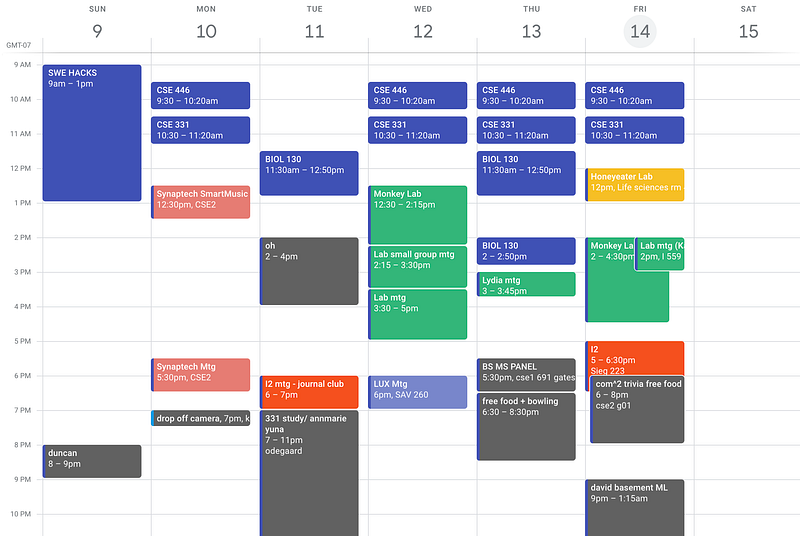
It’s safe to say that every day looks different from the last!
Future
My UW journey is still far from over.
I am currently spending the summer as an AI Intern at NASA Jet Propulsion Laboratory. Together with two other interns, I am using reinforcement learning to develop a new approach to scheduling missions on the Deep Space Network. The problem I am working on is relatively challenging, comparable to the Vehicle Routing Problems with Time Windows (NP-hard), but with even more constraints.
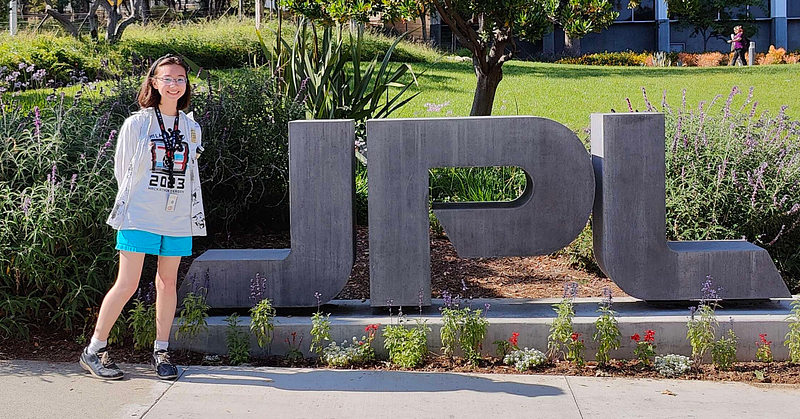
Besides working in my office, there are lots of other activities JPL has for interns to participate in! I get to attend lectures about topics such as the future of deep space exploration, Mars missions, etc. and I occasionally go to dodgeball practice after work! I’m especially looking forward to participating in the Aerospace Games, where various aerospace companies in the Los Angeles area compete in beach sport events.
While I’m at JPL, I’m living with a friend (who I met through a hackathon!) and checking out nearby museums and other attractions together. Some of my adventure highlights include going to the Norton Simon Museum and watching fireworks at the Garden Café. Every weekend, there’s something new to explore!
When school reopens in the fall, I look forward to taking more CS classes in the domain of AI. I also hope to pursue the combined BS/MS pathway and explore possibilities of a double major!