
Day 5 — Machine Learning System Design: a video recommendation system
Let’s talk about the problem statement and metrics for building a video recommendation system.

Problem Statement
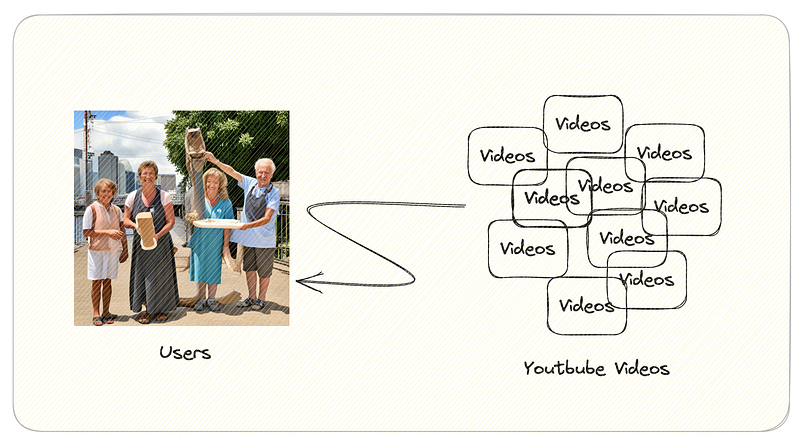
Develop a recommendation system for YouTube users to boost engagement and expose them to a variety of content. In response to the ever-growing demand for personalized content, our objective is to design and implement a comprehensive and advanced recommendation system specifically tailored for YouTube audiences. Through this system, we aim to achieve multiple goals: firstly, to significantly boost user engagement by offering content that resonates with individual preferences; secondly, to diversify the content landscape by introducing viewers to a broad spectrum of videos they might not have otherwise discovered. By achieving these dual objectives, we believe that we can elevate and enrich the overall viewing experience of every YouTube user.
Metrics design and requirements
Metrics for Evaluating the Recommendation System
To effectively assess the performance and impact of our recommendation system, it’s essential to use both offline and online metrics. These metrics will help us gauge the accuracy and efficiency of the system and its real-world impact on user behavior.
Offline Metrics:
These are metrics that can be calculated without direct user interaction, typically using historical data.
Precision: This metric evaluates the number of relevant recommendations out of the total recommendations made. Higher precision means that more of the recommendations were actually relevant to the user.
Recall: Recall measures the number of relevant recommendations made out of all potential relevant items. A higher recall indicates that the system effectively identifies most of the relevant items for recommendation.
Imagine you have a big toy box full of different toys: teddy bears, toy cars, dolls, and so on. Now, let’s say you really love teddy bears and you ask your friend to find all the teddy bears in the toy box.
After searching, your friend gives you 5 teddy bears. But, when you look inside the toy box yourself, you see there are actually 10 teddy bears in total.
“Recall” is like figuring out how good your friend is at finding all the teddy bears you love. If your friend found all 10 teddy bears, then their “recall” is perfect! But if they only found 5 out of the 10 teddy bears, then their “recall” is only half as good.
So, “Recall” is all about making sure we don’t miss out on the things we really love!
Ranking Loss: Ranking loss evaluates the quality of the ranking of the recommendations. It considers the order in which items are recommended, with the ideal scenario being that more relevant items are ranked higher than less relevant ones.
Log Loss: Logarithmic loss measures the performance of a classification model where the prediction input is a probability value between 0 and 1. It’s a measure of uncertainty, and in the context of recommendation systems, it helps in assessing the confidence of the system’s predictions.
Online Metrics
These metrics are gathered in real-time and require user interaction. They provide direct feedback on how the recommendation system affects user behavior.
A/B Testing: By splitting users into two groups, one exposed to the new recommendation system (treatment group) and the other to the old system or no system (control group), we can directly compare the performance of the recommendation system.
Click Through Rates (CTR): This metric measures the number of clicks a recommendation receives divided by the number of times it’s shown. A higher CTR indicates that the recommendations are resonating with the users.
Watch Time: For a platform like YouTube, the amount of time a user spends watching a recommended video can be a direct indicator of the recommendation’s quality. Longer watch times generally suggest that the content was relevant and engaging.
Conversion Rates: This pertains to the number of users who take a desired action (like subscribing to a channel or liking a video) after viewing a recommendation. Higher conversion rates suggest the recommendations are driving positive user actions.
Recommendation System Requirements
Training Requirements
Adaptive Training: Given the dynamic nature of user behavior and the potential for videos to become viral quickly, our model needs to be adaptable. It’s imperative to capture temporal changes by training the model multiple times throughout the day.
Handling Unpredictability: User behavior, by nature, is unpredictable. The system must be robust enough to cater to diverse and changing preferences.
Inference Requirements
Recommendation Volume: For every user visiting the homepage, the system should provide a set of 100 video recommendations.
Latency Constraints: The recommendation system’s response time is crucial for user experience. The latency for generating recommendations should ideally be under 100ms, with an upper limit of 200ms.
Exploration vs. Exploitation
Balancing Act: While it’s essential to offer users content based on their historical data and preferences (exploitation), the system should also introduce them to new content (exploration). This balance ensures that users are not stuck in a “filter bubble” and have the opportunity to discover fresh content.
Relevancy and Freshness: The recommendations should strike a balance between showing users content that is relevant to their preferences and introducing them to new, potentially viral content. This ensures that users remain engaged and exposed to a diverse range of videos.
These requirements are essential to ensure that the recommendation system is both technically sound and user-centric. By addressing these aspects, the system can provide a tailored and dynamic experience for every YouTube user.


