David Hockney and Ed Ruscha
The Essential L.A. Artists
I would never have thought of linking the superstar artists David Hockney and Ed Ruscha. I would never have remarked on any similarities between the two contemporary living painters, other than the fact that they are two favorites of mine.
And probably two favorites of everyone who follows contemporary art.
When I think of Ruscha, the first notions that come to my mind are of witty painted wordplay, portrayals of quotidian ephemera on canvas, and the use of unusual media. With Hockney, my brain’s imagery is flooded with saturated colors, technological feats, unusual perspective and swimming pools.
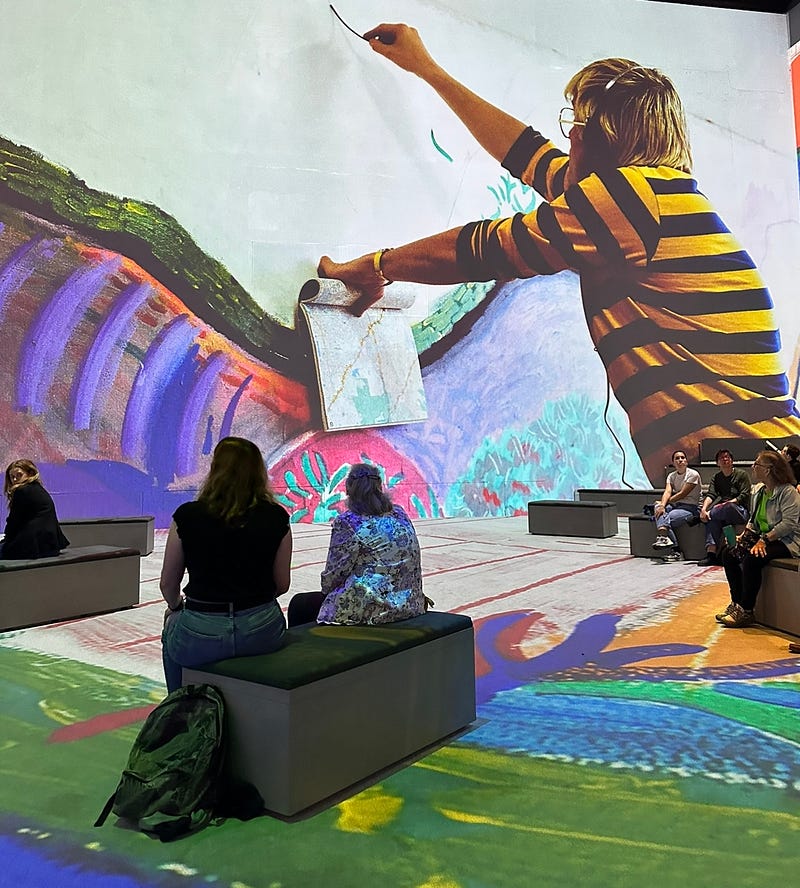
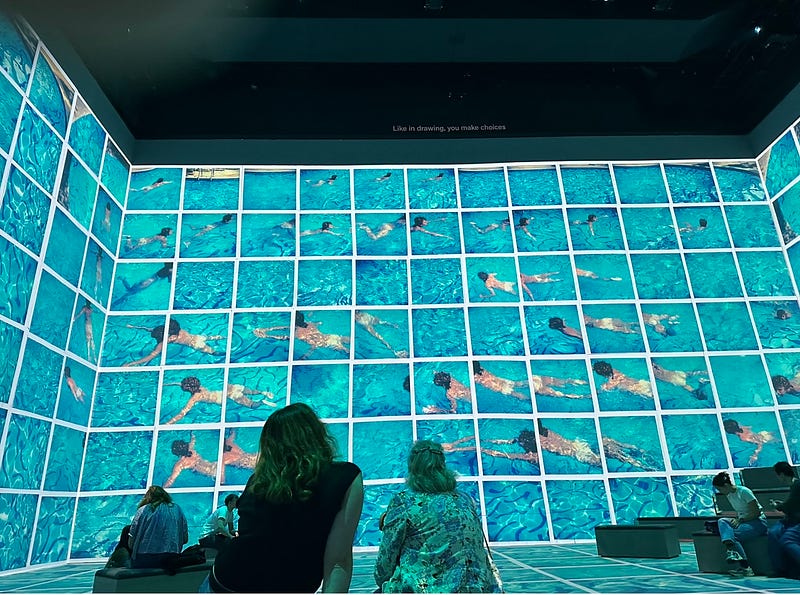
But I happened to visit the Ruscha retrospective last week at New York’s Museum of Modern Art and I also caught the Hockney video-surround immersive installation in London.
And I began to focus on their comparability.
They are exactly the same vintage; Hockey and Ruscha were both born in 1937.
They both are long-time transplanted Los Angelenos. Ruscha arrived from Oklahoma to the City of Angels at age 19 to study at Chouinard Art Institute (Now CalArts), and Hockney, shortly after completing his studies at Bradford College of Art and the Royal College of Art in London, moved from the Atlantic to the Pacific at the age of 26.
Hockney states in his show at London’s exhibition space, The Lightroom in King’s Cross, that when he first visited L.A, not knowing anyone and not knowing how to drive, “Within a week, I got a driver’s license, a car, a studio and a little apartment. I thought, this is the place to be — the land of swimming pools.”
In his voiceover, he also notes that, “No one had painted L.A. so it was unknown visually. I was attracted to that.”
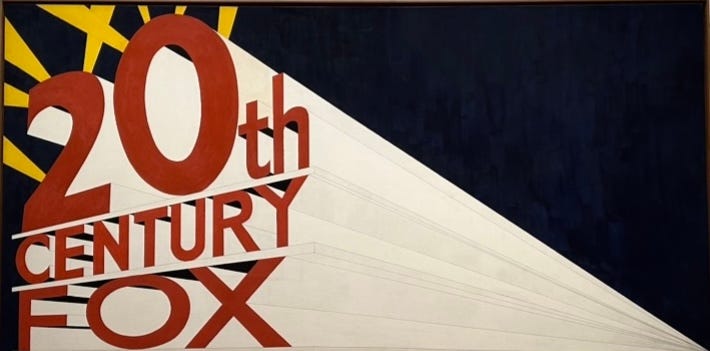
He didn’t know Ruscha or that artist’s work, as Ruscha had also begun to paint his chosen city. His 11-foot-wide word portrait of the 20th Century Fox logo, Large Trademark with Eight Spotlights (1962) was displayed in the storied Ferus Gallery in a 1963 solo show.
In an interview for a previous exhibition at the Tate, Ed Ruscha said that while attracted to Hollywood glamour, ”Los Angeles had a lot to do with my feelings about art and the world and everything.”
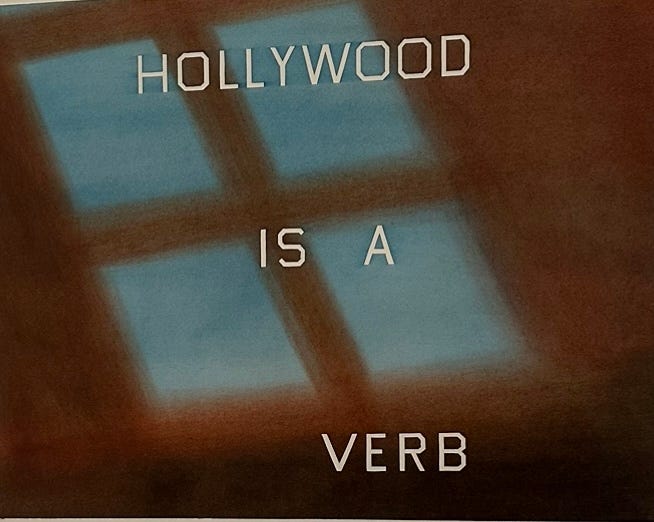
Over six decades, both Ruscha and Hockney have been masters of depicting Los Angeles. Am I allowed to use that word, “master”, or must I say they are two “primaries” painting L.A?
(David Hockney has recently relocated to Normandy after 55 years as an Angelino. It has been said that this move is because the French don’t object to smokers as much as the Californians do and Hockney has been chain-smoking since his school years.)
Both young men fell in love with the unique light of L.A, light that I find both dazzling and murky: the electric, traffic, and sun’s luminescence diffused by smog (which has been decreasing in recent decades due to anti-air pollution measures, although a plenitude of digital billboards is now generating additional light pollution).
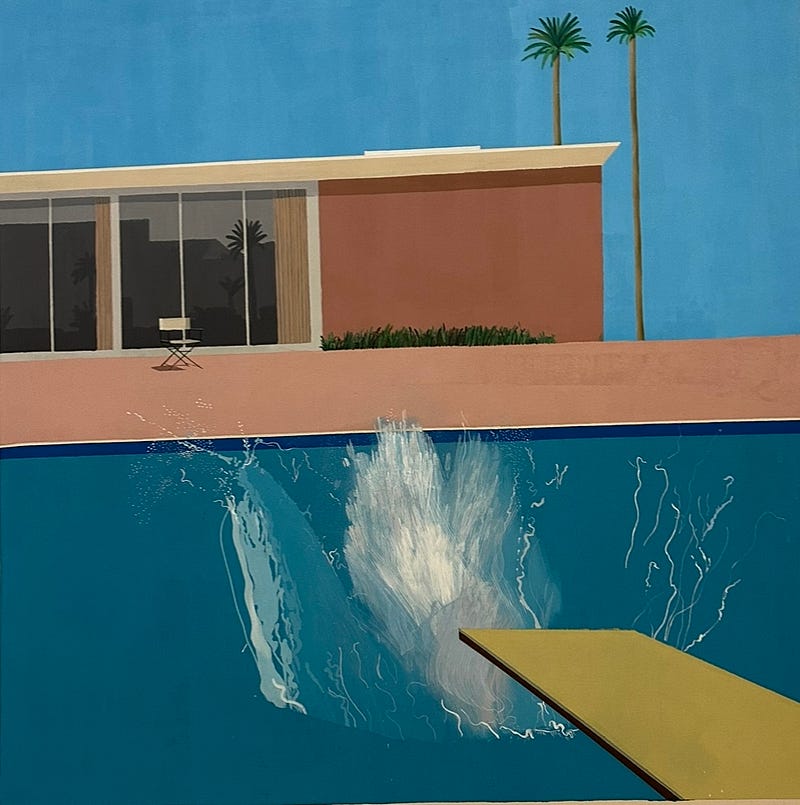
No one has portrayed Los Angeles as well, or as avidly, as these two artists. Hockney broke ground with his bright acrylic and remarkably sensual paintings, especially those of squiggly blue pools, including Picture of a Hollywood Swimming Pool, (1965) Sunbather (1966) and most notably, A Bigger Splash (1967). He painted the actual bottom of the pool at the Roosevelt Hotel in Hollywood and turned his eye and brush to seemingly saturated color landscapes of L.A’s hills and valleys, the grids of Santa Monica, and portraits of human and canine subjects.
Ruscha has consistently painted Los Angeles, famously the word “Hollywood” in various iterations, along with figurative images of some of the area’s buildings.
Cheekily, he painted that classic “googie” architectural gem of a diner, Norm’s, as Norm’s, La Cienega, On Fire, in 1964. (The restaurant is still in place and flame-free).
Did Ed Ruscha anticipate “norm-core” with his attraction to the word Norm’s?
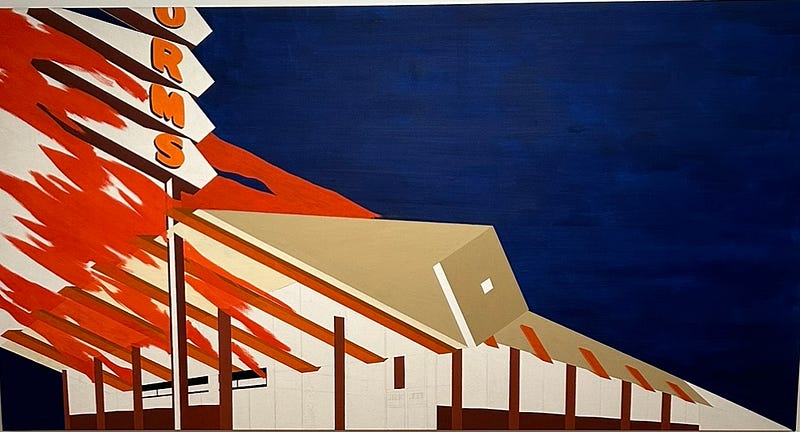
He also painted LACMA, the Los Angeles Museum of Modern Art, on fire in 1965. We should be aware that his present MOMA show: “Ed Ruscha/Now Then: A Retrospective” will be transplanted to LACMA in April.
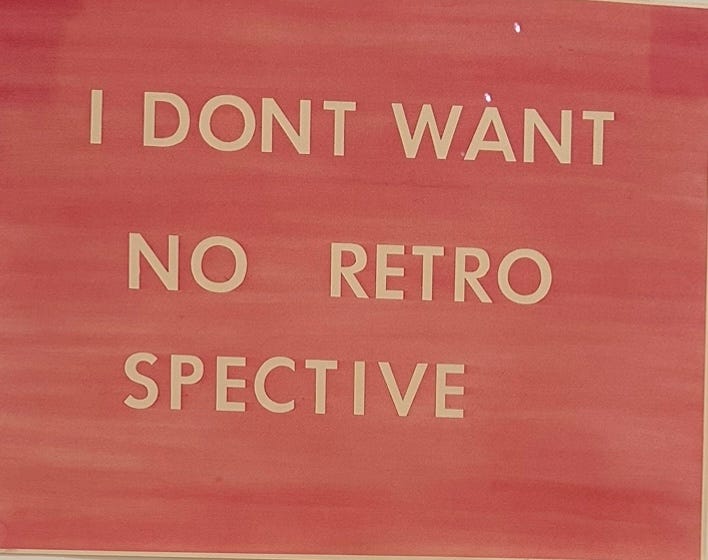
A 1979 Ruscha text drawing featured in the MOMA retrospective clearly states, “I DON’T WANT NO RETRO SPECTIVE”.
He is certainly no longer rejecting retrospectives. His first was in San Francisco in 1982.
The Most L.A. of All Artists
Both Hockney and Ruscha had been beach dwellers early on, and later denizens of the Hollywood/Hollywood Hills area. I have no idea if they have ever hung out.
I Googled, seeking a conversation between them or a reference linking them but found none.
On Getty Images, I did discover photographs of the two together in 2005, speaking animatedly at the Americans for the Arts National Arts Celebration, hosted by Maria and Bill Bell. And I also spotted them in a 2012 group portrait taken in Berlin for the opening of an exhibition that focused on Los Angeles artists.
While they are both known to be quite convivial, their social lives may not have intersected frequently. Hockney has an appreciation for handsome gentlemen, and the notably striking Ruscha prefers the ladies, even marrying the same woman twice and dating such beauties as Lauren Hutton.
That said, they both clearly enjoy the companionship of dogs!
In California, Hockney shows at L.A. Louver in Venice and Ruscha at Gagosian in Beverly Hills, two premiere galleries in different parts of L.A. County.
Along with being maverick painters, they are both groundbreaking photographers, and each has developed a new way of shooting images.
Ruscha’s legendary Every Building on the Sunset Boulevard is a visual travelogue, a 25-foot accordion of a book of continuous images of a single fabled street, a mile and a half of north and south sides depicted on the top and bottom of the pages. Ruscha photographed this continuum from the back of a pick-up truck holding a motorized camera.
I believe this livre d’artiste was unlike anything anyone ever photographed for art (maybe mapmakers shot something similar for non-esthetic purposes). It captures a moment in time. The Sunset Strip remains equally long but there have been many changes.
There are 16 Ed Ruscha California-based artist books featuring such subjects as gasoline stations, palm trees, and parking lots.
David Hockney has used photography to revolutionize perspective. He believes that some of the greatest old masters, like Vermeer and Canaletto, used cameras (film had not been developed yet) to achieve the geometric perfection in their paintings.
In the London show, “Bigger & Closer”, he explains how he became fascinated watching two friends in Minneapolis work on a crossword puzzle and captured their expressions, movements, individual body parts, and New York Times puzzle in a series of Polaroids that somehow together coalesce to the human eye as almost a single portrait.
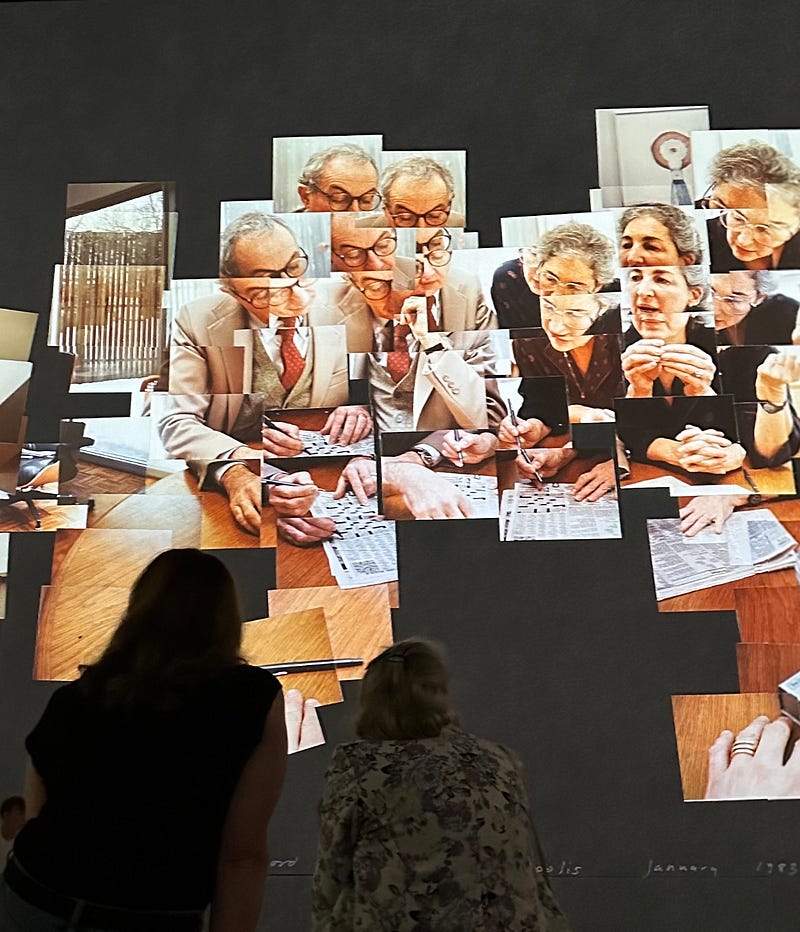
He has since played with this photomontage technique, but realized a grouping of still images would never succeed in capturing the majesty of the Grand Canyon, as there is no single place for the eye to focus on when confronted with the gargantuan hole. He decided the Canyon could only be captured in paint.
Both Hockney and Ruscha have tested the limits of painting, of art making. Hockney is a uniquely early adopter of technology in his work, experimenting and creating art with Polaroids, faxes, iPads, iPhones, and digital video.
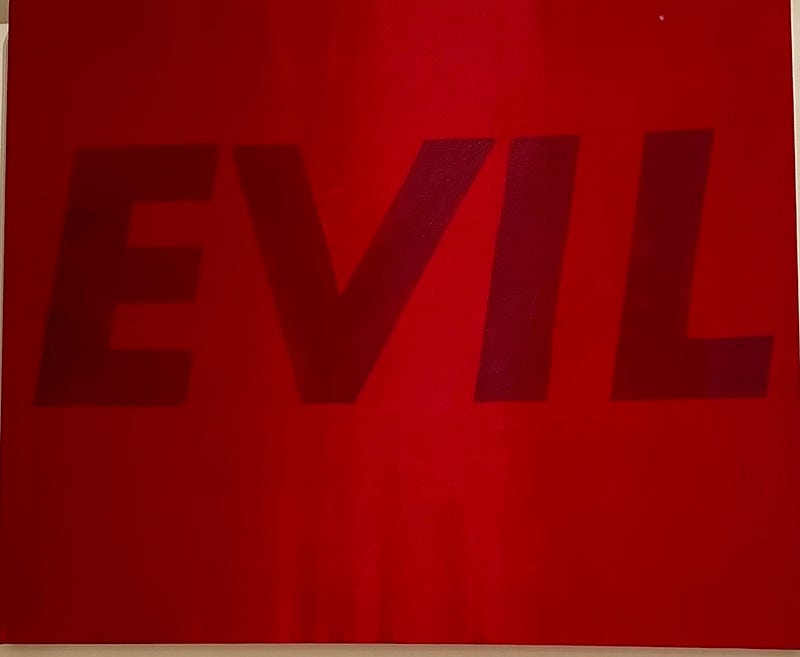
Ruscha stopped using conventional materials for several years in the 70s. He painted with rose petals, with honey, with Pepto-Bismol, coffee, beer, cheese, chewing tobacco, mustard, even with his own blood in a painting titled Evil.
He enjoys drawing with treated gunpowder; he discovered that this medium allowed erasure better than graphite in works he created spelling out such words as “Fire,” and “Sin.”
He has employed various fonts, stencils, and spray guns. While most of his painted surfaces are flat, others are impasto.
In 1970, he installed a room made entirely out of chocolate (recreated for the MOMA retrospective).
There are certain words and images he has toyed with over and over such as the name “Annie” in a font from The Little Orphan Annie comic strips popular during his childhood.
And though he is known for the painted words depicted on canvas, he is an excellent figurative painter of various subjects including buildings and cowboy comic books.
Ed Ruscha doesn’t paint people.
David Hockney frequently paints people, has painted hundreds of friends and acquaintances during his extraordinary career.
The two men have mapped Los Angeles, Ruscha in his 16 artist books, and Hockney in paint.
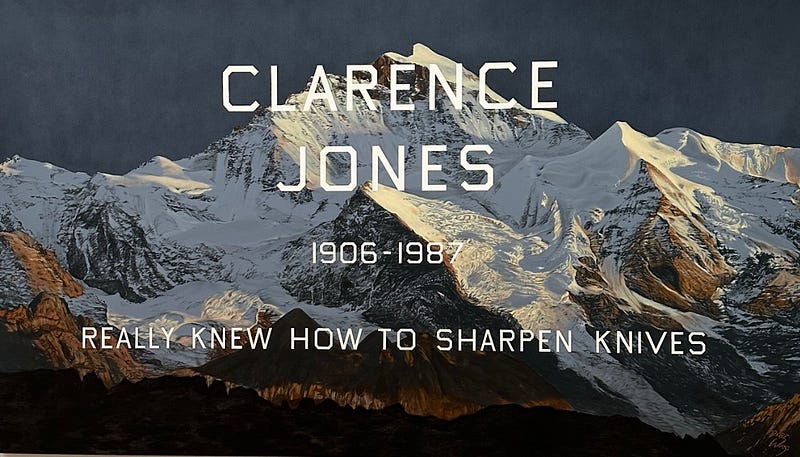
Both artists paint mountains brilliantly. Ruscha’s are snowcapped, cinematographic, and juxtaposed with witty words. Hockney’s mountains are more fanciful, in colors invented by the artist.
They are both extremely skilled at printmaking and are exemplary draftsmen and they both have worked in collage and photomontage.
Each artist has been influenced by Asian scroll art, Ruscha in his expansive books and Hockney in his rejection of shadows.
Hockney and Ruscha have also both been attracted to patterns in their work. The curvy musical movements in Hockney’s swimming pools and in the fabrics worn by his human subjects, are pattern-like. Ruscha’s paintings of bugs –ants, roaches, flies — swarm in patterns in his Insects series from 1972.
While Hockney is most associated with swimming pools, Ruscha designated one of his artist books as, “Nine Swimming Pools and a Broken Glass”
They both have glommed ideas for their work while driving through Southern California. Hockney refers to “the boredom of the road.”
Both are incredibly cool artists: you don’t picture them as drunken angry hotheads looking for a fight like so many of the Abstract Expressionists who were the art stars in the decades preceding their emergence.
I can’t imagine David Hockney and Ed Ruscha brawling at the Cedar Tavern.
I must comment on their remarkable personal style; they are two of the art world’s snappiest dressers.
The dashing Ed Ruscha, with his bolo ties and western wear, even worked on an ad campaign with Stella McCartney.
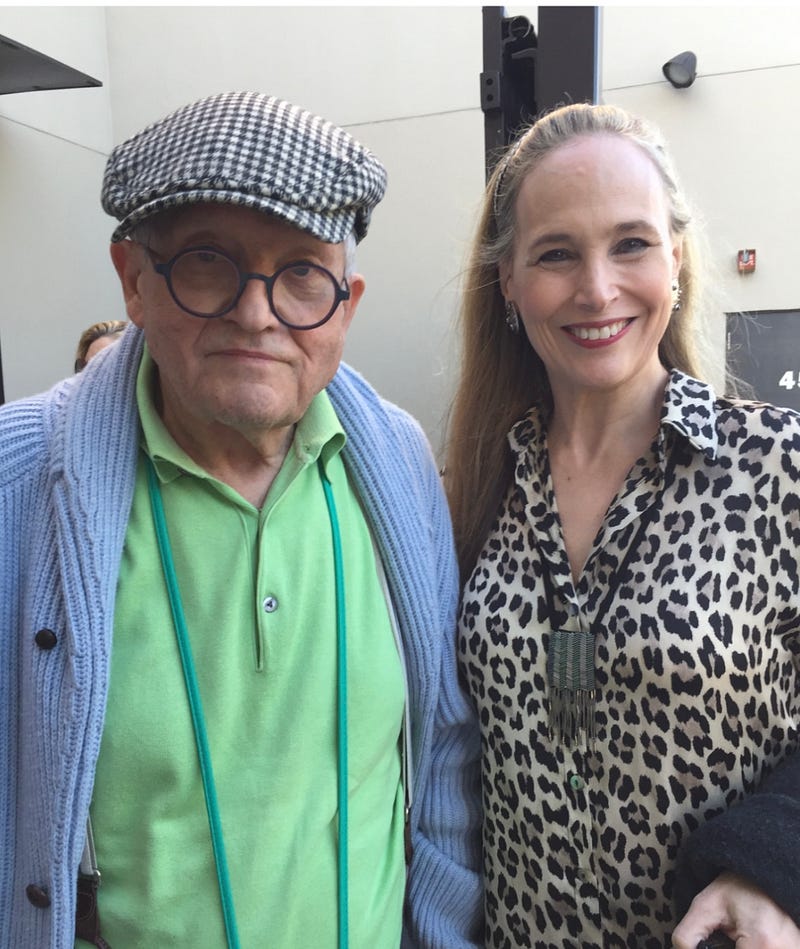
Hockney would be recognizable anywhere with his shock of pale hair, bright socks, striped shirts and ties, suspenders, rounded specs and dashing headwear, often newsboy caps.
Both artists seem not only cool, but effortlessly cool. When I worked for an art magazine called The Art Economist, I called Ruscha’s studio a couple times for comments on stories I was writing, and pithy answers always returned.
I briefly met Hockney at my favorite Los Angeles gallery, L.A. Louver, when he had a show of portraits he created on an iPad.
So often, when I see newer work by an artist I have long admired, I feel that they have flatlined, become stagnant. There is no growth. (I was about to name a few of these frozen but notable artworld figures, but decided there is always hope for development.)
This is something I love about Ed Ruscha and David Hockney. Both octogenarians continue to expand creatively. Even in their mid-80s, they evolve.
Ruscha’s work, while retaining its humor, seems to grow more dystopian. A painting from 2017 features a shredded American flag on a black background.
Hockney, along with trying new technologies, is perhaps more optimistic, now focused on painting landscapes. The lush beauty of his native Yorkshire, England, as well as the recent discovery of the Norman scenery, enchant him.
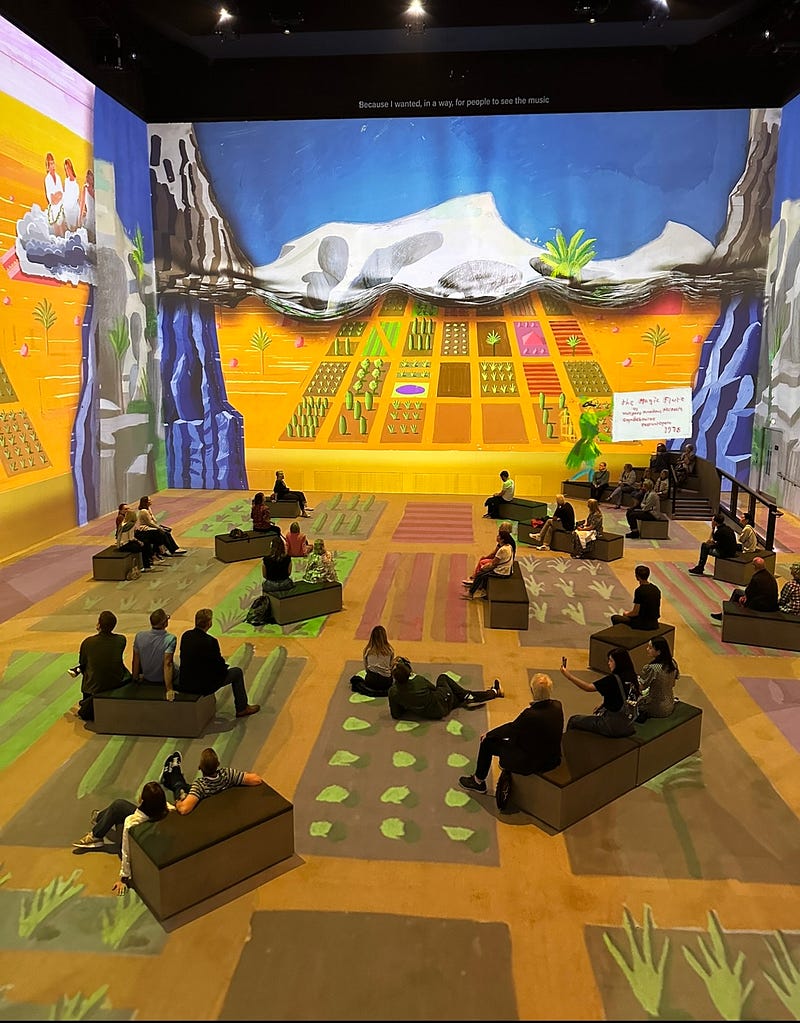
I found Hockney’s surround show absolutely exhilarating. Some elite artworld types have pooh-poohed it, comparing it to the highly commercial traveling experiences proliferating now, immersing spectators in projected works by such artists as Van Gogh, Kahlo, and Monet.
But there is a huge difference here. Those artists are dead, long dead. They had no say in the programming.
David Hockney, the living artist himself, has created this exhibition, spending three years developing the 50-minute experience, working with seven animators.
For “Bigger and Closer”, he has chosen the musical accompaniment, including operas by Stravinsky, Wagner, Mozart and Ravel, as he shows and describes the sets he designed for the Metropolitan Opera House.
It is his voice we hear. He explains his creative choices, delves into his art historical theories, and offers non-pedantic lessons in optics, vanishing points and perspective.
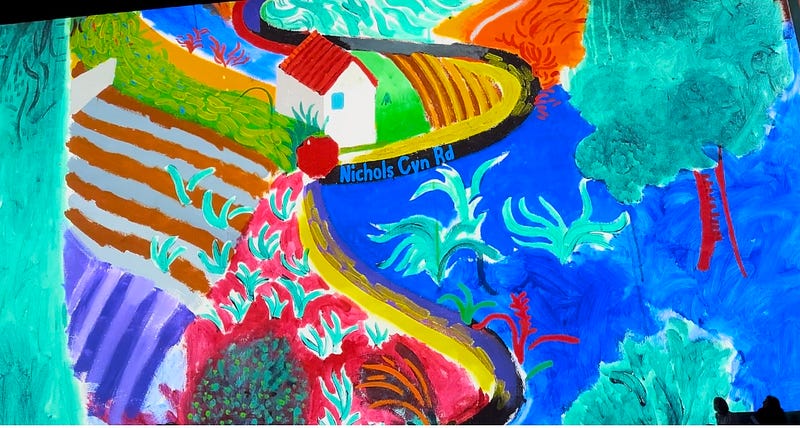
And what a joy it is to have Hockney’s colorful images four walling me, even spreading on the carpet beneath me.
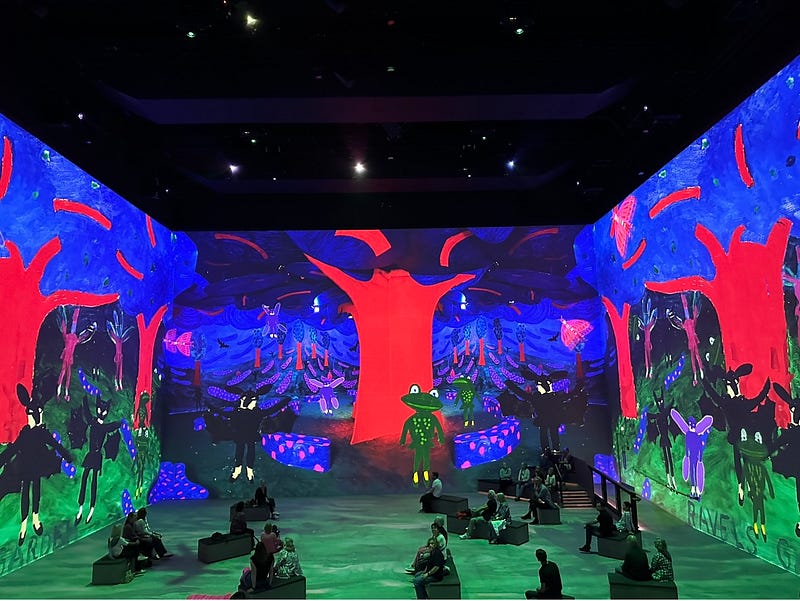
Children in the Lightroom race around, attempting to chase Hockney’s acrobats, moths and bats flying across the walls. Yet the kids don’t hamper the flow of this audiovisual experience.
The Ed Ruscha retrospective at MOMA is both a critical and popular success. There has never been as many of his works, more than 200, gathered together. My appreciation for his artistry and technique, all his techniques, has only grown.
Not that Hockney or Ruscha needed my appreciation.
Ed Ruscha ‘s Hurting the Word Radio no. 2 from 1964 sold for $52.4 million at auction.
A 1972 David Hockney painting, perhaps the greatest of his multiple swimming pools, Portrait of an Artist (Pool with Two Figures), sold at auction for $90.3 million, the second highest price ever paid for a painting by a living artist.
Ed Ruscha/Now Then is on display at MOMA until January 13,2024 and will reopen in LACMA in April.
David Hockney: Bigger & Closer (not smaller & far away) continues showing in London until December 3. An employee at the Lightroom told me that new iterations will appear in Tokyo, New York and Los Angeles next year. This has not been confirmed.