
Dave and Rachel Hollis: Back On Instagram to Narrate Their Divorce?
So far, it seems like another exercise in privilege.

“Anything I’ve ever done, the work I’ve done, has always been like your girlfriend telling you what worked for her.”
— Rachel Hollis, 2018
From the moment Dave and Rachel Hollis announced their divorce in June, there was speculation that they’d somehow use the split to help further their solo careers as relationship and life coaches.
Of course, the biggest question in all of this is how honest they will be. After all, we’re talking about people who aren’t just influencers — they marketed themselves as the epitome of a great, down-to-earth marriage since Rachel first rose to fame a couple of years ago with Girl, Wash Your Face. Considering that the basis of that fame rests upon a good amount of lies, some can’t help but hope they’ll do things a differently going forward.
As expected, both parties have been back on social media with some updates on their experience. Dave emerged first — and literally made headlines for his first solo weekend with the kids. Honestly? His June 29 post left me with more questions than answers. In it, he describes recital day for their daughter Noah, and… church.
So, is the pandemic not a thing for the Hollis family? That’s my first bit of confusion about their divorce right now. They’ve described bits of their lives and social events as if they’re completely unaffected by the coronavirus pandemic that’s made me curious about the planet they’re living on. Seriously.
The trajectory of their public separation seems right on target for their brand, though, and that’s not a compliment.
Dave began posting before Rachel, and it’s all about the kids. Some of you already know my feelings about just how many cookies we give to dads for taking care of their own offspring. So, I suppose none of his posts are much of a surprise. They mostly seem to further the, “Wow, what a great guy” narrative.
Sigh.
Cute photo ops with the kids plus plenty of remarks about how this time is so hard or bittersweet. Dave said he came across an old photo of him and Rachel, so he posted it to Instagram and it’s something their fans really ate up.
It’s not that all of these messages are inherently bad, but they do come across as ridiculously on-brand in a shallow sort of way.
Rachel, on the other hand, has posted less. There’s a two-week gap between Dave’s solo weekend post and her first post-divorce announcement message. Her posts are also on-brand, though a bit more self-focused. She got a dog and apparently takes it to Home Depot. Again, I ask where is this magical place where one goes out shopping — with dogs ?— as if the coronavirus is not a thing.
(It’s Texas, by the way.)
Both parties, of course, have mentioned that they’re now operating out of two households. Obviously, that’s the thing about divorce. However, considering that 32% of Americans didn’t even pay their July housing payments due to the pandemic, the privilege of their current journey struck me rather loudly.
What do I want from them? I guess, at the very least, honesty. I want them to truly acknowledge they have the resources to get through their divorce in much better shape than most of the fans they counsel.
It’s easy to make your divorce look sort of “perfect” when you’ve got the wealth to not worry about how you’ll manage two separate households. Easier to pose as relationship experts who’ve “been through it all.” Of course, it seems more than a little disingenuous too.
But don’t get me wrong. Rachel and Dave have both written posts about how divorce is really hard. It’s hard being alone when you’re used to being together. It’s hard for your kids to go through even when you do everything you can to make it “not terrible.”
It’s hard, but I’m afraid that’s all we really get to hear on the subject. Part of me wants to commend them for talking about it — I really do. Yet, once again, they’re only scratching the surface with sentiments that everybody already knows.
Everybody knows that 2020 is a shit show. Their followers could something more from them — something actually raw, personal, and vulnerable. It’s ironic but as influencers, they’ve got a huge platform to hide away from all of that.
I get the sense that nobody is going to go ahead and dig deep throughout this entire journey, based upon everything else that’s been said or done that completely lacks substance.
What a missed opportunity.
It’s worth mentioning that both Rachel and Dave have dedicated a few Instagram posts to the promotion of a friend’s new book. Brit Barron just released her first title, Worth It: Overcome Your Fears and Embrace the Life You Were Made For. Also tagged in Christian literature and self-help, it appears to be all about coming out and facing adversity — and it features a forward written by Ms. Hollis herself.
I don’t know how to feel about this one. There’s a lot of folks who can appreciate self-help from a queer author, but selling that self-help on the bedrock of a Hollis friendship is a bit disturbing. After all, Rachel has made bank by plagiarizing and regurgitating a litany of other moms and self-improvement gurus.
It’s hard to feel confident that Brit’s book won’t just be more of the same.
“This book is about the incredible possibilities that await each of us. It’s not just a coming-out story or the story of me and Sami. It’s not just about leaving the church and the world I grew up in for the pursuit of love. It’s a call to action for all of us, wherever you are and whoever you are, to become the people we are meant to be, even if that means hard seasons. I promise spring is coming, and spring is always, always worth it.”
— Brit Barron, Worth It
Furthermore, Dave and Rachel’s posts about Brit’s new book feel a lot like a contractual obligation. Dave’s post about it literally tells us nothing except that it’s “so good.” Er, excuse me — “so so good.”
After reading his pitch, I’m now convinced that the phrase “so good” ought to be stricken from my vocabulary as a writer since it says little more than “I like it.”
Or, “I’m contractually obligated to say I like it.”
I suppose “deeper” a lot to expect from people who weren’t honest about their failing marriage, but I keep hoping we’d get something of more substance from these two. It would certainly help counteract the negatives to any association with the former couple.
And, to be honest, pushing Brit’s book is a little reminiscent of them pushing Glennon Doyle’s third book, Untamed.
Now, I believe Glennon has been more forthright and working hard to lead a more authentic and vulnerable life. But it’s a little bit ironic how she also rose to fame by writing about saving her marriage… which wasn’t so salvageable after all. The same year she published Love Warrior, she and her husband divorced and Glennon fell in love with a high-profile lesbian, Abby Wambach.
Maybe it’s time to be honest that Christian literature and self-help books are filled with a lot of well-meaning liars — and often, those people lie to themselves first. While I know there’s a lot to love about Glennon Doyle and her writing, her third memoir has also earned criticism for failing to embrace itself as a queer love story. Which means, it still feels like she’s holding back.
I’m not surprised.
Doyle recounts in “Untamed” falling for Wambach in a fairy-tale meet-cute that’s pretty endearing, and this reviewer will never scoff at a love story between two women, no matter how cheesy. But the “Love Warrior” story that Doyle shed for this slightly queerer love story falls into the same trappings of the first: everything tied in a neat little bow, even the hard bits.
Where “Untamed” gets even more interesting is in its position in the broader discussion about what it means to be queer, and how queerness as an ethos manifests or doesn’t.
While Doyle is now in a lesbian relationship, the book’s narratives of marriage and parenting are very traditional. This isn’t right or wrong, but it doesn’t disrupt cis-hetero patriarchal dynamics either. Marriage equality has long been criticized by queer activists as too mainstream of a fight; it ignores other ways of making family, erases conversation about gender outside the binary and falls into step with an institution many folks argue is rooted entirely in power dynamics based on gender and sexuality.
“Untamed” does not bring a queer ethos to its storytelling, but rather happens to have a lesbian relationship in a narrative that has “Lean In” vibes — that is, general, oversimplified advice about finding and cultivating inner power that only works for a certain subset of the population.
— Sarah Neilson, Is Glennon Doyle’s new memoir ‘Untamed’ inspirational or heavy-handed?
The last time I checked up on the popular ex-couple over Instagram, Dave was talking about identity and making lemonade. How his identity was “husband,” but now he’s leaning into dad.
I don’t know, folks. I’m having such a hard time with the wishy-washy spirituality of this whole thing. The hopeful — but undoubtedly naive — part of me keeps thinking these people are surely going to get real soon… right? I mean, we’re talking about people who’ve made a living as virtual marriage counselors who used their marriage as something healthy and attainable — a relationship to strive for.
Unless I’ve missed it, there’s been no acknowledgment or admission about allowing their followers to believe they were #RelationshipGoals. On the contrary, it appears that they (and especially Dave) are digging themselves in deeper by giving us all a supposedly exemplary separation story over social media.
Make no mistake. They’re still telling us it’s hard. But the substance is sorely missing, and I can’t help but notice thousands of comments from women affirming them both as the most incredible and inspiring role models they’ve ever found.
Why is that so problematic? Well, remember where I said that Christian literature is filled with liars? Let’s talk about that.
You see, Dave and Rachel Hollis (and Glennon Doyle, etc) operate in a very specific subculture of Christian self-help books. This is a world where grown adults are finally coming to terms with and speaking out about the abuse they endured — and sometimes inflicted upon others — within the cult of evangelical Christianity. Carefully curated, yet perfectly imperfect folks like Rachel pose as a liberal and “safe” alternative for spiritual inspiration without the abuse.
But a liberal Christianity that embraces queer friends (or marriage) and also drops F-bombs is not necessarily a healthier brand of spirituality. As its critics will remind you, the leaders are still bogged down by issues of elitism, privilege, magical thinking, and sometimes even shame. These self-made gurus wind up preaching “do as I say, not as I do,” which primes followers to get stuck in vicious cycles of self-loathing and pseudo-self-awareness. Remember, Rachel herself is the current queen of personal responsibility without taking personal responsibility for any of her lies.
Look, I get it that everyone has their weaknesses and blind spots. In no way am I saying that influencers and self-help authors or spiritual gurus need to be perfect. However, they really do need to be honest and vulnerable, as that’s the only way to really be held accountable in their fields. And as it’s already been established, accountability hasn’t been Rachel’s strong suit.
For someone like myself who grew up steeped in spiritual abuse, the recent circle of liberal Christian influencers brings up one red flag after another. And no, I don’t see their faux authenticity as a harmless thing.
If anything, folks like Dave, Rachel, and Glennon ought to be screaming from the rooftops how much damage occurs when you lie to yourself and others. How it causes more pain than it’s worth.
But when influential Christian writers lie to themselves, they pull their followers down with them.
Do they really want to help people? Then maybe they should open up their lives — not as carefully curated and adorably messy works of art, but as cautionary tales. As in, “this is what happens when you lie to yourself about who you are or what makes a healthy relationship.”
Personally, I’m still holding out hope that Joshua Harris (who wrote and eventually disavowed I Kissed Dating Goodbye) might break the mold and write an unflinchingly honest memoir like that. One that takes real responsibility. I can already see signs of that honesty peeking through his Instagram posts.
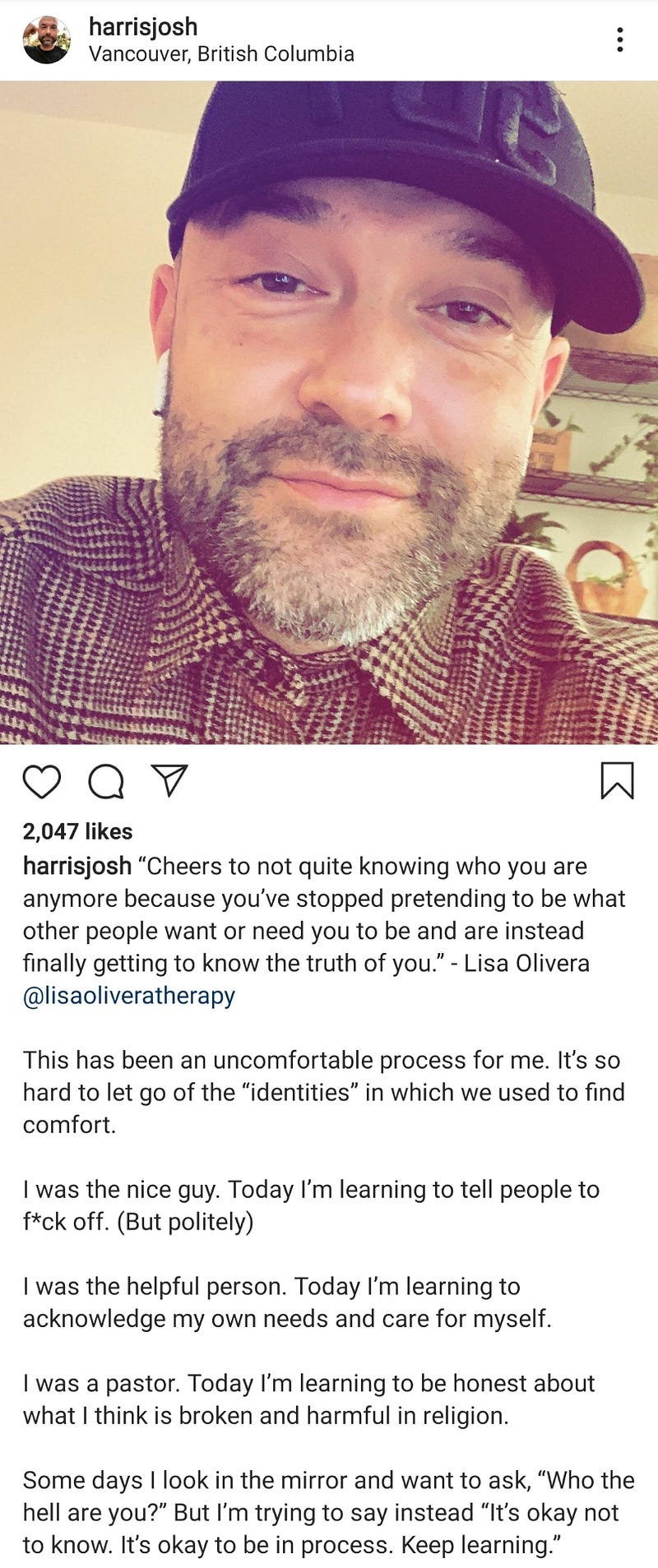
But do you know what? Nothing is stopping Rachel and Dave from doing that for themselves. Can you imagine how refreshing it would be to hear one of them say, “I fucked up when I wrote about our incredible marriage?” Or, “I screwed up when I ignored red flags in my life and then posed as a life coach for all of you?”
That’s the kind of book and pivoting that would offer real healing and true self-help.
But instead, we get more cute quotes that look great on Target merchandise but fail to tackle what’s really happening.
While Dave and (especially) Rachel’s social media posts are currently few and far between, they’re setting the tone for a divorce that appears absurdly out-of-touch.
I keep hearing Rachel talk about how hard she’s pivoting (and how hard she’s working), even as she indulges in the luxury to stay away from social media. This wouldn’t be so strange if she hadn’t made herself a life coach and online influencer.
Clearly, there’s nothing wrong with focusing on your family and taking a break from social media when you’re going through a tough time. I’m not suggesting that Rachel Is wrong to do so. What I’m saying is that she’s built her career upon a pile of privilege and even now that she’s been exposed to be remarkably fraudulent in that career, she’s still unwilling to acknowledge that privilege.
When Rachel Hollis refuses to talk about such elephants in the room, she encourages a very bad habit among many semi-spiritual white women. That’s no small thing. Books and social media shape us as people and I’m afraid that this liberal Christian movement of inspirational authors is going to leave its own trail of destruction and spiritual abuse.
In his article, 5 Habits of Highly Self-Aware People, psychologist Nick Wignall says that self-aware people:
- Listen more than they talk.
- Are curious about their own minds.
- Look for emotional blindspots.
- Ask for feedback (and take it well).
- Reflect on their values.
But are these the types of habits that influencers like Rachel and Dave Hollis model? I would argue that they don’t. Surely, the dissolution of a marriage which people have used as the bedrock for their “expertise” as relationship coaches reveals the need for course correction.
Somewhere along the line, that marriage wasn’t as strong as they thought or as healthy as they claimed.
And while a failed marriage doesn’t make for bad coaches, a lack of self-awareness really does.
The good news is that this also doesn't have to be the end of the story. So, here's hoping that somebody has the courage to come clean.