
Daughter of Two Worlds
A Story of Divinity, Duality, and Destiny
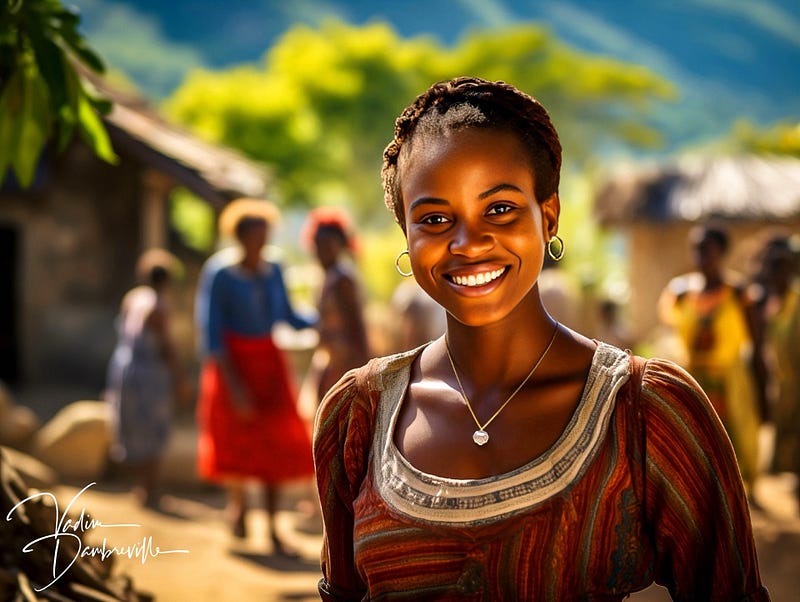
Boucan Gelé awakened to the sun’s embrace on December 8th, a day marked by the Immaculate Conception. Its streets hummed with the day’s promise, echoing the significance of the date – a symbol of purity and divine grace in the Catholic faith, yet uniquely intertwined in Haiti with the spirit of Erzulie, the Vodou Loa of love and fertility, a poignant testament to the sequels of slavery and colonialism. Amidst this vibrant scene, rich with cultural syncretism, Marie’s presence was a quiet storm of contemplation. Her eyes, deep pools of untold stories, mirrored the duality of her existence: a Baptist pastor’s daughter, yet heir to a Vodou Asogwe’s legacy. This day, embodying the fusion of beliefs, mirrored her life’s juxtaposition.
“Why do I feel torn between two worlds?” Marie thought, her gaze lingering on the festivities.
The festival’s kaleidoscope swirled around her – drumbeats clashing, colors swirling. These were the threads of her life: the staunch Baptist teachings of her father interwoven with the whispered lore of her grandfather, the revered Vodou priest.
“Papa’s sermons, Grandpère’s chants… they both resonate within me,” she reflected silently.
Flashbacks of her childhood flickered in her mind. Young Marie, hidden behind a tree, watched her grandfather with wide eyes as he, commanding and mystical, danced with the spirits.
The memory shifted to her father, torn between the cross and the Vodou charm, a silent war of beliefs playing out in his eyes.
“Grandpère, what secrets did your dance hold? Papa, why did you fear them?” she wondered inwardly.
Present-day Marie thumbed through an aged photo album. Each image fragments her disjointed past: her grandfather’s ceremonial grandeur, a stark contrast to her Baptist simplicity. Conversations with elders, tinged with nostalgia and reverence, deepened the chasm between her roots and reality.
“Grandfather, you were a man of mystery,” Marie murmured to a photo, her voice tinged with longing.
Marie’s days in the village, seemingly mundane, were marred by restlessness. Market colors evoked images of her grandfather’s ceremonial attire. The scent of incense teased out memories, elusive and intangible.
“These colors, these smells… they’re fragments of a world I’ve only glimpsed,” Marie pondered, wandering through the market.
One evening, a simple accident – a cut finger, a drop of blood forming a heart – halted her. It was as if Erzulie herself whispered in that moment. And later, a ladybug’s crawl on her hand – a Vodou messenger – felt like a caress from the past.
“Erzulie, are you reaching out to me?” she asked softly, watching the ladybug.
Her dreams were an ethereal tapestry: a moonlit river, a mysterious woman’s figure, a connection deep and unspoken. These were not mere dreams but ancestral calls guiding her toward forgotten shores.
“In my dreams, you speak, but why can’t I understand?” Marie whispered in her sleep, reaching out to the figure by the river.
Then came Jean, a stranger with the wisdom of ages in his eyes. Their first meeting, amidst local artworks, was a collision of past and present. He spoke of Erzulie with an affection that resonated within Marie, kindling a spark of curiosity.
“Your words… they open doors I’ve long ignored,” Marie said to Jean, her voice a mix of wonder and fear.
Their encounters, frequent and profound, became Marie’s gateway to her heritage. Jean’s stories painted Vodou in strokes of beauty and depth. Through his eyes, she saw her ancestral beliefs not as relics but as living, breathing traditions.
“Jean, you show me a world I’ve always been part of but never really seen,” Marie confided during one of their walks.
Marie’s journey, like a walk through a misty forest, was a path of discovery and conflict. Dreams melded with reality: her grandfather’s enigmatic presence in her sleep, butterflies, and shadows in daylight hinting at Vodou symbols. Each moment was a subtle call to embrace her complex identity.
“Grandpère, are you guiding me in my dreams?” she pondered, watching a butterfly flutter.
Jean’s arrival in Boucan Gelé was a subtle disturbance in the village’s rhythm. Their first meeting, amidst the marketplace’s vibrancy, was a convergence of two worlds. Their conversations, hesitant at first, blossomed into a shared exploration of faith and heritage.
“Your faith is deep and complex, like the roots of the ancient mapou,” Jean observed, gesturing to the surrounding forest.
Marie’s nightly dreams became a vivid bridge to her ancestry. The drums of Vodou ceremonies, the hills’ whispers, the river’s serene flow – these were not fantasies but ancestral echoes, calling her to embrace her legacy.
“These dreams… they’re not just echoes. They’re a part of me,” Marie realized, lying awake under the moonlit sky.
The line between the spiritual and the mundane blurred for Marie. Erzulie’s symbols in everyday life – flowers, songs, sunlight patterns – became messages, guiding her toward a deeper understanding.
“Every petal, every note, every ray of light… They’re all speaking to me,” Marie mused, finding solace in nature’s subtle language.
With Jean’s wisdom, Marie’s spiritual exploration deepened. The realization dawned: her heritage was not a chain but a vibrant tapestry, weaving together her Baptist beliefs and Vodou roots.
“Jean, it’s like a dance of spirits and scriptures, each step leading me closer to who I am,” Marie shared, her voice brimming with newfound confidence.
The storm that shook Boucan Gelé also stirred Marie’s soul. In the old Vodou temple, amidst the rain’s fury, she faced her inner storm. Visions of her grandfather and her past converged with Erzulie’s comforting presence. This was not a clash of beliefs but an invitation to a harmonious blend.
“Grandpère, Erzulie, I feel your strength in this storm. Help me find my way,” Marie prayed, her voice barely audible over the thunder.
Post-temple, Marie returned to the village, transformed. She balanced her Baptist faith with her Vodou heritage, integrating both into her life. Her family, initially resistant, gradually accepted her spiritual amalgamation.
“Papa, I am both your daughter and Grandpère’s. My faith is my own,” Marie declared, her conviction bridging the gap with her father.
The story’s climax, a festival night under Erzulie’s watchful moon, celebrated Marie’s journey. Jean’s pendant gift to Marie symbolized their shared path. Their dance, a fusion of faiths and hearts, represented unity and acceptance.
“This dance, Jean, it’s our story, our journey,” Marie whispered, her eyes reflecting the moon’s glow.
In the quiet aftermath, Marie’s solitary walk through the village was a meditation on her journey. Her connection to the land, the stories of her grandfather, and the village’s rhythms solidified her identity – a blend of past and present, Baptist and Vodou, creating a unique harmony within her soul.
“I am the daughter of two worlds, guardian of a legacy that is uniquely mine,” Marie thought, her heart at peace as she walked under the starlit sky.
To enhance your understanding and enjoyment of “Daughter of Two Worlds,” here’s a glossary of specific terms related to Haitian culture and Vodou practices:
Erzulie: A major Loa in Haitian Vodou, associated with love, beauty, and femininity. Erzulie has several aspects, each embodying a different expression of these themes.
Vodou Loa: Spirits in Haitian Vodou, considered intermediaries between the divine and humanity. Each Loa has unique characteristics, roles, and stories.
Asogwe: The highest rank in the Haitian Vodou priesthood, responsible for leading ceremonies and rituals, and offering spiritual guidance to the community.
Cultural Syncretism: The merging of different cultural, religious, or philosophical beliefs into one unified system. In Haitian Vodou, this often involves the integration of African spiritual practices with elements of Christianity.
Mapou Tree: A sacred tree in Haitian culture and Vodou, often considered the dwelling place of spirits and a symbol of life, connection to ancestors, and resilience.
Vodou: A spiritual and religious practice originating in Haiti, rooted in West African Vodun and influenced by Christianity. It involves the worship of spirits known as Loa and emphasizes respect for ancestors.


