Data Meets the Pitch: How PlayeRank is Redefining Player Evaluation in Football
Introduction
Performance evaluation and player ranking are important tasks in the world of soccer, as they help coaches, scouts, and fans to identify top talent and understand the strengths and weaknesses of individual players. In the past, these tasks have typically been carried out using simple metrics such as goals scored or passes completed. However, these metrics do not capture the full complexity of player performance and can be misleading.
To address this issue, a group of researchers led by Pappalardo L, Cintia P, Rossi A, Massucco E, Ferragina P, Pedreschi D, and Giannotti F has developed a data-driven approach to player evaluation and ranking using machine learning. The approach, called “PlayeRank,” is based on a public data set of spatio-temporal match events in football competitions, which includes information on a wide range of events such as shots, passes, and tackles, as well as the location and timing of these events. The data set was created using a combination of manual annotation and machine learning techniques and covers over 25,000 matches from various football competitions.
If you want further information on this dataset you can look into this article I published:
Objectives
Using the PlayeRank approach, the researchers wanted to create a ranking of football players based on their on-field performance. The ranking is designed to be objective and transparent, and it takes into account a wide range of factors that can impact a player’s performance, including their position on the field and the specific actions they take during a match.
Methodology
To create the ranking, the researchers first preprocessed the data set to extract a set of features that capture the most important aspects of player performance. These features included things like the number and type of passes a player made, their shot accuracy, and their defensive contributions.
Next, the researchers trained a machine learning model on this data using a supervised learning approach. They used a combination of linear regression and decision tree algorithms to learn the relationships between the featuresand player performance. The combination of linear regression and decision tree algorithms allowed the model to capture both linear and non-linear relationships in the data, resulting in a more accurate and robust prediction of player performance.
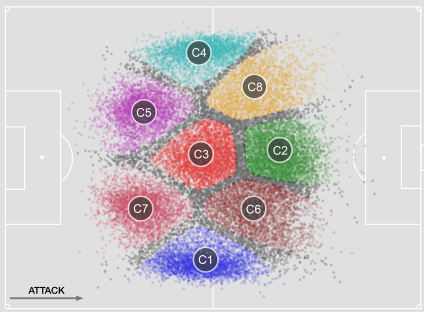
Once the model was trained, the researchers used it to make predictions on the performance of players in the data set. They then ranked the players based on these predictions, with the highest-ranked players at the top of the list.
Results and applications
The authors tested the performance of PlayeRank using a dataset of players from the Italian Serie A league. They compared the rankings produced by PlayeRank to those produced by traditional methods and found that PlayeRank was able to provide a more accurate and comprehensive assessment of player performance.
One of the key benefits of the PlayeRank approach is its ability to provide a more nuanced and accurate view of player performance. Traditional methods of player assessment often rely on simple statistics such as goals and assists, but these metrics do not capture the full range of a player’s contributions to a match. By considering a wider range of events and actions, PlayeRank is able to provide a more comprehensive view of player performance.
In addition to its use in player evaluation and ranking, the PlayeRank approach could also have applications in other areas of football analysis and decision-making. For example, it could be used to identify the most effective strategies and tactics for a given team, or to evaluate the performance of coaches and managers.
Future Work
In future work, the authors plan to further refine and improve the PlayeRank system. They also hope to apply it to other soccer leagues and countries in order to expand its scope and utility. Overall, the PlayeRank approach represents a significant step forward in the field of soccer analytics and has the potential to revolutionize the way that performance evaluation and player ranking are carried out.
Conclusions
Overall, the PlayeRank approach is a significant step forward in the field of football analysis and player evaluation. By using data-driven techniques and a public data set of spatio-temporal match events, the researchers have developed a transparent and objective approach to player ranking that provides a more nuanced and accurate view of performance. The combination of manual annotation and machine learning techniques allows for a rich and detailed understanding of player performance, going beyond simple statistics to consider the full range of actions and events that contribute to success on the field. This makes the PlayeRank approach a valuable tool for anyone interested in analyzing and understanding the complex and dynamic world of football.
References
- Pappalardo, L., Cintia, P., Rossi, A., Massucco, E., Ferragina, P., Pedreschi, D., & Giannotti, F. (2019). PlayeRank: Data-driven performance evaluation and player ranking in soccer via a machine learning approach. arXiv preprint arXiv:1903.11939. https://doi.org/10.1145/3343172
- Pappalardo, L., Cintia, P., Rossi, A., Massucco, E., Ferragina, P., Pedreschi, D., & Giannotti, F. (2019). A public data set of spatio-temporal match events in soccer competitions. Scientific Data, 6(1), 1–9. doi:10.1038/s41597–019–0247–7
If you liked this short article do not hesitate to give me a clap and follow me for more similar content or drop a comment below. You may also be interested in reading my previous article on the “Spatio-Temporal Match Event Data Set” which provides more information on the data set used in the PlayeRank approach: