
Data Center Democratization
Amazon is creating opportunity for everyone

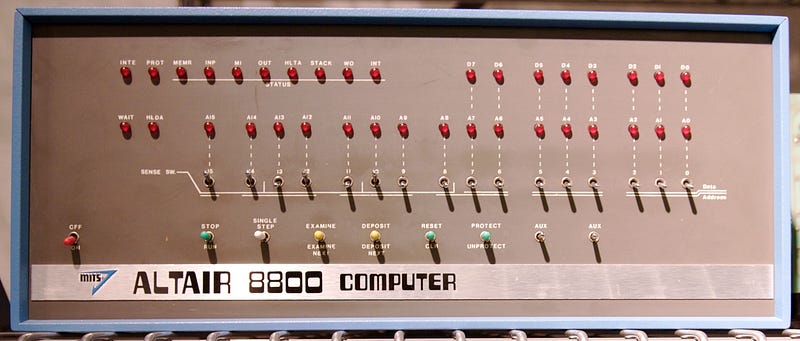
There was a time when I did not have a computer. In fact, almost no one did. A friend of the family, Dr. Gordon W. Wolfe, built an Altair 8800 from a kit. It had to be booted with switches on the front panel, I have no idea how and neither do I recall how data was processed but 45 years later I am still impressed. Did I mention he also built a lute? — it’s the Medieval version of a guitar.

My curiosity about technology continued into high school where the math club had one computer to share. As a photography & commercial art major I pretty much averted my eyes from the brainy bunch, so can’t even tell you what type of computer it was (Commodore PET would be a good guess).
I lived not too far from the university and went to the library there frequently with my alumnus parents or on my own. When I wasn’t reading comics on microfilm, browsing the map room, or exploring quartos in the humanities section, I would hang around the terminals hoping to get access to an unlocked terminal to play a round of “Hunt the Wumpus”; a game that could have been played over a telegraph. I attended the same university as an art major but did take one computer class and wrote a bubble sort in basic on an IBM Model 5150.
In my Junior year, I transferred to an art college in San Francisco and they had just started up a computer arts lab with two Commodore 64 and the first Macintosh (we did not say Mac at that time). As you can see I still did not “own” a computer and gaining access was difficult. If you considered my tuition, it would be cheaper to buy computer time directly from IBM if that was your goal.
After graduation, I did not have much call for computing as a typewriter with 4K memory could store and recall the one-page resume I needed. The resulting page did look professional, much better than the dot matrix “NLQ” crap (I continue to be very picky about my printer).
Finally, I inherited a fully loaded Epson PX-8 Geneva!
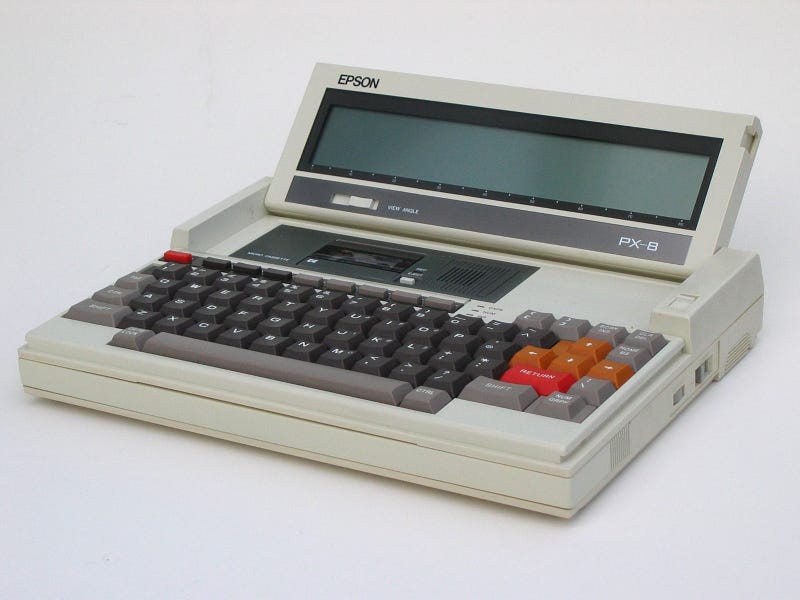
This was a heck of a lot of fun and I wish I still had it, though I am unwilling to shell out $2,000 to get one off eBay.
I made some invoices in Wordstar and VisiCalc, and even generated images on the screen by defining each pixel in Basic. Wow, the hours I wasted!
The NiCad batteries lasted for days without a charge as the LCD screen was not backlit. The cells were “C” equivalent so you could load it up with alkaline batteries in a pinch. Internal storage was on a micro-cassette — easily obtained at Radio Shack. This “H” drive was painfully slow and only useful for backups. I was lucky to have two external 3.5" floppy drives, also powered by C-size NiCads. For pre-Internet computing, this was the bomb.
I am a late adopter, also known as a poor, so I did not transition to a “real” computer until the 486 DX was out, skipping the AT, 286, and 386 generations. From there the story is pretty familiar; various Intel-based computers with Windows 3.11, 95, Me (ew, I know), 98, and finally NT Server which leads me to my point.
My NT server OS was “borrowed” from a friend that had an MSDN subscription — basically access to anything Microsoft. This gave me a web server to start coding with. The rest of the stack would be open source, PERL CGI for starters. PERL CGI scripts would eventually give out to PHP and MySQL but all along the way, I stuck with Open Source because it was free. Java, Visual Basic, .NET, Silverlight, Activ-X, and so on all required expensive IDE or runtime environments. Server hardware I could get access to was usually Unix-based computers in shared hosting environments such as Earthlink.
Every step of the way Open Source has been there to provide me the tools to build a career. PERL, PHP, MySQL, JavaScript, and recently, Python have provided the software in the stack. Linux deserves a shout-out as well.
Open source development tools rounded out the suite with syntax highlighting text editors and FTP clients, but it was always access to data center quality hardware that was the most expensive part and was either hobbled in features or power.
The straw that finally broke the camel’s back was having a MySQL union fail because MySQL “unions” were not allowed in the shared environment — even if the script ran fine on my laptop. I migrated the application to an AWS EC2 t2.nano instance and it has been running fine ever since.
As you can see, not too long ago it would have not been possible to set up a reverse proxy server proof of concept without layout significant money or cobbling an emulation that would be hard to demonstrate to a client. From the AWS (Amazon Web Services)dashboard, I was able to start an EC2 x86 Debian instance in a matter of minutes, and within the hour, NGINX was installed and running. The cost is incredibly low and costs can be lowered even further by stopping the service when not needed.
Looking back on how difficult it was to gain access to hardware even though Open Source software seemed to be paving the way, I see an opportunity for those with more xx than resources to boost their skills and career. Amazon Web Services is about as close as we will get to the equality of access for the populace.
Stay tuned for technical details on building a reverse proxy in AWS.