
Darwin’s Golden Rule Will Completely Change the Way You Think About Yourself
He didn’t have the looks, he didn’t have the IQs — but he did have a rule.
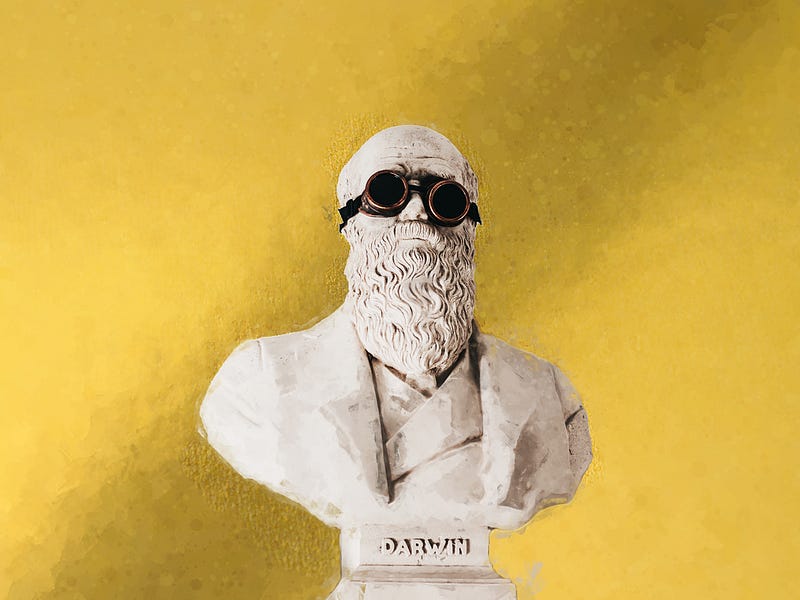
Darwin wasn’t a particularly smart guy.
Some experts estimate his IQ capped at about 130, which surely is enough to obliterate a 100-flatter like me at checkers — but we’re talking about someone who’s buried a couple of feet away from Isaac Newton, the intellectual anomaly.
When I went to Westminster Abbey I had to pay 18 pounds to visit their graves. That’s how we know they’ve done something special.
But what kind of life advice can Darwin give?
Meaning, something that hasn’t been yet covered by Marcus Aurelius, Mark Manson’s blog, or whoever writes the fortune cookies.
Well, Darwin was no Buddha, but he was a scientist with a rule.
As he admits in his autobiography, this rule helped him discover that theory of his, you know the one. But how can this rule be applied in the broader context of life?
This is what Darwin’s “golden rule” is all about
I had followed a golden rule, namely, that whenever a published fact or new observation came across me, which was opposed to my general results, I’d make a memorandum of it without fail and at once.
Basically, Darwin’s golden rule was “look for exceptions.”
Fair enough, looking for exceptions is standard practice for scientists. I reckon that for every lab mouse that perishes to prove a theory, a second one has to be killed to attempt a debunk.
But what about outside the scientific world?
In life, we do the opposite: we look for confirmation
Like the confirmation checkbox for “I’ve read the terms and conditions,” but also in terms of, am I beautiful?
My face doesn’t ache and my mum has pointed out my charm on several occasions, so I must be beautif — well, if I compare myself to the airbrushed portrait of that Instagram model, I guess I’m only moderately beautiful…
That’s an unembellished way of saying “we learn about life by navigating it and comparing it to the lives of others.” What’s my place? Who am I? How talented am I, at least compared to that 5-year-old wonder-kid playing virtuoso piano, backwards, whilst reciting Shakespeare from memory?
Guess I’m a moderately beautiful, moderately talented specimen trying to survive in a moderately merciful world.
There’s just one problem with this confirmation-seeking way of life.
Reality is far too big for our brains to grasp it whole
Our senses — the only doorway to reality — are terribly ill-equipped to bear with the full extent of it.
I mean, car mirrors have to warn that “objects are closer than they appear.” We’d buy overprized stuff just because it’s “at a discount.” We couldn’t even agree on whether if that dress was black and blue or white and gold.
That’s why we look for confirmation: it makes us feel we have a grasp on a world that doesn’t really have any handles to hold on to.
It turns the daunting reality of life into something personalized, private and familiar.
This confirmation-obsessed way of life comes with a price
Back in the Darwin years, upon looking at the differences between monkeys and turtles, crabs and barnacles, people were of the opinion that “God did it.”
No one could’ve imagined that barnacles were related to crabs, or more shockingly still, that barnacles are distantly related to us, the monkeys.
Our need for confirmation makes reality more manageable, but it also blinds us to the (sometimes counterintuitive) truths of life.
So creationists keep pushing the “God did it,” new-age self-development junkies try to summon an indifferent Universe to conspire in their favour, flat-earthers perform their ground-level experiments, and in the midst of the chaos, Kanye West might be very well thinking he’s the reincarnation of Jesus.
Hereby the reason why we’re all trapped in our own confirmation biases and self-fulfilling prophecies: we don’t see reality as it is; we see reality as we are.
That’s why we might as well “look for the exceptions”
We might as well look for counterpoints to those ill-fated beliefs that won’t let us live our lives the way we fancy.
Disprove the belief that a face should ache from shame for not having Robert Pattinson’s perfect jawline. Debunk the opinion that success is reserved for the talented and the overprivileged.
If exceptions give us perspective, we’ll get a better grasp of life when we prove ourselves wrong.
We’ll realize that we’re ordinary in some ways, but remarkable in some others. We’ll recognise that “bad guys VS good guys” is a vulgar simplification: reality is made out of space, time, and nuance.
Your “self” can be whatever you want
And you can be just a few exceptions away from it.
In the end, every belief and opinion is but a single frequency in the whole spectrum of reality. You can tune in to a different frequency if you look at the exceptions, counterpoints and objections.
Follow the golden rule: look for exceptions, and you’ll change the way you think about yourself.
And just in case you to do something remarkable with your life: don’t force tourists to pay 18 pounds to honour your grave. That’d be a nice gesture.


