
Dark: What your ‘Present’ can learn from your Future?
Whenever we talk about our past-self or future-self, we talk on a comparative basis — a comparison with our current self. For the past, we carry a nostalgic feeling of how happy we were and for the future, we imagine (and strategize) how we could be happy. But there’s a common underlying flaw in this model of self-criticizm. In both of these scenarios, we are imagining “happy” moments.
If you have accumulated sufficient experience in your life, you might have realized that ‘that’s not how life works.’ Yet our mind constantly lures us to these happy memories — from our nostalgic past and ideal (probable) future. Though, Netflix’s Dark gave a whole new dynamic to this conversation, at least for me.
**Major Spoilers & Self Talk Ahead**
Dark, created by couple duo Baran bo Odar & Jantje Friese, is a German TV series that has explored a number of sub-genres of Sci-Fi like Time Travel, Parallel Universe, Quantum Entanglement, Time Loop, and Apocalypse. And that too to the utmost perfection. Yet one characteristic feature of this mind-bending story-telling, which stood out to me was the characters having a discussion with their future self (and past self, depends on the perspective).
In the last episode of the first season, it is explained that the stranger guiding our protagonist is the future self of our protagonist who has traveled back in time. Though this became a common occurrence there onward and many characters interacted with their older or younger self.
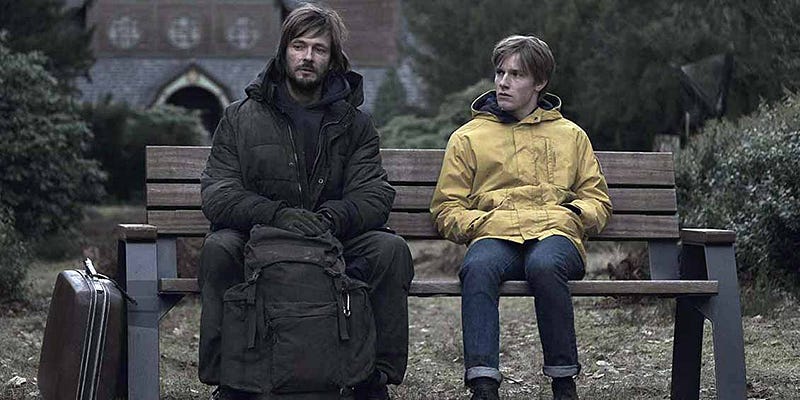
But apocalypse being at hand and with some missing relatives, there was very little room for compassion or curiosity. The only expression which was prevalent during these interactions was of disbelief, disregard, and on some occasions disgust (ref. Adam).
Obviously it was a dramatized version pushing the human extremes. But if you imply these situations in your real life — it helps you understand the different characters of your own personality.
As I said earlier we see past and future from the lens of happiness, but it’s essential to see it from the lens of pain, once in a while. This will help you gain perspective and help you realize that both joy and sufferings are inevitable. This will allow you to acknowledge the present more.
For instance, you might have felt about your childhood-self that ‘all he used to worry about was missing his favorite cartoon show or collecting Tazo cards’. Being 15–20 years ahead of that kiddish version of yourself, you are prone to undermine those childhood worries. Yet this very analysis of yourself tells you that:
(1) Those worries were all you could think of, in that moment. So those childhood (or even adolescent) worries were equivalent to your current career-related worries.
(2) Your future self is going to undermine the worries of your current self.
Yet all we worry about is having a future — which means having a decent paying job, earning more and more, getting married, and settling down. Thus we “die” every day to achieve that lifestyle for your future self.
You need to ask yourself: What makes your future self worthy of your present self’s sacrifices and considerations? The person you are right now is as transient, as amendable, and as temporary as all the people have ever been. The one constant in our lives is, change.
Another interesting postulation which Dark presents is how indifferent the future version could be from your current version? In the last episode of the first season, the future self (stranger) of our protagonist (Jonas) tells about his identity after capturing him in a bunker, “I have been through everything you are going through.” The stranger knew his younger self wouldn’t believe him, neither did he when he was in his place.
An advanced intensity of hatred was developed between the protagonist and his even older self, Adam. For he was 66 years older than him and had seen more life (and universes) than him, he was much more rational in his approach than his younger self. He has outgrown his infatuation [for Martha] and is now determined to see the bigger picture.
And that’s exactly how our life would unfold. I mean, not creating a secret society controlling the time travel, but evolving from your current self to your future self in a much mature and logical version of you. In order to make that happen, we need to keep exploring and keep learning, seeking betterment.
While imagining a hypothetical future situation, we erroneously assume our current self in that particular moment. Completely ignoring the fact that, both our appearance and thoughts would have changed by then.
Your future self will be a different person regardless of effort and intention. Change is inevitable. Growth is optional. Moreover, as Dr. Gilbert explains, remembering is easier than imagining.
We treat our future selves as though they were our children, spending most of the hours of a days constructing tomorrow that we hope will make them happy.
Our future self will be more like our ungrateful son, incapable of acknowledging what we are sacrificing for them. (Just kidding)
If I had a conversation with my future self, I would like him to thank me for the efforts I am doing in order to give him a better life. But then again, he might tell me to leave all these capitalist shenanigans behind and do what you like. Quit your full-time job and focus on this writing thing more and it will lead you to your better self.
Yield to your passion and minimalist happiness, we would earn less, enjoy more. Learn to make that origami turtle, imagine how reassuring that would be. Ironically, we are ready to believe in our time traveling future-self but not the voices coming from our present-consciousness.
The uncertainty about the future has made us too insecure. The only certainty about the future relies partly on hard-work and partly on luck. Though our decisions and life choices are the ones that bridge the gap between our current self and future self. The relevancy of that future self and the current day expectations of your future self, will not matter when you will be in the future.
Hence, appreciate your past self; stop imagining stuff, start taking actions, accept failures, learn from mistakes, enjoy the ride, and your future self would be proud of how far you have come. Appreciating your past-self will unlock the door for you future-self to appreciate your present-self, relieving you from the burden of failures.


