
Dark Topics Earn Big Money
Fellow writers, have you had the same experience? And what does this say about us as a society?

I recently conducted an audit of my nearly 200 articles’ stats. I wanted to see which topics, keywords, and key phrases did well, so that I could search for similar ideas to write about.
I thought it would be a fun exercise. Given my background in math, I love crunching numbers. I love figuring out what works and replicating it.
It turned out to be depressing.
Just about every story I’ve written that has done really well — which I will define as greater than 1K views and earnings well into three figures or higher — has been about a dark topic.
Narcissism.
People who don’t take responsibility in their lives.
Fake, two-faced friends.
You get the idea.
What do you do when dark topics sell, but you’re not a dark person?
More than anything else, I enjoy showing others how to have happy, fulfilling lives.
My favorite topic to write about is gratitude. I have a practice I do every morning where I list things I’m thankful for. I connect with the best future version of myself and invite his energy in. I express my gratitude for being part of the universe experiencing itself. I love that. I love writing about that.
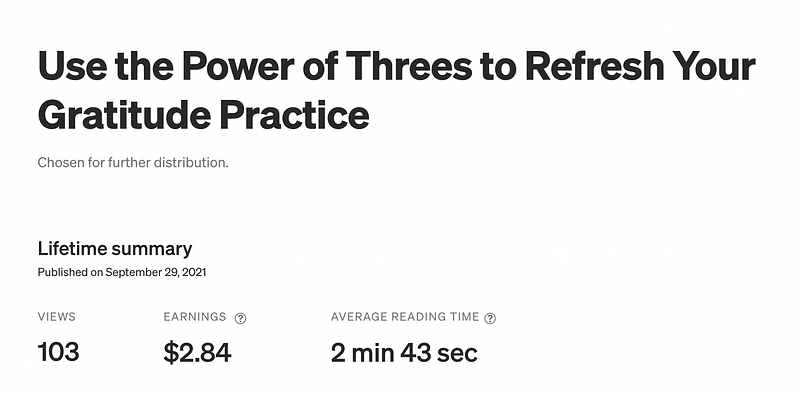
You know what I don’t love, though? Earning $2.84 for a story that took me three hours to write.
I’m not a dark person. I’m a happy, loving, empathetic person who is generally at peace with himself. Like many of us, I have had encounters with dark people that have temporarily put me in a dark place. Okay, I should clarify — when I say “temporarily,” I mean, I was in a dark place for a matter of years.
But I’m not there anymore.
I don’t want to go back.
Writing about those dark characters, and the ways they attempted to destroy me, takes me back. It makes me re-live experiences I don’t wish to re-live anymore.
There’s a concept in dealing with personality disordered people known as “no contact.” You cut them totally off. You block them on all communication channels. You make it a point to stay away from places they frequent. Not only does this cut off their supply of attention from you, but it also gives you space to recover your mental health.
Writing about these dark characters violates “no contact” in a couple of ways. First of all, it renews the lease they have on space in my mind. Thinking about them lowers my energetic vibration and reduces my ability to attract good people and situations to me.
The other way it violates “no contact” is that these people stalk me on social media. I’ve caught a suspected narcissist stalking me on Instagram and Twitter, and I know he’s on here because he actually had the nerve to give me a follow. I blocked him immediately, but I have to assume he’s created new accounts and is reading everything I publish.
If I had my way, I’d never write about dark people and topics again.
According to my stats, however, if I stop doing that, I’ll be living in a cardboard box and eating cat food.
It’s human nature to gravitate toward dark topics
When I have 30 minutes to an hour to kill on here, and I want to get some good reading in, you know what topic I’m most likely to pull up?
True crime.
It’s fascinating to read about sinister minds and the elaborate plots they concoct to snare their victims. It’s enthralling to read about narrow escapes from the law time and time again. And it’s a relief when they finally get their comeuppance at the end.
So I understand how dark topics can draw you in.
There are few bigger rabbit holes on the Internet than Quora. Anybody can ask a question, anybody can answer a question.
Quora provided me closure to a situation in which I thought there would never be any. Victims of narcissistic abuse feel like no one else could possibly have as bad an experience as they had, like no one would possibly understand, like they’re the main character in a modern Shakespearean tragedy.
When I found Quora, it helped me understand what I experienced is quite common. It helped me understand that the people who attacked me are deeply broken people. It helped me understand that I don’t need revenge on them, because they’re already more miserable than I can ever imagine.
Quora gave me my sanity back. I’ve probably spent 500–1000 hours on there reading about narcissism, historical narcissists, and Cluster B personality disorders. I don’t regret the time I’ve spent on there a bit.
Yet, I think, how much time have I spent on Quora reading about how to be happy and grateful and alive in the present moment?
Maybe 30 minutes to an hour, tops.
No wonder my gratitude article earned $2.84.
What does this say about the direction we’re heading as a society?
One of my favorite people is my friend Mary. I met her when she was 19 and she was clearly an old soul even then. She went on to become a yoga teacher who has adopted a holistic approach toward healthy living.
Mary once told me that the human race is close to a decision point. We have to decide whether to embrace consciousness, love, our connection to all other humans and forms of life — and if we do that, the human race will evolve. How cool would that be, if Homo sapiens sapiens chose to evolve into an entirely new species, through the power of our minds and our spirits?
Not long after I had that discussion with Mary, I started reading author Eckhart Tolle (The Power of Now, A New Earth) and his message was much the same.
However, if we don’t choose to evolve, we will choose fear and unconsciousness and disconnection from one another. We will keep hurting each other. We will keep going to war with each other — and while war has been around for millennia, within the past 80 years we’ve developed the weaponry to drive the human race to extinction.
Given how much time we (myself included) spend reading about unconscious, unevolved, emotionally disconnected people and the pain they cause, I fear we as a society are about to make the wrong decision.
Final thoughts
We’ve reached the part of the article where I’m supposed to provide an insightful takeaway, a call to action that inspires the reader to better their life in some way.
Sorry. Today I don’t have one of those. All I have are questions. And I’d sincerely like to hear from my fellow writers and readers. Sound off in the comments if you’re so inclined.
Fellow writers, do you also find that writing about dark topics earns you considerably more money?
If you have found empowering, uplifting topics that earn well — how did you find them?
Do you yourself find that you spend a lot more time reading about broken people than peaceful, happy ones?
Are you concerned about our future as a human race, given our inclination to gravitate toward the darkness more than the light?
Any other comments? I’d love to read your thoughts.
Thanks for reading.
Let’s keep in touch! Feel free to sign up for my newsletter. You can also subscribe to me on Medium. Join Medium today and read unlimited articles!
If you’d like to read my light, happy articles, here’s a link to my gratitude article index. If you want to read my dark articles, here’s my index of articles on narcissism.