
Dark Runners
How much suffering can you endure?
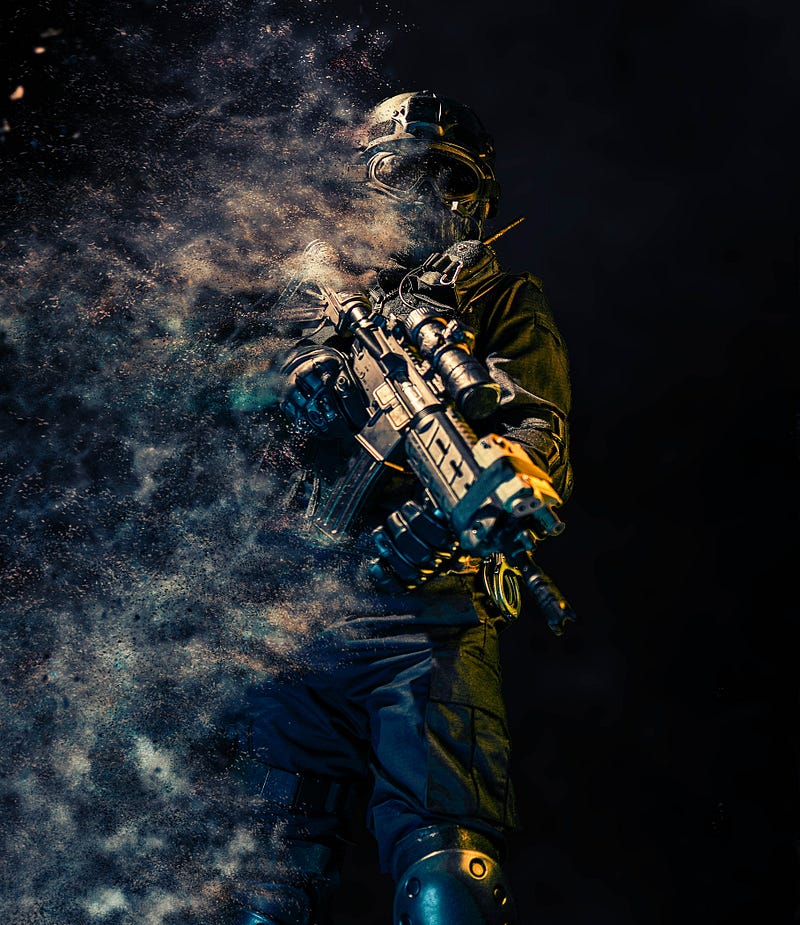
It’s the last week of training. At evening formation, our instructors tell us to get a good night’s sleep. Our final test will be tomorrow and we’ll need to be ready. We don’t know what the test will be. This is one of the most well-known schools in the military. The training and testing is all made clear to everyone, even before applying. Except for this one. This test is a secret known only to those who’ve been through it… and survived.
Those who pass this test become Dark Runners. The most elite of all the services. In the past, they would have been considered black ops, but times have changed. The people have been aware of the government’s secretive acts of violence for decades, so they see no point in trying to hide it anymore. Trying to hide something you know everyone is going to find out anyway is a waste of time and resources.
Dark Runners are notoriously dangerous. Stronger, faster, and more accurate than anyone else known to man. Many consider them to be super-human. But it’s not their physical abilities that scare people. Dark Runners show no evidence of emotion… ever. They don’t laugh, cry, or even grieve. They can be merciless without showing even an ounce of remorse or regret. Their complete lack of empathy or compassion is what terrifies people.
And they’re easy to spot. Always dressed from head to toe in all black. The only skin ever showing is their face. They dress this way even when they’re not on duty. Or, maybe it’s that they’re always on duty. No one really knows.
Some apply to this school because they want to be the elite. Some just want the prestige of belonging to this organization. The second group are the ones who usually wash out right away. They don’t actually understand what they’re getting into. I joined for the abilities you develop while here. I’ve always wanted to serve, but I want to be the razor’s edge of the blade.
Four months ago sixty of us started out, but now only five remain. That’s on the lower side of average for this school. No one is forced into this program. We all chose this. But neither are you forced to remain. You can drop out any time and no one will think less of you for it. This isn’t the place for most people.
Since there are now so few of us, we’ve all been moved into a single barracks room. It’s adequate, with enough room for two sets of bunked beds and one standalone. After dinner, we all go back to the room. We need to sleep, but we’re all nervous. None of us know what’s going to happen tomorrow. The tests we’ve already been through have been brutal, but we know this one will be harder. And not knowing what it’ll be makes it even worse.
Today was a hard day though. They’ve all been hard days. As soon as we’d arrived, the instructors made sure we hit the ground running, and they never let up. Before long, today’s exertion wins out over our nerves, and we’re all unconscious.
In what seems like the next instant, our room is swarmed with our instructors and several Dark Runners. They’re so fast. They’ve got us bound with hoods over our heads before any of us are even able to get up out of bed. They fast march us to a transport vehicle and literally throw each of us inside and shut the door. The vehicle is moving before we’re even able to get up out of the dogpile we’ve landed in.
With the hood over my head, I can’t see anything but I try to follow along with the turns the vehicle makes, hoping I’d at least know where we’re being taken. There’s too many turns, stops, and reversals though. I know they’re doing it on purpose so we won’t be able to follow along. Right near the end, the vehicle is on an elevator going down. This is very confusing. We’d never gone up any inclines and I’m not aware of any underground facilities in the area.
Once the elevator stops, the vehicle drives a short distance and comes to rest. As soon as the vehicle is stopped, the doors are thrown open and we’re forcibly removed. We’re fast marched about 100 meters and my bindings are cut. But, before I can react, I’m thrown onto a flat, hard surface and my arms and legs are strapped down.
The hood still prevents me from seeing anything, but I can hear a lot of commotion in the room. I hear one of my classmates try to say something but it sounds like he’s struck and someone tells him to be quiet. Someone gives me several injections into my neck, while others cut my clothing off. When they finish, the surface I’m laying on is set at an incline with my head higher than my feet.
After another moment, the commotion in the room stops, and my hood is removed. I see that my classmates and I have been strapped to surgical tables which have been arranged in a circle and, due to the incline, we’re all facing inward, toward each other. Our Chief Instructor is standing in the middle of the circle and he says, “Welcome to your final exam. The objective here is simple: survive the procedure. Doctors, get to work.”
As soon as he’s finished, a small module with several needles is jammed into my side. The tubes leading to the needles are transparent and I can see a beige liquid begin to pump through them. Several other needles are jammed into my other side and blood begins to flow out of my body, through the tubes. Seeing the look of concern on my face, one of the doctors points to the tubes with the beige fluid and says, “This is what’s going to keep you alive.”
After a few moments, the strange fluid replaces the blood that’d been coming out through the other tubes. The doctors wait a moment more and then start to pinch and slap me all over my body. Arms, legs, torso, head, everywhere. After each one, they ask if I could feel it. When I tell them I can, they say, “Good,” and move on to the next until they’ve covered my entire body with red pinch and slap marks.
When they’re finished, they undo the bindings on my wrists and ankles. I try to shake out my arms but find I can’t move them. I try to move my legs with an equal lack of success. I try to look toward one of the doctors and say, “I can’t move.” The words come out in a croak, but my head doesn’t turn. Another doctor gives a hard slap to my abdomen and says, “But you can feel, right?” I croak out a “yes,” and he responds, “Good,” and goes back to what he’d been doing.
I can blink and move my eyes, I can breathe, and I can speak somewhat, but beyond that, I’m completely immobilized. I look at my other classmates, who are all in the same state, and I’m a bit relieved to see I’m not the only one who’s scared. It’s clear we all are.
The doctors leave us and start to work on various tasks around our perimeter and I’m not able to make out what they’re doing. After watching the doctors for a couple of minutes, my eyes return to my classmates who are now looking very pale. As I try to focus on their skin I see that it isn’t simply a color change. Their skin has taken the appearance of raw chicken skin. I can’t see my own body but assume my skin looks that way as well. I also notice I feel very cold now.
The doctors return to us and do a few more pinch and slap tests. Satisfied with the results, one of the doctors takes my arm by the wrist and positions it out away from my body. He then places the sole of one of his feet against my ribcage and gives a hard tug. My arm is ripped from its socket and the flesh torn away, completely detaching from my body. The pain is intense and I croak out a scream. The doctor takes my arm somewhere behind me and I hear the others cry out. I look to see my classmates receiving the same treatment.
I’m twitching from the pain when the doctor returns. He looks at me and says, “Don’t worry, it’s just shock,” and lets out a chuckle. He then holds a robotic arm up to where I can see it and says, “You’re getting an upgrade.” Then he and another doctor shove the limb into my empty shoulder socket. I’d thought the pain of getting my arm ripped off was bad, but somehow having this new arm placed is worse.
Several doctors then go to work on the new arm. I can’t see what they’re doing, but looking to my classmates I can see they’re having wires connected between the robotic limb and what I can only guess is nervous tissue. When they’re finished with one of my classmates, a doctor says to him, “Congratulations! You’re a cyborg,” and another doctor rips his other arm off.
He screams out in pain which is followed by the scream of another classmate. I look to her to see that, when they’d removed her second arm, a large patch of skin had peeled off from her shoulder all the way up her neck and to her face. The skin of her face is gone, still connected to the flap of skin from her neck and left shoulder and hanging over the right shoulder. Her twitches become full convulsions and her doctors stop what they’re doing and remain in place to ensure she doesn’t fall off the table. When the convulsions die down, one of the doctors flops the skin back across to where it should be but makes no attempt to reconnect it. Because she’s still twitching pretty hard, the skin on her face doesn’t line up right and she looks at me with her left eye, but through the hole in her face for her right eye.
I don’t have time to be horrified as my other arm is torn from its socket. It’s also replaced with an “upgrade.” When they’re finished wiring in that arm, they go to work on my legs, which receive the same treatment and similar upgrades. The pain is unbelievable, but toward the end of the procedure, I become indifferent to it. I can still very much feel it, but I no longer care. The cries of my classmates have stopped as well. We’re all still twitching, but none of them are reacting to what’s happening anymore either.
When the doctors are finished connecting the limbs they go about other, more routine, tasks. This includes ensuring the new limbs are working properly, which is done via remote access ports, checking vitals, and applying stitches where needed. The last takes a bit longer on my classmate, but when they’re done her face is back where it should be.
As the doctors are finishing up, our Chief Instructor comes back into the center of the circle. He says, “Congratulations. You’ve survived the hardest part, which means you’ll likely recover. Recovery will take a few weeks, and during that time you’ll become accustomed to your enhancements. You’ll be given blood transfusions at a couple of points as well. By the end, you’ll have a mix of blood and nanofluid coursing through you. Your body will continue to make blood, though not as much as before, and the nanofluid is self-replicating. Together, they’ll keep you in tip-top shape.”
“I know you’re curious,” the instructor continues, “as to why this wasn’t carried out in the same manner as a regular surgical procedure. The truth is we could have done it that way, and it would have been safer and had a higher likelihood of success. But it would have denied you an important weapon in your arsenal. When a person experiences the destruction of their own body and witnesses the destruction of their friends, the emotional centers in the brain shut down. This is a form of shock, and it’ll last the rest of your life.
“Because of this, when it’s time for you to carry out orders that would make the average person squirm, you won’t hesitate. Fear, regret, and compassion are no longer problems for you. You can thank our doctors for that, as well as your increased speed and strength. These weapons together will make you all but unstoppable.
“You’re going to be moved into a recovery room now and suited up with your new uniform. You will have this uniform on at all times when in the public eye. It’s imperative that no one find out about the augmentation you’ve received. Do you understand?”
We all respond, “Yes, sir!”
“Excellent,” the instructor says. “Well done, Dark Runners.”
Thank you for reading.
For something dark:
For a moralistic tale:
For something short and ominous:


