
Dark matter mystery (#1)

Dark matter is a mystery. Astrophysicists have been talking about dark matter for nearly 100 years. Billions of dollars have been spent on research into dark matter. Some people believe that whoever can explain the composition of dark matter will win a Nobel Prize. There is a lot of competition among physicists to discover what dark matter is.
Dark matter was first postulated as an explanation for why stars seemed to have velocities faster than the predictions of Newton’s law of gravity. Newton’s inverse square law is taught in high schools. Measuring the velocities of stars is difficult and requires sophisticated equipment. Nevertheless, data about the velocities of stars has been published and so anyone who is familiar with Newton’s law of gravity can compare predictions using Newton’s law with actual velocities.
Out of interest, I made some calculations using statistical information about the masses and velocities of stars contained in the SPARC database of 3,360 stars in 175 galaxies. With an excel spreadsheet, I calculated the root mean square error (RMSE) and standard deviation between predicted and actual velocities. For the 2,684 stars greater than 2 kiloparsecs (kpc) from the centre of a galaxy, the RMSE was -19% with a standard deviation of 28%. In brief, Newton’s equation underestimates actual velocities by on average 19% with wide differences between stars. This conclusion is well known to astrophysicists.
I was, however, surprised when predicting the velocity of stars using the following formula:
P₀ = N₀ +E-₁ ………………………… Eq(1)
where:
P₀ = Predicted velocity for star 0;
N₀ = Predicted velocity for star 0 using Newton’s formula;
E-₁ = Error-₁ = A-₁ - N-₁ where -₁ refers to the adjacent star closer to the centre of a galaxy;
A-₁ = Actual velocity of adjacent star.
This formula had a RMSE of -2% with a standard deviation of 5%. The 5% standard deviation is consistent with the uncertainty associated with measuring the actual velocities of stars.
I believe, without any supporting evidence, that at least some astrophysicists must be aware of this statistical relationship. Nevertheless, it seems to me that the relationship is worth investigating even though it might turn out to be just due to chance. The issue is that, depending on how the error term is interpreted, this formula is inconsistent with astrophysicists’ ideas about the nature of dark matter. If the formula were found to be causally meaningful, millions of dollars of expenditure on research into dark matter could be a waste of money. Furthermore, the careers of astrophysicists investigating that the possibility that dark matter is some kind of new particle could turn out to be wild goose chases.
Renzo’s rule
In 2003, Renzo Sancisi, Professor of Astronomy at Groningen University in the Netherlands published a paper about possible relationships between visible matter and dark matter. He concluded:
“… the observed correspondence between the shapes of the rotation curves [of galaxies] and those of the luminosity profiles … [suggests] the gravitational potential is strongly correlated with the distribution of luminous matter: either the luminous matter dominates or there is a close coupling between luminous and dark matter.
… these results bear on the debate on cusps in the mass profiles of the central regions of disk galaxies as predicted by CDM simulations. … if the baryons indeed dominate in the central regions of all spirals … how can the CDM profile be compared with the observations? If, on the other hand, the baryons do not dominate but trace the dark matter distribution, why, in systems of comparable luminosity, are some dark matter halos cuspy (following the visible matter) and others (also following the visible matter) are not?”
In brief, Sancisi’s conclusion that galaxy rotation curves seem to be strongly correlated with the distribution of luminous matter is inconsistent with hypotheses of dark matter that are part of the standard model of cosmology namely Lambda Cold Dark Matter (CDM). Eq(1) above, however, could be consistent with Renzo’s conclusion. The issue is what might be a scientifically acceptable theoretical explanation for the error term in Eq(1)?
Origin of error term
This section which speculates on the nature of the error term, is intended to provide a context for subsequent articles in this series; articles that provide a theoretical explanation for Eq(1).
Newton’s explanation for gravity could be described as belonging to a static description of our universe. When Newton formulated his law, he did not know that our universe was expanding. Einstein, who built on Newton’s idea that the velocity of a mass in space is proportional to the square root of the distance between two masses, also did not believe the universe was expanding when he first formulated the Theory of General Relativity.
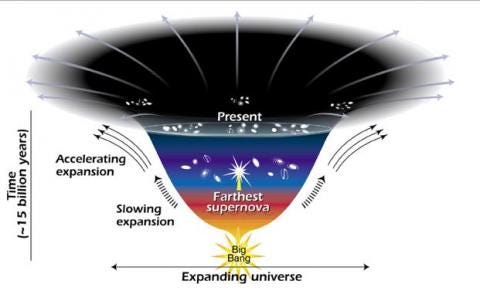
Astrophysicists now claim that the universe is expanding because of a negative force called dark energy. This expansion means the distance between a star and the centre of a galaxy might increase over time. As a consequence of this expansion, if the velocities of stars were to remain unchanged, the stars would need to move in a way that offsets the expansion in space in order to be consistent with Newton’s law of gravity.
Astrophysicists may have derived complicated equations to explain the dynamics of how stars move as a result of the expansion of space. Empirical research to test such dynamics, however, is likely to be difficult due to uncertainty associated with accurately measuring movements of stars over relatively small distances.
A different approach to predicting the velocities of stars using available information i.e. Newton’s equation, involves reformulating the error term, E, in terms of the difference between the Newton equation and unknown adjustment equations associated with changes in velocity due to growth in space. For example, the actual velocity of star 0, A₀, could be set equal to the velocity predicted by unknown adjustment equations plus the prediction associated with an adjacent star, E-₁, as adjacent stars are equally affected by the expansion of space.
E₀ = A₀ - N₀
When A₀ = K₀ + E-₁
then E₀ = E-₁ + (K₀ - N₀) ……………… Eq(2)
where:
A₀ = Observed velocity of star 0
K₀ = Velocity of star 0 based on some unknown dynamic adjustment equations. K is short for Kolmogorov for reasons to be explained in later articles.
Assume that star -1 is located in the space that was occupied by star 0 before the expansion of space. This assumption is analogous to using calculus to estimate the effect of small changes in position.
Assuming that the error term is zero when the star is born at time B (E-B = 0) and using this approach to account for unknown adjustment equations, the Error term for star 0, E₀, is the sum of all previous errors for the same star because K-B = N-B. In other words, Newton’s equation applies at the birth of a star but the relationship changes as space expands.
This adjustment equation is consistent with the universe being configured to store information. Following Einstein’s analogy of the fabric of space being like a rubber sheet that stretches where there is matter, this analogy could be expanded to the fabric of space being more like a stretchable sheet made out of memory foam. The fabric of space is rough and uneven like ‘footprints’ created by past events.
The theory developed in these articles suggests that:
Dark matter is information about the curvature of new space around a star; as our universe expands, dark matter increases.
The idea that our universe might consist of information is not new. Professor Seth Lloyd of Massachusetts Institute of Technology has written about our universe being a giant computation. Other physicists such as Leonard Susskind have suggested our universe is a hologram. Some academics such as Nick Bostrom speculate that our universe could be a simulation.
Fabric of space as memory foam
The memory foam interpretation of Eq(1) could have implications for laws of physics. Some laws may evolve over time. What was true in the past may not be true now. The application of Newton’s original inverse square law evolves into something that needs to incorporate past events.
A memory foam interpretation may also include the possibility that when consciousness becomes an event in the evolution of the universe, the laws of physics might also evolve according to how a conscious interpretation of those laws changes. In brief, a memory foam explanation of physical laws might allow consciousness to change those laws.
For example, when the position and velocities of stars are determined by information, changes in that information could result in stars changing their orbits and velocities. Analogously, the orbits and velocities of greenhouse gas molecules in Earth’s atmosphere could be determined by information. If we could change that information, we might be able to moderate the rate of global heating by expanding the volume of space around Earth within which the greenhouse gas molecules circulate i.e. reduce the density of the molecules in space. How we might change that information requires more research.
This series of articles discuss a number of mathematical and scientific discoveries that could explain why Eq(1) is causally meaningful i.e. can be justified in terms of known science.
This article is the first in a series of 47. A collection of the first drafts of all the articles can be accessed at https://www.amazon.com/dp/B09L6VK75K/


