
Dancing on the Face of the Swarm
A honeybee colony in swarming season
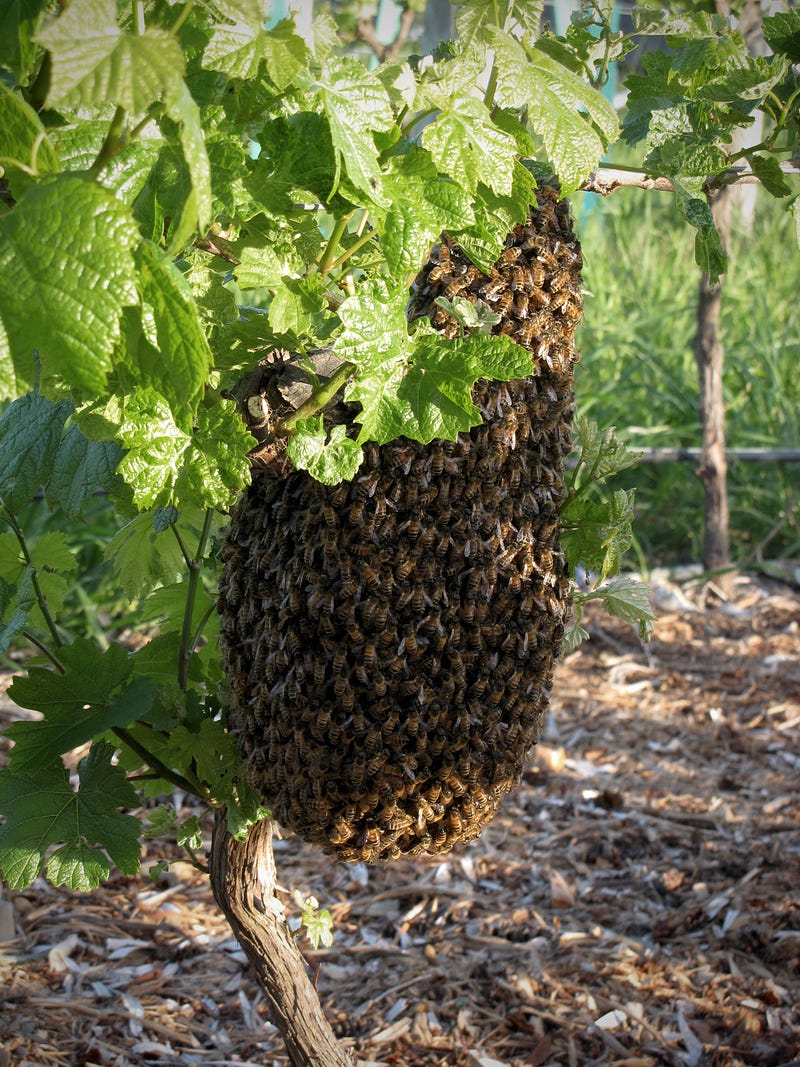
We’re in the middle of spring here on the Victorian coast.
At this time of year, honeybee colonies expand and their nests become congested, as the queen increases her rate of egg laying, and foragers bring in increasing supplies of nectar and pollen. All of this activity requires additional storage space and living quarters, and sooner or later, home is full.
Beekeepers attempt to keep up with the bees by providing extra space, but the wild swings of spring weather limit the opportunities to open the hive and add new boxes.
Stasis isn’t what bees are about. Never mind a steady state economy: honeybees are expansionists. They’re in the business of filling the world with honeybee colonies.
So, when home is full of baby bees and the larder is full to bursting, the answer is — SWARM!
The queen of a honeybee colony is no monarch: as the only fertile female she is the genetic future of the colony, but she has no autonomy of decision. It is the workers who ‘decide’ that it’s time to start rearing new queens. Their ‘decision’ is itself a response to stimulus: an awareness of congestion within their home, a dearth of empty cells to deposit new eggs into.
So now we’ll build a few queen cells, and put these female eggs in them, thank you very much, Ma’am. We’ll feed the larvae on royal jelly to turn them into queens. And as for you, Old Girl, it’s about time you lost some weight. You’re far too fat to fly! We’re putting you on a calorie-reduced diet, and we’re going to nip your chunky arse until you get running around like you mean it!
The preparations for swarming are complex, yet it only takes a few days to turn a busy hive into one that is going to swarm, come hell or high water.
Soon those princesses are taunting each other from their cells: ‘Come over here, b_____ es, and I’ll f____ing have you!’ Every queen bee got where she is by slaughtering her sisters. Yes, Freddie: she is indeed a Killer Queen.
Excitation in the hive builds inexorably.
It’s a still spring day. Warm and humid: thunderstorms are forecast for tomorrow. At the hive entrance, it’s strangely quiet, then …
Swarm’s on, girls! Yeeeeehaaaah!!
Half the colony, maybe 50,000 insects, have been filling their honey stomachs with the amber stuff. Gorged, they barrel out of the narrow entrance to the hive, carrying the old queen, now trim and flight-ready, with them.
The hum of insect wings becomes a roar. The air vibrates with energy. A loose, chaotic cloud of bees coalesces around the queen — the precious spark of life without whom all are doomed.
The swarm gathers on a grapevine a few metres from the hive. With the queen protected deep within, it takes on form. Soon it is an elongated ball of bees hanging like a huge, ripe bunch of grapes. The living skin ripples with movement. Individuals break away from the swarm, depart and return.
Some of the departing bees are scouts. They are scouring the area within a radius of a kilometre or so for suitable nest sites. Their criteria are quite specific:
Desirable residence sought. Living area: 40 litres. Situation: at least 2 metres off the ground, ideally. Features: a small, east-facing entrance would be nice. The home should be in reasonably good repair, but we’re happy to do minor renovations. Rent: we will provide pollination services as required; otherwise, free. Landlords attempt to steal honey at their own risk.
The scouts busily check out the apian real estate market and return to the swarm with their assessment. They dance on the face of the swarm:
I will now perform an interpretative dance entitled ‘Empty Hollow in Old Gum Tree.’ From it you will infer my degree of enthusiasm and also the distance and direction of this bijou residence.
I give you ‘Old Desk in Garage’ …
Ladies! Let’s hear it for ‘Wonky Brick Chimney’ …
And so on and so forth. Fifteen prospective new homes have been identified. At length, consensus builds for one candidate. ‘White Box on Veranda Roof’ is considered the best of the options at hand, being the right size, smelling dry and weather-tight and having a pleasant aroma of bee pheromone which the scouts deem most attractive. After three days, most are dancing for this option.
In the meantime, there have been a day and a night of violent thunderstorms with gale-force winds and occasional hail. There have been casualties in the swarm, and the ground below the vine is littered with tiny corpses.
Yet most have survived. As individuals became drenched and dangerously chilled, they burrowed into the ball, and others took their place on the outer skin. In the centre of the swarm, the queen is safe, warm and dry. It’s a cosy 35˚C in here.
Moving in day! Come along, ladies!
That, with a degree of literary licence, was the process that came to its conclusion in our front yard yesterday. As I write, I can see the bees exploring their new home.
You see, I had prepared a bait hive to try to lure any swarms in the area. We don’t have room for another hive ourselves, being limited to two hives by the council regulations. Instead, the swarm will be collected by a local small-scale commercial beekeeper later today.
We try to be good beekeeping citizens and remove feral swarms from the environment. They would otherwise displace native mammals and birds from nest hollows or end up in someone’s roof or wall, costing the householder time and expense. The Eurasian Honeybee is an introduced species with pest potential here in Australia. Suburban beekeepers like us pursue our hobby only with the good grace of our neighbours and the local council, so it’s wise to keep folks on our side.
A note on the nest-site selection process
I haven’t invented anything here, other than the dialogue. This actually happens. It has been researched over many years by entomologists including Prof. Thomas D. Seeley. His book Honeybee Democracy is an engaging and fascinating read. I highly recommend it.
My thanks to ScienceDuuude and KS Copeland for accepting this humble contribution to the genial hive mind of WotWU.
Thanks for reading! You might also enjoy this piece:


