
Dancing Bees
In Flower Petals
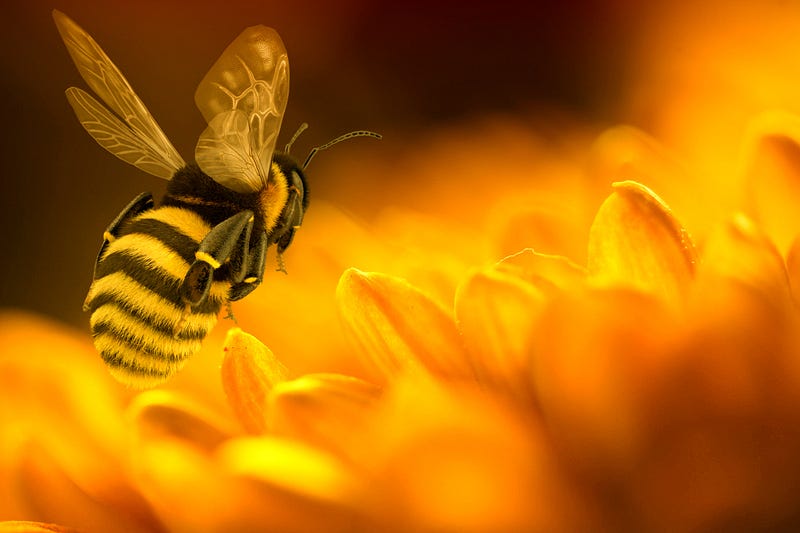
Outside, in the not so vast flower field, the colorful petals are blooming in cheer, with a hint of breeze surrounded, and the sun rays reflecting yellow flavors, I see the dancing bees, moving around flowers to flowers, connecting dots to life and nature, in effortless beats, in smooth tender embracing flowers.
Oh, the joys of juice extraction, catching the flower pollen, transferring from one to another, spreading the smile of the flowers into places, they travel, and the plants they touch, concentrated in their lifelong artistry, and surviving.
Poetry words by Suntonu Bhadra
Related facts (numbers after the fact represents the source#)
- Among the top 100 human food crops worldwide, 70% of them are actively supported by bee pollination — that 70% of crops cover 90% of the world’s food nutrition. (1)
- Honey bees perform 80% of all pollination in the world. (1)
- Previously, a bee-hive or colony declined around 15%-20% in every winter (in the worst-case scenario) and revived those gaps in spring. (1)
- In the recent past, the losses in both U.S. and European countries have reached to approx. 30%-40% in the winter, which is not being replaced in the spring, hence the bee population is declining. (1)
- In other countries, the statistics are probably even higher, as accurate statistics are not widely available. (1)
- Several factors cause the decline, such as pesticides, drought, habitat destruction, nutrition deficit, air pollution, global warming, and more. Humans are mainly directing two prominent causes, pesticides and habitat loss. (1)
- Bee is not the only insect that is declining in the world. The overall mass of all insects is decreasing by 2.5% every year; in that trend- the Earth may not have any insects at all by 2119. (2)
- Based on the February 2019 study by Business Insider, it was found that insects are going extinct eight times faster than other animals like mammals, birds, and reptiles. (2)
- As mentioned in the Business Insider, the rapid shrinking of insect populations is a sign that our planet might find itself clasping the sixth mass extinction in the near future because of these changes in natural habitat. (the Business Insider’s report is based on the work- “The Sixth Extinction: An Unnatural History,” Book by Elizabeth Kolbert) (2)
Source 1. Greenpeace. Link: https://www.greenpeace.org/usa/sustainable-agriculture/save-the-bees/
2. Business Insider. Link: https://www.businessinsider.com/insects-dying-off-sign-of-6th-mass-extinction-2019-2


