
The Career Theme Canvas
An application of Themes of Practice
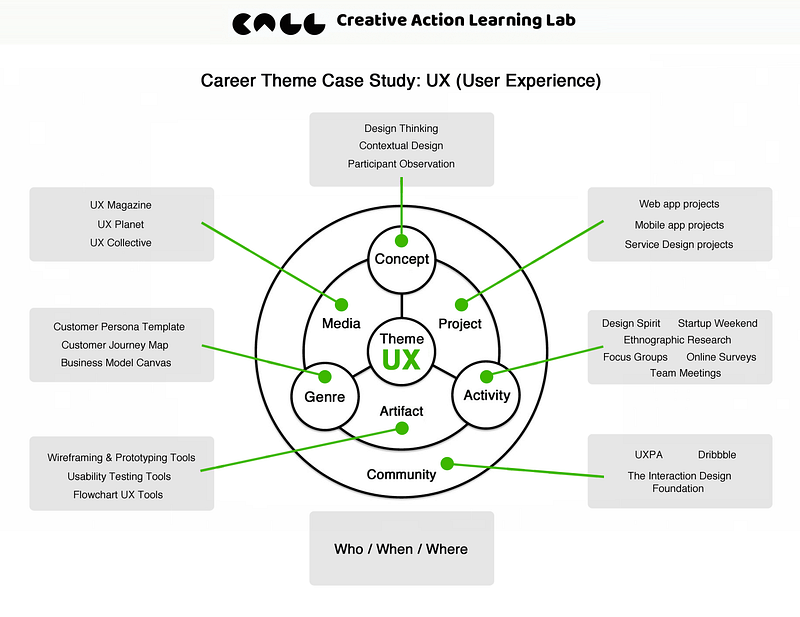
The above picture is an example of the Career Theme Canvas which is based on the Themes of Practice framework.
The Concept of Themes of Practice
I started developing the concept of Themes of Practice in 2019 for the Curativity Theory. I have mentioned the concept in my previous articles many times. The purpose of the concept is connecting “life theme” and “culture theme”.
Anthropologist Morris Opler (1945) developed a theoretical “themes” for studying culture. Career counseling therapists and psychologists also developed a theoretical concept called “life theme.” If we put culture themes and life themes together, we see a great debate of social science: “individual — collective”.
The Old Diagram of Themes of Practice
I consider Themes of Practice as a process type of concept, not a substance type of concept. Thus, it is not a new category of themes, but a transformational process between individual life themes and collective culture themes. It refers to both concept and action. It connects mind and practice. It indicates the transformation of both person and society.
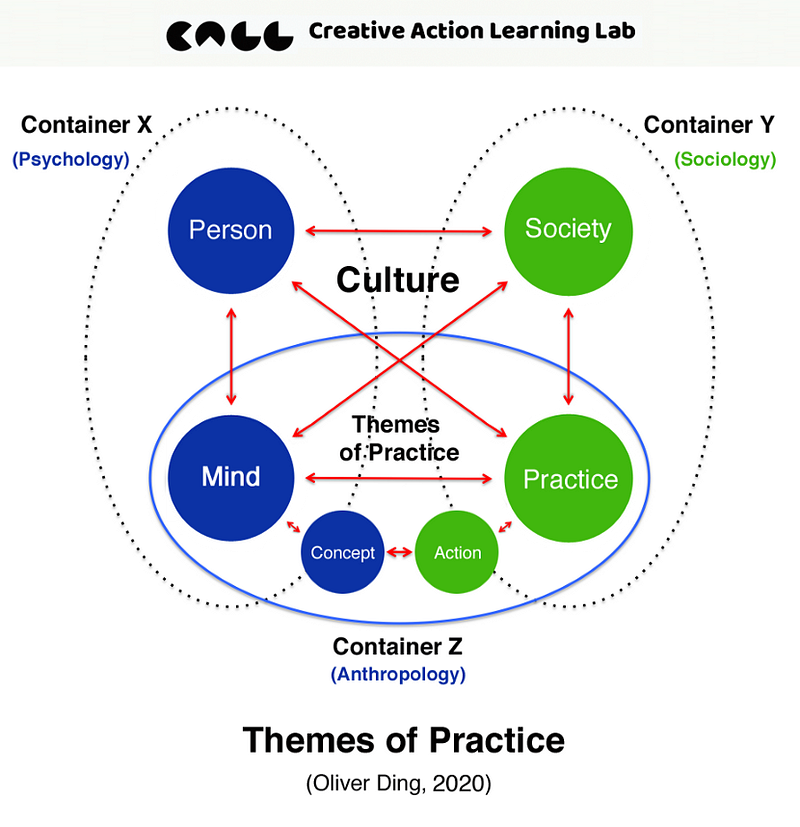
The above diagram is based on the WXMY diagram because it is great for visualizing cross-boundary connections. However, it is a highly abstract model for explaining the concept of Themes of Practice.
A New Diagram of Themes of Practice
In April 2021, I designed a new diagram for Themes of Practice. It was shared on Twitter for discussing Genre Theory. At that time, I didn’t realize that the new diagram offers me a concrete framework for analysis.
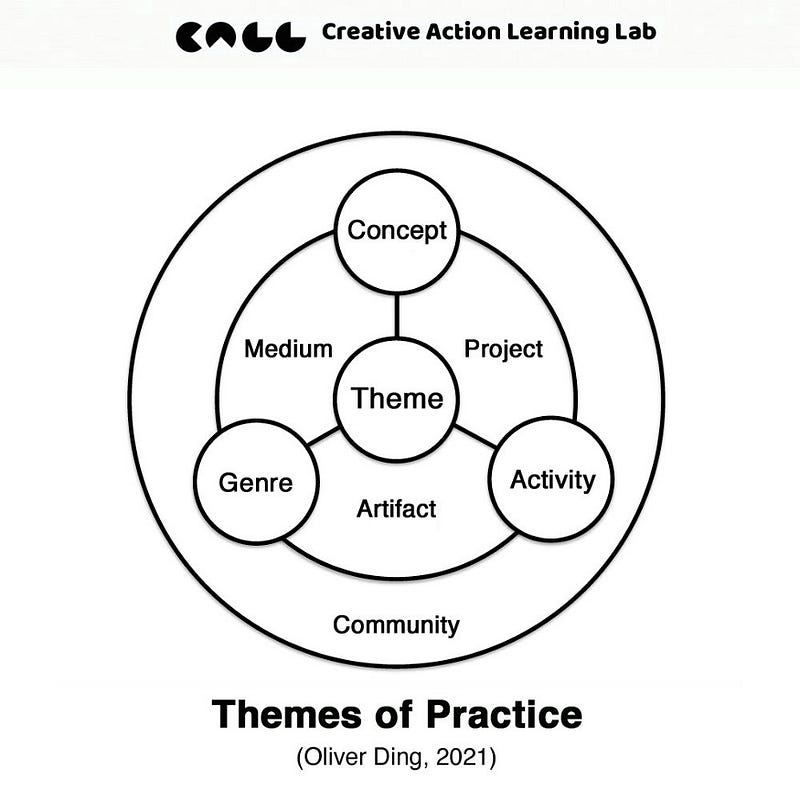
Last month, I started the Career Curation project and applied the concept of Themes of Practice to discuss career development. The project guided me to move to a concrete level from an abstract level. I realized the new framework is perfect for career theme case studies because it offers a structure for observing and evaluating the “Practice” part of “Themes of Practice”.
Career Theme Case Study: UX (User Experience)
Thus, I chose UX (User Experience) as an example of Career Theme and made a simple case study with the new diagram. See the diagram below.
UX (User Experience) is not a job title, but a concept. UX designer and UX researcher are two related job titles. As a concept, UX (User Experience) can be seen as a career theme of UX designers and UX researchers. However, job titles are not the primary factor for discussing career themes. The concept of Career Themes pays attention to real world practice. It’s reasonable to claim that UX is shared by Product Designer, Usability Testing Expert, Human Factor Researchers, Brand Manager, and Community Manager as a career theme.
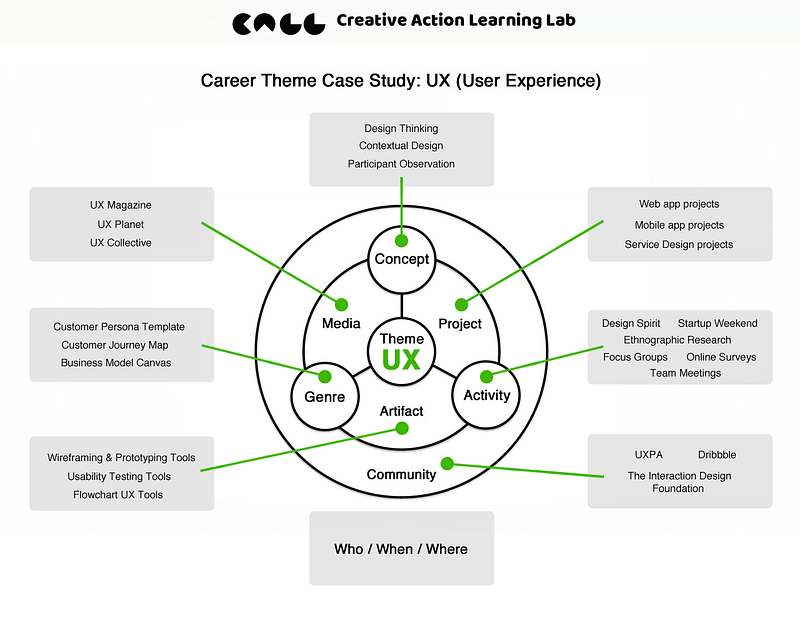
The new diagram of Themes of Practice uses the following ten dimensions for case study:
- Concept: What are related concepts for this career theme?
- Project: What are related projects for this career theme?
- Genre: What are related Genres for this career theme?
- Media: What are related media for this career theme?
- Activity: What are related activities for this career theme?
- Artifact: What are related artifacts for this career theme?
- Community: What are related communities for this career theme?
- Who: who is the person behind this case study?
- When: when is the career duration behind this case study?
- Where: Where did these career events of this case study happen?
The above diagram only presents the general information for UX. It doesn’t offer information of “who/when/where”.
For real case study, we need to collect personal information from the above ten dimensions.
I consider Career Theme Case Study as a component of the Career-fit framework because it offers deep information for each career theme. By understanding this deep information, we can make reasonable Career-fits.
For personal innovation, we can think about possible actions from the above ten dimensions.
You are most welcome to connect via the following social platforms:
Twitter: https://twitter.com/oliverding Boardle: https://www.boardle.io/users/oliver-ding Linkedin: https://www.linkedin.com/in/oliverding
License
This work is licensed under the Creative Commons Attribution-NonCommercial-ShareAlike 4.0 International (CC BY-NC-SA 4.0) License. Please click on the link for details.


