
This Is Us
I Need Mary Anne of ‘The Baby-Sitters Club’ Now as Much as I Did When I Was 13
Thanks to Netflix’s reimagined version of ‘The Baby-Sitters Club,’ I got a glimpse of me again
I’ve often thought about the right way to write about this era of Covid-19 and the racist fury of 2020. But all the tumult of my mid-thirties is something I really don’t want to put into words — at least for now.
If there’s any bright side to this year, it’s that I’ve found myself leaning on my favorite pastimes to create a soothing and safe bubble. If it can’t exist outside, at least it can happen within my own four walls. Without my usual weekly salon blowouts, I’ve fallen in love with my hair and exploring its textures: the natural springy curls, and combing them out for a luxurious lion’s mane like the Leo I am. I head to my Animal Crossing island, Coco Bear, to experience a virtual vacation — swimming, fishing, and shopping all included. My nine-year-old cockapoo has been my best friend for some time; we curl up while I read novels from Reese’s Book Club picks or break out my Rainbow Brite adult coloring book for some zen time.
And while all of these mental health practices have sustained me in quarantine, the toll of racism has been this albatross that feels impossible to co-exist with — this year, especially. From wincing at the performative tweets of people who have been directly racist to me, to feeling like I’m less than enough when it comes to my value, intelligence, and beauty — more so than I’ve ever felt in my life — I needed a complete reset. Thanks to Netflix’s reimagined version of The Baby-Sitters Club, I got a glimpse of me again: The hopeful, shy, tiny me, with a tote bag full of Ann M. Martin’s series and my belief in an ultimately good world.

Although I was a huge fan of every member of the BSC growing up, Mary Anne Spier was my all-time favorite. The shyest of the group, she was the secretary of The Baby-Sitters Club because of her incredible organizational skills and top-notch handwriting. Definitely sounds familiar. At 13, she wore her hair in pigtails, only letting it down for special occasions. I could relate to Mary-Anne immensely, as a shy middle-schooler who would only speak up to defend or befriend someone who needed help. The fact that Miss Spier was the only member of the club with a boyfriend (Logan Bruno) made her even more aspirational to tween me.
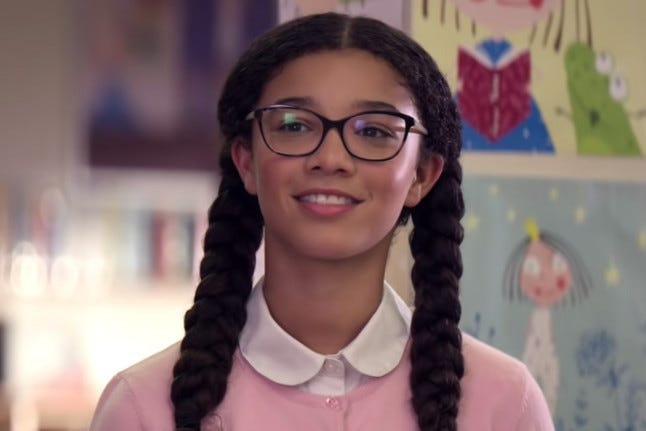
I had no idea Netflix would cast a brown girl as Mary Anne (Malia Baker), and I teared up from her very first scene. Even though Mary Anne had always been my girl, to see her thick curly pigtails and chunky glasses on screen, reflecting me, reminding me of my younger self exactly when I needed her most, was incredibly special. I rooted for her as she struggled to find her voice, and watched it completely consume her as she demanded that doctors use the proper pronouns for her tiny charge. As she undid her braids and found her first confident steps into tweendom, I could see my life’s journey so far. But more than any single storyline, Mary Anne’s casting reminded me of the parts of myself that are soft, special, and precisely Jada. That image of my worth has gotten so muddied with age, heartbreak, disappointments, discrimination, and negativity.
To the many brown girl Mary Annes the world loves to forget, who belonged to generations that came before mine and to those to come, you are love and you are loved. We’re often encouraged to harden up our soft edges, told we need to “tone it down” or “step it up,” told to be anything but ourselves. Those messages are so wrong. Your beauty is uncontainable, your integrity is next-level, and your intelligence is limitless. You’ll never find a girl in the world more worth it than you.
Times will arise when we feel anything but good about ourselves. I can tell you that in the past six months, I have felt too smart and not smart enough; I’ve picked apart everything about myself, from my physical appearance to what resides deep within mind and heart. Seeing my younger self in Mary Anne reconnected me with who I am underneath all of that. I’ll keep this image of myself, 13-year-old me, in my mind and heart, whenever I don’t feel quite like me, whenever I need reminding.


