
Google Coding Interview Problem (Hard Difficulty!): Shortest Path in Grid with Elimination
This problem is called “Shortest path in a grid with elimination” and is one of the most frequently asked Google interview questions.
The problem is:
You are given an m x n integer matrix grid where each cell is either 0 (empty) or 1 (obstacle). You can move up, down, left, or right from and to an empty cell in one step.
Return the minimum number of steps to walk from the upper left corner (0, 0) to the lower right corner (m — 1, n — 1) given that you can eliminate at most k obstacles. If it is not possible to find such a path return -1.
Let’s walk through an example.
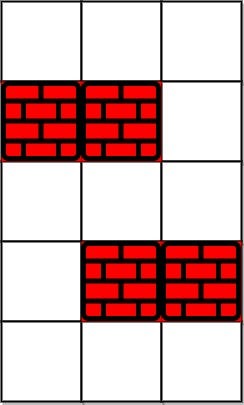
The input and output are defined as:
Input: grid = [[0,0,0],[1,1,0],[0,0,0],[0,1,1],[0,0,0]], k = 1
Output: 6
So one valid path is to go across the top row, then all the way down, which takes 6 steps.
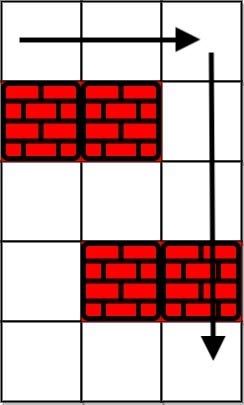
The one removal we’re allowed we’ll use on the obstacle in the cell right above the bottom rightmost cell. Alternatively, we could go straight down from the initial cell to the bottom leftmost cell, then all the way to the right.
Intuition
At first glance, this problem feels like a typical graph traversal problem. Since we want to find the minimum distance to get from the top left cell to the bottom right cell, a breadth-first search feels appropriate.
In a breadth-first search, we need the following key bits of logic:
- What information should our queue store? How do we determine what our addition to the queue should be?
- What information should we store in our “visited” set?
- What’s our exit condition?
What should our queue store?
So we definitely need to know the number of steps we’re on while traversing the grid, because the number of steps at our “goal” cell is what we’ll return as our answer. We’ll also need to know our current position.
The key distinction here is we need to track the *number of obstacles we can still remove* (let’s call this num_available ).
So our queue will store:
- current row
- current column
- number of obstacles we can still remove (
num_available) - number of steps used to get to the current position.
For each position, we can go above, below, left or right. If we encounter a path without an obstacle, we can simply enqueue the new position without changing the number of obstacles we can still remove; we’ll just increment our current path count by one.
However, if we hit an obstacle, we’ll have to see that we still have an available number of obstacles to remove (num_available ). If not, we can’t enqueue that position.
What should our “visited” states be?
The other tricky part about this problem is what we need to store in our visited set. Normally, we’d just store visited positions (pairs of rows and column coordinates). However, note that we can also reach multiple cells in different ways, with different values for num_available ! So, our visited set needs to store both the visited positions and the number available at that position, i.e. (curr_row, curr_col, num_available ).
What’s our exit condition?
Because we’re doing a breadth-first search, we know that once we encounter the exit cell (lower-rightmost cell), we should just return the number of steps to get there.
Code
With that, the rest of the solution looks like a typical grid traversal problem. Note the edge case to return 1 if we only have one cell (we assume it’s a valid value).
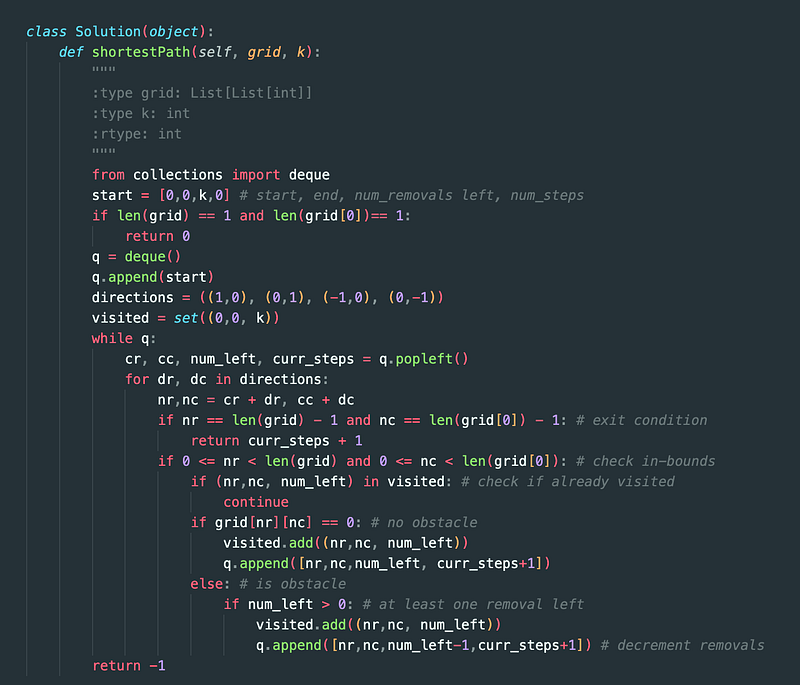
Let’s say the number of rows is r and the number of columns is c and the number of obstacles we can remove is k.
Runtime: O(r*c*k). Worst case we need to put every position in the queue k times.
Space complexity: O(r*c*k). Worst case we put every position in the visited set k times.
Let me know if anything’s unclear and thanks for reading!

For more articles like this, follow me on Medium. Not a member yet? Join the community. Want more software engineering interview guides and coding question tips? Check out all of my writing organized by topic in this article.
If you have any requests for what I should write, please let me know!


