
Is a Crash Coming? Comparing Today’s Stock Market to the Dot-Com Bubble
I wasn’t old enough to be interested in the stock market during the late ’90s and early 2000s. So to me, the dot-com bubble, and its crash, is not something I have lessons from. But I’ve experienced enough in my investing life already that I’ve learned everything is a teachable moment.
Whether good or bad, every experience teaches you something to make you better. As a recent example, in the past year, I bought Intel Corporation (INTC) and SAP both the day after their stock was down big from negative news.
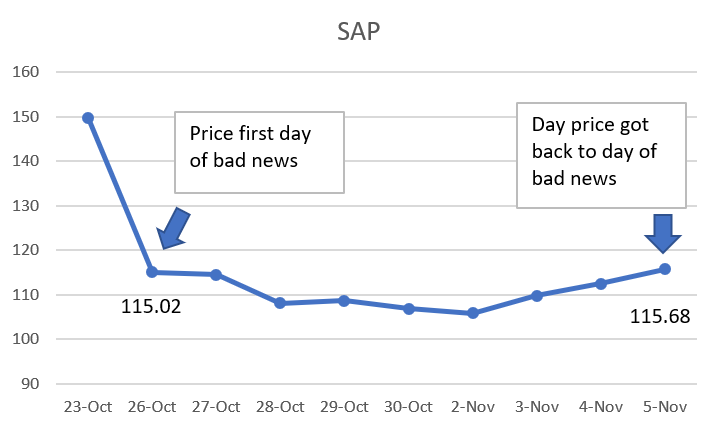
The lesson I learned from INTC and implemented for my SAP purchase is to dollar cost average (DCA) your purchase in this situation. When I bought INTC I put all my money in at once. So when SAP fell, I bought in the day after the news, the third day after, and the fourth day after. The lesson from SAP is that if I waited a few days instead of buying the day right after, I would have been better off still.
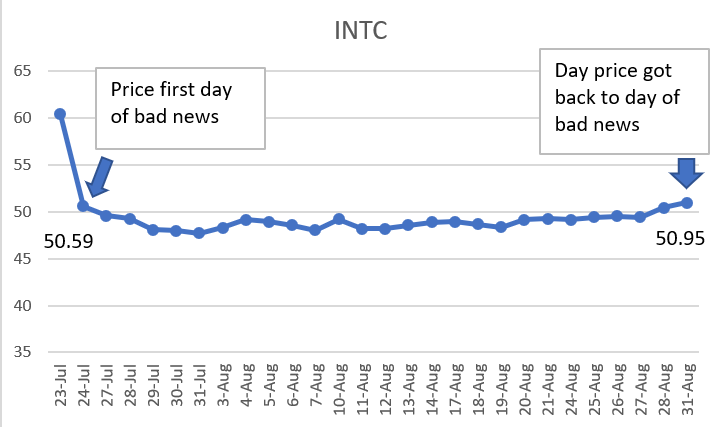
As the charts show, just because a company is down big one day because of negative news does not mean you need to buy into it that day. You have time and it will likely go down even more, depending on the news. A good lesson to have learned.
The biggest lesson from this story: Learn from your mistakes. If you don’t, you will lose money. And the point of all this is to gain (much) more than you lose.
What Was the Dot-Com Bubble
Also known as the tech bubble, the internet bubble, or dot-com boom, the dot-com bubble occurred from 1995 to 2001.
Several events led to the start of the bubble. In 1989 the Berlin Wall came down, the cold war ended, and globalization and free trade reigned. This opened up a free flow of goods and access to markets like never before. The Internet was becoming a huge part of society, helping business and personal lives. And interest rates were at extreme lows. Interest rates went from double digits in the 90s to as low as 4% in the mid-90s. All of these factors created the perfect storm.
Investors were eager to invest and make money. Entrepreneurs were eager to start a technology company and make money. Companies were eager to IPO without an extensive track record and make money. Are you seeing the trend yet?
As the Internet was booming, companies were being started left and right. Now all you needed to start a company was a .com website and you were ready to make money. These dot-com companies were going public quickly, most without making a profit yet. Investors did not want to miss out on the future growth potential, so they bought shares, rapidly driving up prices.
Between 1995 and 2000, the Nasdaq Composite stock market index rose 400%. The Nasdaq is a tech-focused index of the market. In 1999, the Nasdaq rose 85.6% and the S&P 500 Index rose 19.5%.
You would think with returns this great, every company saw their share prices go up. That wasn’t the case. In 1999, more stocks fell in value than rose in value as investors sold stocks in slower-growing companies and invested in tech stocks.
People were putting more and more of their money into stocks. Prices kept going up and up with no end in sight so people pulled money from their savings to risk in the market. Some people made a lot of money, some lost a lot of money.
Similarities to Today
History repeats itself…
If as you were reading about the dot-com bubble you thought it sounded like today, you aren’t wrong. There are several ways in which today’s market is similar to how it was 20 years ago.
Interest rates are again extremely low. In March, the Federal Reserve cut rates to a range of 0–0.25%. So now when you put your money in your savings, you earn the bare minimum on it. You actually “lose money” as the interest rate is lower than current inflation so your money is worth less than it was before.
TINA — There Is No Alternative. With interest rates so low and bond yields also at extreme lows, where can you grow your money? The stock market is attractive because of the return it can provide. More people are investing in the market because there is nowhere else for them to put their money to grow. This increased flow of money is helping prop up prices.
In the dot-com bubble, companies were IPO’ing before making a profit. That isn’t the case as often now. But there have been many technology-related companies IPO’ing relatively fast. And they’ve been doing so via a SPAC.
While SPACs were a thing before 2020, they have become popular and common this year. There have been over 100 SPACs this year, with the biggest name probably being DraftKings. Several other companies have come to market in a traditional IPO, such as Snowflake, Airbnb, and DoorDash. One similarity of all these: after they went public their share prices skyrocketed.
Another similarity to today is how not all industries have benefited from the rising market this year. In the dot-com bubble, people sold off slower-growing companies. This year they sold off “travel” companies. Almost anything related to travel was down this year.
Airlines like United Airlines or American Airlines are down. Car rental companies like Avis and Hertz are down. Hotel companies like Marriott and Hilton are down. Oil companies like Exxon Mobil and BP.
Tech stocks are up this year. FAANG is killing it.
Among individual stocks, there are strong performers from both periods. In 1999, Qualcomm was up over 2,000%. This year Novavax is up over 2,500%. What I would give to have invested in either of these.
Why Today is Different
There are many similarities and the high valuations of today are causing people to scream for worry. But there are many differences between then and now.
While interest rates were low in the 90s, they were not nearly as low as they are now. And bond yields were also not as low as now. There were other options for investors besides stocks. Today it seems stocks are your only option for a healthy return.
Many companies have gone public this year. But the companies going public now versus in the late 90s are more established. In the dot-com bubble any tech company with a website could go public and garner attention. Today it takes a little more to be successful.
And although industries are not all rising, it is understandable travel companies are down now as travel is basically on hold for many areas. The companies that are not in travel, and are solid companies with healthy financials, have benefited this year. Some of that may have to do with the lockdowns and increase in online shopping from large companies, but overall it seems most company’s stocks are up this year.
As said before, the Nasdaq rose 85.6% and the S&P 500 Index rose 19.5% in 1999. This year so far the Nasdaq is up 42% and the S&P 500 is up 14%. These gains are not as astronomical as they were during the dot-com bubble. But these gains are also in the middle of a recession where almost no one is leaving the country.
Verdict
You can’t sit on the sidelines. You’ll miss all the gains.
But investing also shouldn’t be this easy. You can put your money into almost any company in the last six months and make money.
The P/E ratio of the S&P 500 is around 37 right now. The only two times in history that it has been higher were during the dot-com bubble and the Great Recession in the late 2000s. This means stocks are overpriced, compared to historical prices.
The world is so different now than it was 20 years ago. This is not the dot-com bubble. But these high valuations should have investors somewhat wary.


