
My Inner Editor Won’t Let Me Journal
But I’m learning to get more vulnerable on the page
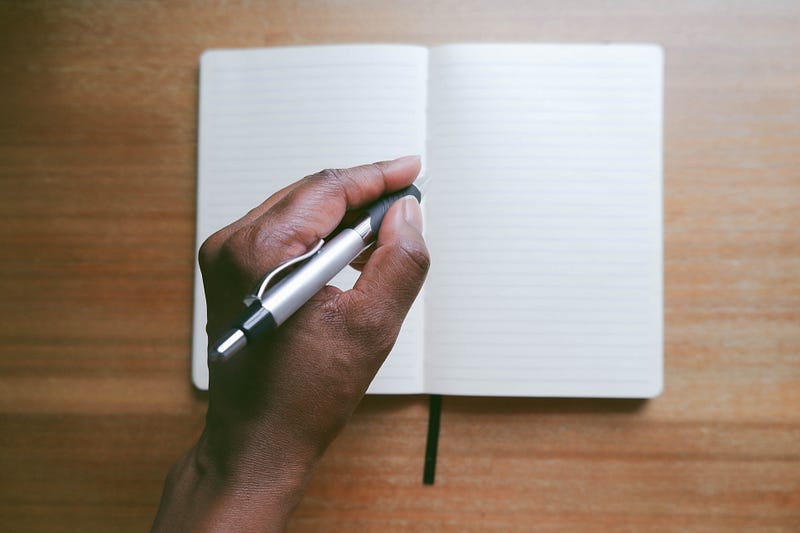
My first diaries, from the late 1980s and early 1990s, were bound in marbled paper, with paper lined just wide enough to fit an ever-changing juvenile scrawl. My very first one was pink; the second, green. After all these years (approximately three decades), the binding is weak and the diaries are held together by little more than old tape. They didn’t come with a padlock, but I developed a foolproof method to secure my precious secrets: After writing the entries, I tore out the pages, tore them up, and threw them away. So when I say the diaries are bound together by little more than tape, I’m not kidding around. They are empty paper shells, collapsing into themselves.
I had my reasons. First, a clear concern for privacy: My father was known to rifle through my journals for entertainment. Second, powerful insecurity: I just couldn’t stand how stupid I sounded. I don’t use that word lightly — it’s just the one that always came to mind as I was writing. My diary entries never had much of a chance — if I didn’t rip them out immediately after writing, you could be sure they’d be gone after the first rereading.
Why have I kept the bindings at all? By miracle, a few entries escaped the censor, and if they were lucky enough to escape my scrutiny for a few years, at the bottom of a box somewhere, they were too good (read: bad) to toss.
Check out this nugget, from the fall of 1992:
…the clouds themselves and their arrangement are so beautiful that I cannot find the words to explain. When I was younger, I used to imagine dead people (or just people who have transcended humanity) …
Okay, that’s enough. I can’t.
In my defense, I hoped to fill the empty pages one day. I also used the diary shells as containers for memorabilia… like the note of apology from a high school dance date, who really shouldn’t have because I wronged him. Or the photos of my ninth grade softball team and math teacher, taken just before my family moved away.
A pattern emerged in the diaries that followed — a compromise that allowed me to stop ripping out pages. I had more privacy living on my own, for one, but also I found that I could keep a record through documents, without exposing myself. Things were safe: feelings were not. My internal censor couldn’t dispute a photograph or a piece of paper printed by someone else — and I would know their significance without having to disclose it.
To this day, my diaries still contain few personal expressions. I use them to take notes on all of my phone calls, to doodle and draw, to make lists of the bills I need to pay, or to paste the drawings my kids make on napkins, meaningful notes from friends, or magazine cut-outs. My only commitment is to fill every page, even if it means going back, out of order, to sketch a face in a blank spot.
My current, unemotional notebooks provide what I always sought and wished for as a lawyer: a timeline with documentation. Of course, no one else can interpret the documentation — or rather, the documentation likely would be meaningless and worthless to anyone else — but it provides proof of my life, which is something I appear to need.
A need for privacy pushed me toward this habit, but the protective mechanism became a process: documents, whether legal or nostalgic, remain my starting point. It is hard — to the point of being painful — to proceed without my documentary markers, which is why fiction often scares me off. Also, there’s always the risk of this happening:
The clouds still seem to face the same direction (opposite to ours) and the puffs and tips that are touched by the sunlight seem exalted and enlightened!!
You can’t tell, but every time I read this, I flush with hot shame.
On the bright side, the constant doodling, collaging, and annotating in my notebooks means that I can imagine pieces of writing visually, thinking of shapes, directions, colors, pieces, and sequencing before any of the words come around. But the internal censor, of course, defies and conquers most efforts. She’s always there, ready with her rapid reflexes and mean words; she rarely attacks the shape or an idea of a piece but knows that if she knocks out all of the words, everything will remain, like my diaries, just an empty, harmless shell.
Sometimes, she’s right. Here’s how my 1992 rant about death and clouds ended:
What shitty prose.
You can see why I moved toward factual, legal writing and nonfiction. There is little trust in my literary instincts.
When I was writing Bad Medicine, I relied heavily on the 7,000-page trial transcript of our case, against a doctor accused of homicide for the overdose deaths of his patients. The transcript recounts every word spoken “on the record,” which includes verbal descriptions of the exhibits (but no images). It was a gift to find those days captured on paper. In a way, the trial transcript is my writing ideal: thorough, indisputable, authentic. No transcendent beings. No exalted clouds. No shitty prose.
After rereading the transcript, however, it became rich with new meaning. As a participant in this grueling, complex trial, I’d been trapped by own focus and stress: necessity determined where my attention would lie, each day. I also was intrigued by the craftsmanship of the document itself; knowing that it had been generated by the stenographers who’d rotated in and out of the courtroom over those four long months, in coded notes. The words, to my surprise, were on equal footing on the page, defying my recollections of the dramatic moments — it’s almost as though I’d expected some bits to be rendered in all caps. And there were jokes I’d missed. There was sadness I’d missed. I found comfort in the fact that four months’ worth of work memories were forever preserved, down to the throwaway comments. There was imperfection. There was civic duty. There was humanity. In the end, the book I wrote reflected my expanded understanding of the trial, not just the bare facts of the case — and not just my personal impressions.
This is why my diaries need to evolve, I’ve realized: unable or unwilling to record my inner life, my trains of thoughts, or my conversations with others, I’ve settled for a bare collection of exhibits. The pasted scraps mark the battlefields, like historical plates — but you’ll find no little explanation of what happened. For a long time, it was enough. But I’ve got an entire shelf of notebooks now, their pages curved with dry glue and hashed with lines. They feel like an accomplishment because I’ve cut down on the silliness and I’ve managed to get past the destructive phase. Surely I can evolve further?
I’m making several changes. First, I’m delegating some work to index cards instead. The drawback of notebooks, of course, is that it’s hard to turn back the pages or work with the contents in a dynamic way. Thanks to a new friend, who happens to be a talented writer, I’ve begun using index cards to record odds and ends of research, sentence fragments, or questions. In fact, I’ve got a dozen scattered in front of me on my desk now, relating to two future books.
I’m also working on a (fictional) short story using Scrivener (a digital equivalent of index cards, with other genius properties). I’ve been inspired by recent readings — Kazuo Ishiguro’s Klara and the Sun, for instance, Ruth Franklin’s biography of Shirley Jackson and, of course, Shirley Jackson herself — to try my hand at building a world, rather than reconstructing a world based on the evidence I hold. The project as a whole is intimidating, but I’m trying to ignore that by setting down a few hundred simple words each day to move the story along, granting myself permission to return and layer. The transcript also serves as inspiration: it’s taught me about dialogue and pacing.
Since the world appeared to be ending recently, I’ve also allowed myself a few paragraphs in my diary, here and there, of personal reflection. My internal censor has scratched over them a few times, but there is enough remaining to defy her.
I owe the little progress I’ve made to another entry in my 1992 diary. Just before leaving for college, I set down some resolutions. They now serve as inspiration — or rather, counter-inspiration:
(1) Stay calm (2) No petty emotions (3) Never let people know what you think (4) Future first
My current goal, as a writer, is to ignore every single one of these self-imposed rules. They have stifled me for too long: I’m ripping them out and will leave much more on the page.