
Cinema|Film
D. W. Griffith and The Language of Film
Career landmines in teaching the history of film
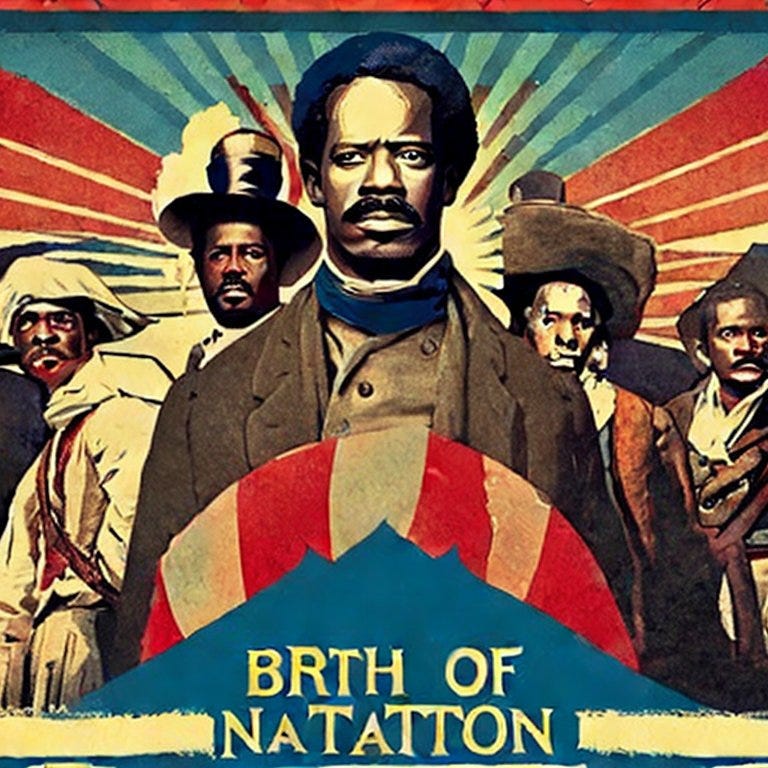
Controversial and racist American motion-picture director D. W. Griffith (David Wark Griffith) 1875–1948, established many of the basic techniques of filmmaking in such films as The Birth of a Nation (1915), Intolerance (1916), Broken Blossoms (1919), Way Down East (1920), Orphans of the Storm (1921), and The Struggle (1931).
Teaching David Wark Griffith in film classes is like walking a career tightrope over a field of career-crushing landmines as he has been subject to criticism and controversy for his 1915 film The Birth of a Nation. The film, while groundbreaking in terms of its technical innovations and narrative structure, is widely seen as deeply racist in its portrayal of Black Americans and glorification of the Ku Klux Klan. Hence — the tightrope.
In recent years, there has been renewed attention and discussion about the harmful impact of The Birth of a Nation on American culture and its continued influence on racist ideologies. Consider that the film endorses the KKK as its hero. For this reason, some individuals and groups have called for Griffith to be canceled, meaning that his body of work should no longer be celebrated, promoted, or taught due to its inappropriate content.
Recently a professor at a notable California film school was removed from his position for using the film during a history of film class.
So, whenever I come to Week Three of my syllabus, I’m stumped as to how to negotiate this historically significant film pioneer, for I do believe that Griffith’s contributions to the development of cinema are substantial and should be recognized. At the same time, it is also imperative to acknowledge and confront the racist and harmful aspects of his work, particularly in The Birth of a Nation.
This does not necessarily mean erasing or banning his films but rather engaging in critical discourse and education about their historical context and impact on society.
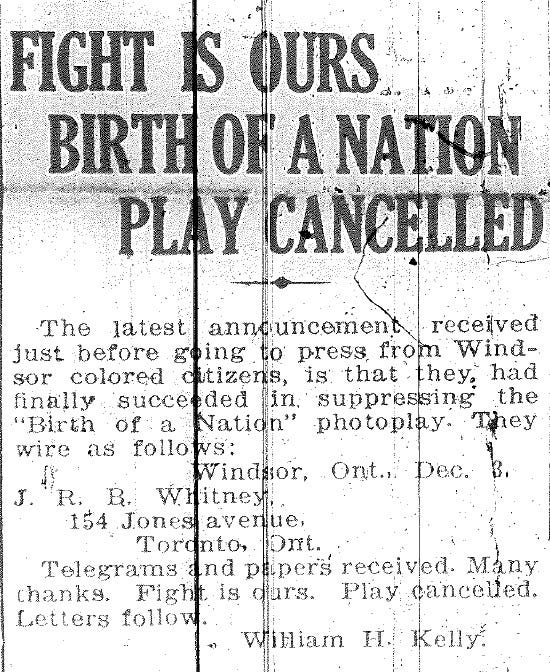
History hurts. Sorry. We can’t ignore it. We must understand our history. Film helps us to look at the good, the bad, and the ugly.
First, the Good: Griffith is credited with developing the common language and grammar of film, thereby giving us tools to see how/why visual images communicate meaning. Griffith created a repertory of basic camera shots, each with a storytelling purpose. Understanding these different camera shot types is essential for writers, directors, camera operators, and cinematographers to effectively communicate the visual elements of a shot, mainly the size of the person, place, or thing within the frame.
D.W. Griffith is known for pioneering many camera and editing techniques that have become essential to modern filmmaking. Here are some of the techniques he contributed:
Cross-cutting: Griffith is credited with inventing the cross-cutting technique, which involves cutting between different shots to simultaneously show multiple storylines or perspectives. One of the first films to use this technique is A Corner in Wheat. In this film, Griffith specifically contrasts scenes of wealthy business people with people waiting in line for bread.
Close-ups: Griffith was one of the first filmmakers to use close-ups, which zoom in on the face or another detail to emphasize emotion or detail.
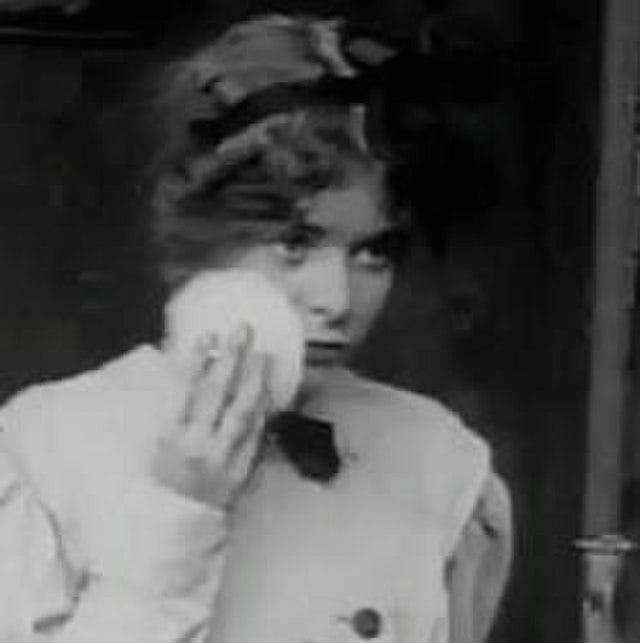
Tracking shots: Griffith also used tracking shots, where the camera moves along with the action, to create a sense of movement and immersion.
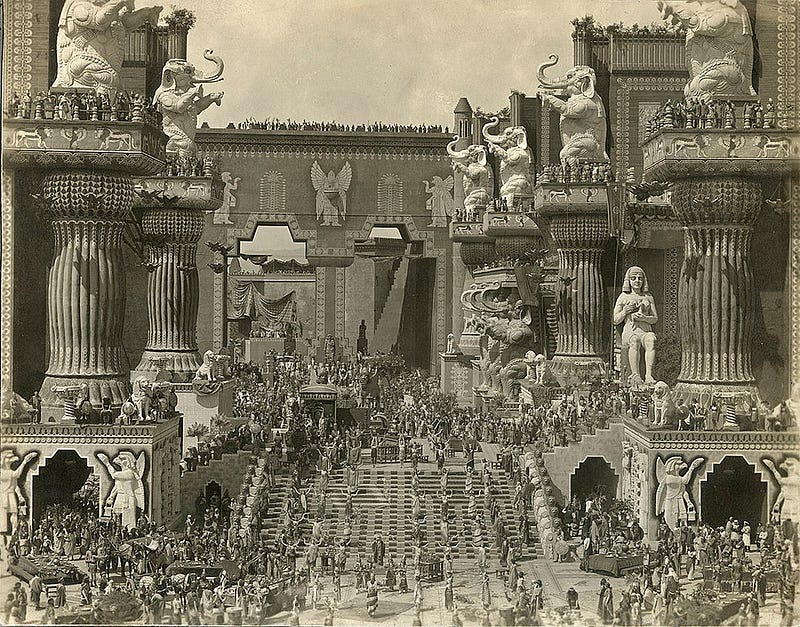
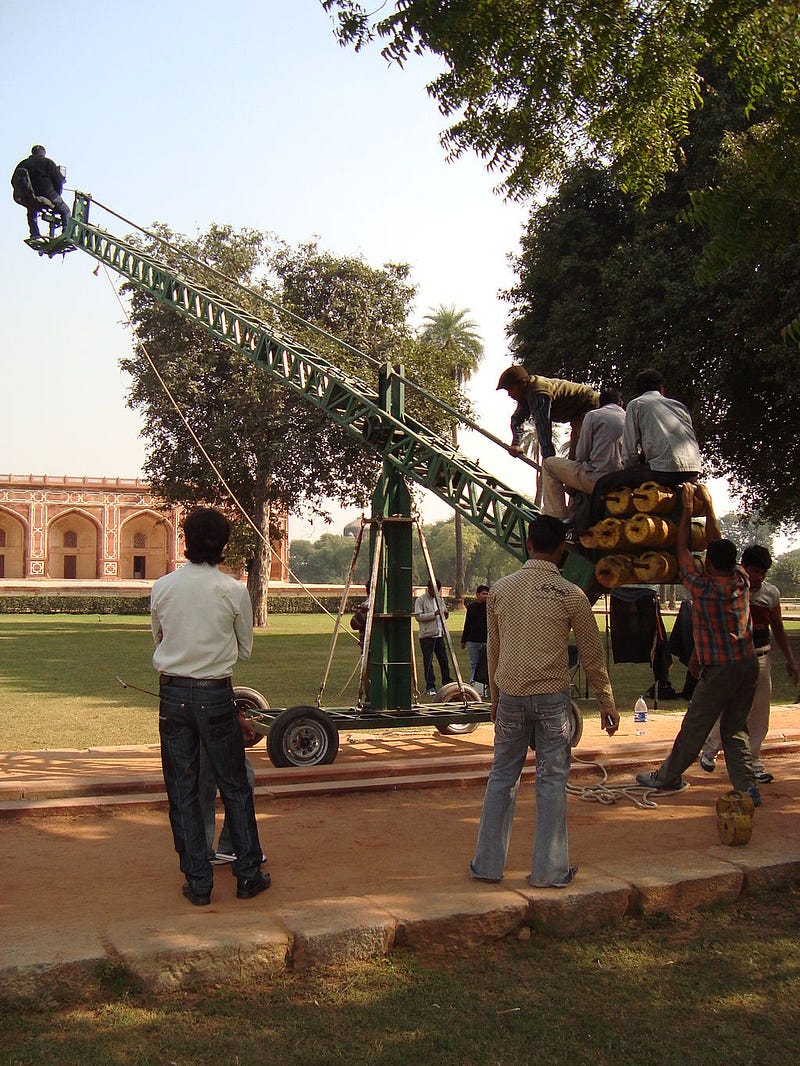
Crane Shot: Also known as a Close-Upboom shot or jib shot, is a cinematographic technique that involves using a mechanical arm, called a crane or a jib, to lift the camera up and down or move it horizontally while the camera operator controls the movement of the camera. This allows for shots that are high up in the air or that sweep across a scene.
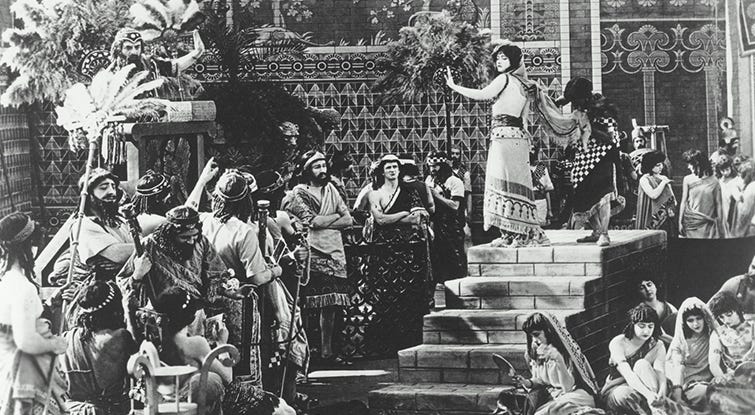
In Intolerance, Griffith uses a crane shot to create a sweeping, panoramic view of the ancient city of Babylon. The shot begins high above the city, then descends slowly to ground level, revealing the city's grand architecture and bustling activity. The shot then continues to move forward, following a procession of characters as they make their way through the city streets.
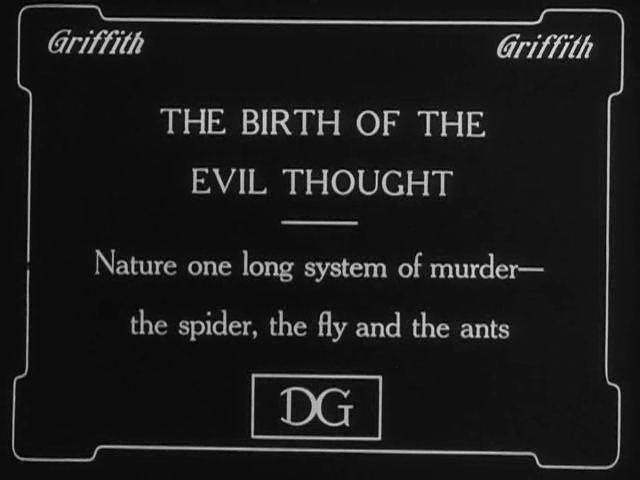
Intertitles: Griffith helped to popularize the use of intertitles or short titles that appear on screen to provide context or dialogue. Here is one from The Avenging Conscience.
Parallel editing: Also known as cross-cutting, Griffith used parallel editing to create tension and excitement by cutting between two or more action sequences happening simultaneously. This method of editing helps to build dramatic tension between the world and its characters. Birth of a Nation was one of the first films to have simultaneous action.
However, Griffith’s groundbreaking techniques would be overshadowed by the rightful criticism of the film’s controversial depiction of slavery and racism.
Nope. I won’t play the screening Birth of a Nation, so here is an example from The Godfather:
Long Shot (aka Wide Shot) Shows the subject from top to bottom; for a person, this would be head to toe, though not necessarily filling the frame. The character becomes more in focus. This shot often sets the scene and our character’s place in it. This can also serve as an Establishing Shot instead of an Extreme Long Shot.
Medium Shot shows part of the subject in more detail. For a person, a medium shot typically frames them from about the waist up. This is one of the most common shots seen in films, as it focuses on a character (or characters) in a scene while still showing some environment.

Establishing Shots — set the stage for the story's action; many settings are first viewed from a wide angle to give audiences a scope of the setting in which the action takes place. A wide shot of a battlefield tells us first that the characters are part of a larger battle before moving to a medium close-up of just a few people fighting.
Color tinting — The Birth of a Nation varies in color as the movie progresses (though traditionally called a “black-and-white film”). Early scenes in the south are filmed with a more sepia tone as life is peaceful and harmonic, but later scenes are harsh black and white as black soldiers fill the streets and the clansmen come to break them up.
Matte — Covering some of the shot in black was one way Griffith would spotlight characters or objects of importance, like cotton picking or John Wilkes Booth’s gun.
Dissolve — is a graduation transition from one scene to another. From a fixed camera position, dissolving from an empty courtroom to a courtroom full of newly elected black representatives, Griffith suggests that they overran the court and sullied the entire room and its traditions.
Flashbacks — a brief return to a past time that interrupts the forward progress of a linear narrative. Griffith invented what today is called the flashback, though he called it the “switchback.” Overall, Griffith’s camera and editing techniques helped revolutionize cinema and laid the foundation for many of the techniques still used today.
While many Silent Movies consisted of the stringing together of stage effects and sensationalist trick scenes, and other pre-cinematic “spatial and bodily experiences,” David Wark Griffith also created an “institutional mode of representation,” also known as “classical narration.”
Classical Narration is a filmic discourse that produces coherence of vision without any disruptions in time or space or other discordant elements that might interrupt the viewing process. The basic narrative structure of Classical Hollywood narration involves establishing a cause-and-effect logic with a clear subject-object relation and beginning, middle, and end. Shots are sliced together to fashion a cohesive narrative story of visual elements that appears to be “seamless.
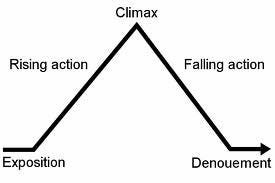
The Classical Narrative is universal, dating back to Aristotle’s Poetics, with a five-part story structure, which includes exposition, rising action, climax, falling action, and resolution (and sometimes a denouement, a tag scene after the resolution).
Now the Ugly:
The Birth of a Nation is infamous for glorifying the Ku Klux Klan and its dehumanizing depiction of Black people. The film has been rightly criticized for perpetuating harmful racial stereotypes and promoting white supremacy.
Given the harm caused by these films, there are valid reasons for reconsidering Griffith’s place in film classes. One argument in favor of “canceling” Griffith is that his work should not be celebrated or studied in a vacuum but rather in the context of its historical and cultural impact.
Goodbye, Griffith. Teaching Griffith is a career landmine which is why many universities, including Chapman University, have torn down Birth of Nation posters. No school wants to be affiliated with the promotion of institutional racism, the perpetuation of harmful stereotypes, or the glorification of white supremacy.
I certainly don’t. Instead, I’ll do a tip-toe dance around his cinematic contributions and examine his work as cultural production from an ugly point in American History.
“History Hurts.” This phrase, coined by Fredric Jameson, suggests that historical events and narratives can be painful because they disrupt our sense of stability and continuity. Films like Birth of a Nation force us to confront how power structures and historical forces beyond our control shape our understanding of the world. Films about the legacy of slavery and racism in the United States are painful and hurtful because they challenge the myth of American exceptionalism and force us to confront the ongoing consequences of these historical injustices.
Yet, confronting this discomfort through the film is necessary to fully understand some of the horrific inhumanities to men that have occurred in America. As cultural production, it forces its audiences to acknowledge the systematic subjugation of people of color. I think acknowledging the ugly underbelly of American history is a good thing, so it can never repeat itself.
I’ll let you know if I’ve been canned next week.


.jpg)
