
Cyclists Protest Racial Injustice Against Homeless and Blacks for Helmet Citation
How law enforcement unjustly and racially enforces the helmet law.
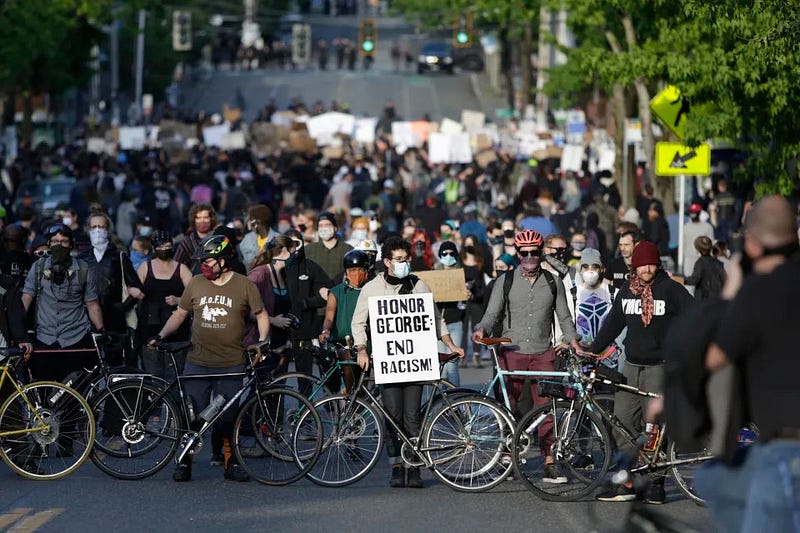
Who would have thought about systemic racism being a part of citations for not wearing a helmet? It appears any avenue or cracks, racism seems to find its way to inflict injustice upon any opportunity.
Seattle, Washington, one of the largest populations of bike commuters in the country is standing for justice for all. It is the largest city in the country to enforce a bike helmet requirement. In the past, helmets were mandatory but lately, this helmet law has been overturned due to its discriminatory practices against people of color and the homeless.
No one can dispute the efficacy of the helmets but the discriminatory practice has come to the public cyclists’ attention and much outcry has ensued. The enforcement by the police has caused an outcry that led to overturning the helmet law. The problem caused by the police enforcement of the law outweighed the danger of helmet usage.
Similar to Seattle, Tacoma, Washington repealed its 2020 requirement, with the same concerns of inequity in policing practices, as did Dallas in 2014 mandated 18, and older to wear a helmet to encourage bike-sharing.
Seattle’s King County health board declared racism a health crisis as they put racial justice reform a priority over the safety benefits of helmet wearing to prevent brain or other head injuries.
After much scrutiny, the health board made up of elected officials and medical experts across the country scrutinized the helmet rule and showed that it was disproportionately enforced.
Since 2017, the Seattle police had given 117 helmet citations, more than 40% to the homeless and since 2019, 60% of citations went to homeless people.
A different study pertaining to Black cyclists was done by the Central Seattle Greenways, a safe streets advocacy group, which noted that Blacks are four times more like to receive a citation for violating the helmet law than white cyclists. Also, Native American cyclists were twice more likely than white cyclists.
This law opened the door to allow the Seattle Police Department another avenue to harass Black and brown communities. From the very young to the old were accosted by the police regarding helmets as a pretext with another agenda.
There was one case where a young boy, 8 years old, and his friends were stopped by the police a few blocks from their home not wearing helmets and were accused of stealing the bikes. This is a clearly discriminatory practice that demands to be dealt with to stop the police from targeting people of color. Unfortunately, this incident has caused this little boy to stop riding his bike.
Another instance was in 2016, a Black man was stopped by the Seattle police while riding his bike with no helmet and according to the dashcam video, it was a 19-minute stop as the police conferred he looked like a burglary suspect.
Any reason to stop a person of color, and harass them seems to be an unwritten creed within the police department to target people of color. Blacks and the homeless are being targeted as the helmet law was used as a pretext to make a stop and charge them with some crime.
As to be expected, the Seattle Police Department justified the stops as a moment to educate riders about the benefits of wearing a helmet. This is a joke. Any tactic for stopping people of color has been a practice since the beginning starting with walking, driving, and now cycling to charge with some crime of sort in the face of no probable cause.
Opponents are yelling that no helmets lead to more serious injury but in their eyes, one can assume that it is okay for the police to harass and cite people of color more than whites regarding the helmet law.
Overturning the helmet law does not mean others who desire to wear a helmet while biking is acceptable as they are obliged to continue to wear their helmet. The purpose of overturning the helmet law was to discontinue the police from targeting people of color with citations unfairly.
Chicago has experienced similar practice by law enforcement where citations were issued to Black cyclists eight times more often than other cyclists. Also, in Tampa, Florida, Black cyclists comprised 73% of bicycle stops between 2014 and 2015, according to the U.S. Department of Justice, despite the fact that Blacks are only 26% of the population.
In conclusion, this helmet law is a barrier to one’s freedom to ride a bike and instills fear into the communities of color from doing so. The numbers speak for themselves about the helmet law as they show the disparity in its enforcement by the police.
For additional reads:


