
Cycling Through Vietnam’s Violent Past
Part Four of Six — The Crash
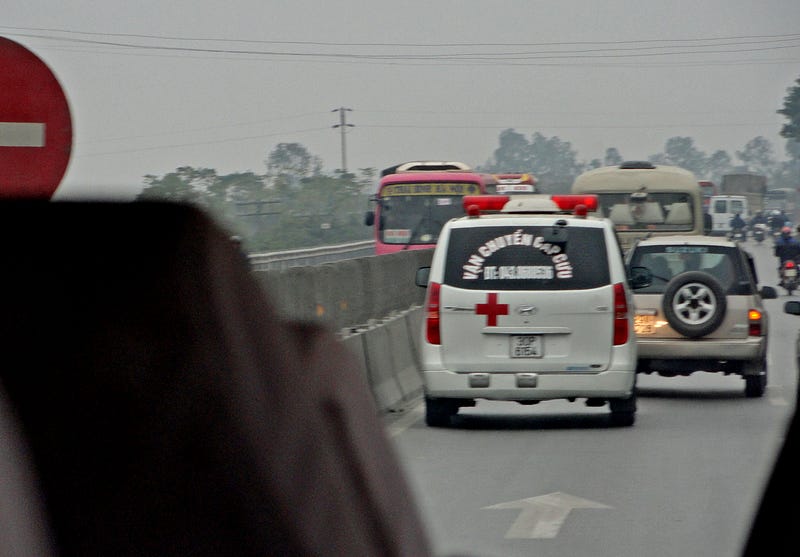
The last thing you want to consider when traveling is a motor vehicle crash in another country. But about an hour after boarding our bus in Tuy Hoa, Vietnam we were involved in a serious collision with a motorcyclist as we traveled down Vietnam’s highway 1 to Quang Ngai City.
One of the things that struck me when I arrived in Vietnam is the traffic and the way people drive. They don’t pay attention to things like speed limits or even lanes, even on the busy two-lane highway. In order to pass, you are forced to drive in the oncoming lane and hope you can get back into your lane before traffic reaches you. Motorbikes, scooters, and bicycles are forced to ride along the shoulder to stay out of everyone’s way. There were numerous times we would all wince and catch our breath as our bus swerved from lane to lane barely avoiding a crash.
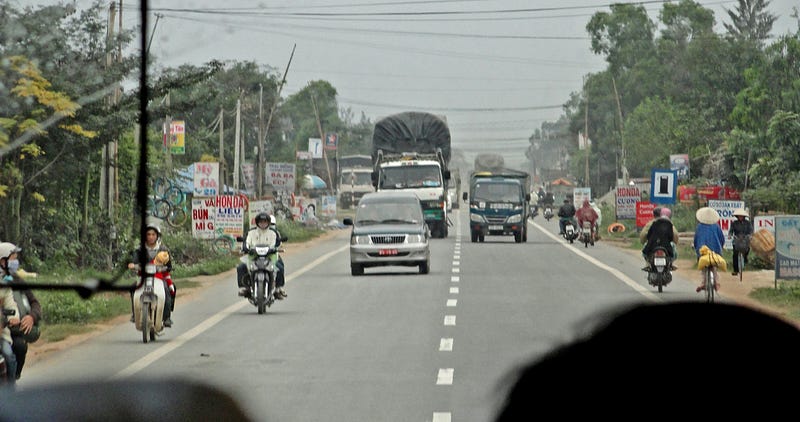
This time not only did I hear the crash, but I did see debris fly off the left side of our big tour bus — it was a motorcycle and its rider. The motorcyclist had crossed over into our lane and hit us, his bike scraping along the side of the bus almost the entire length, before he finally lost control and went skidding across the road. If he had been a few centimeters closer he likely would have fallen under our wheels and he just narrowly missed being run over by the traffic following him.
Our guides and driver and the driver’s assistant rushed to the scene as we all looked out the bus windows in horror. The motorcyclist wasn’t moving and we feared the worst.
Our bus driver’s assistant stopped a truck, loaded the motorcyclist on the flatbed and they took off toward a hospital in the next town, about 5 minutes away. Of course, there is always speculation when something like this happens, but what we later pieced together is that he had been impaired when he hit us (that was the word from our driver’s assistant who was with him en route to the hospital).
Still, we had to wait before the police arrived to investigate while our driver appeared to be almost catatonic, in severe emotional shock. We worried about what might happen to him, would he be arrested? Charged? Would he lose his job? There were few answers. Police arrived and began taking measurements of the scene, and questioning any witnesses (not us).
While this was all going on, big trucks continued to speed past us with their horns blaring, as they dodged motorcycles and scooters. We also attracted a large crowd of rubberneckers, as locals ran over to see what had happened. After checking out the scene, they turned their attention to us; a group of mud-covered cyclists, obviously not local, paying special attention to the women in their cycle shorts. We stayed on the bus for several minutes but gradually began wandering off to see what happened.
We were all in shock and concerned for the man injured but also for the mental state of our driver, his face registering everything that had just happened. Our guides were still worried about our wellbeing and had called ahead to the hotel immediately, which dispatched a couple of mini-buses to come and pick us up. It would take them about 3 hours to reach us and then about that long again to get to the hotel. Our last concern was for our own comfort, but this was going to be a long night.
We also had to take all of our stuff off the bus so the police could take it away as evidence. We began unloading all of our bags and moved them into a roadside restaurant where we were parked, but immediately a man we assume was the manager started yelling at us, pushed one of the women riders, and told us to get out, to put our bags outside. So we did that, putting everything under a rusted-out awning to protect it from the rain, and then we sat down, dirty and wet from our ride and still a little shell-shocked from the accident.
We were told our driver would have to go to the police station and would likely face heavy fines. Even though it was obvious this wasn’t his fault, we were told that in Vietnam, the bigger vehicle is considered liable and pays the penalties. We all passed the hat and chipped in what we could to help him out, it was the first time we had seen him smile since this drama began.
The mini-buses finally arrived, almost 4-hours later and we split off into two groups and began the long drive to our hotel, more nervous than ever to be driving in this dangerous traffic, and wishing the buses had come equipped with seatbelts.
We later found out that the motorcyclist was going to be okay. We were told that he would be released from the hospital, not that he is in good condition, but it just meant the hospital had stabilized him enough to send him home because his family didn’t have the money for additional care. It was shocking for those of us who came from countries with socialized medicine that Vietnamese people don’t have the same… and this is a communist country. Since then, I have learned, that about 87% of Vietnamese people now have health care coverage.
Our bus driver and the bus were held at the police station for about 24 hours for the investigation, and while both were released without charge, our driver did have to pay some fines.
When we finally arrived at the hotel, about 8 hours after first boarding our bus, we really didn’t care how we looked, we just wanted to get to our rooms to get cleaned up quickly and get to bed so we could be back cycling at 9 am.
Coming up in Part Five is a solemn visit to My Lai.
___________________________________________
You could read so much amazing content on Medium and it could be your next step in becoming a writer, for just a few bucks a month. And if you sign up with this link you will also be supporting my writing.


