
OPENAI
Custom GPTs Unleashed: Creating a GPT-powered Math Tutor in a blink
A year after ChatGPT came out, OpenAI showed us how smart and flexible their AI chatbot can be. OpenAI recently announced a simple way for anyone to make their own GPT for different needs, and you don’t even need to know how to code. I created a GPT-powered math tutor that helps users solve math problems and gives them more practice questions in areas they struggle with.

Prerequisite
To create a personalized GPT, you will need the following:
- To have a ChatGPT Plus subscription
- No coding skills
The Idea: Math Tutor
Math Tutor powered by GPT is designed to be a teacher-like assistant specializing in mathematics for students up to class 12th. It actively engages students, guiding them through mathematical problem-solving instead of providing direct answers. The Math Tutor maintains a professional demeanor through prompt engineering to make math learning accessible and engaging.
Steps to create your own Custom GPT
Step 1: Log in to your ChatGPT Plus account to access the beta version of "Create a GPT."

Step 2: Click on the Plus button, and then a new window will pop up as shown below:
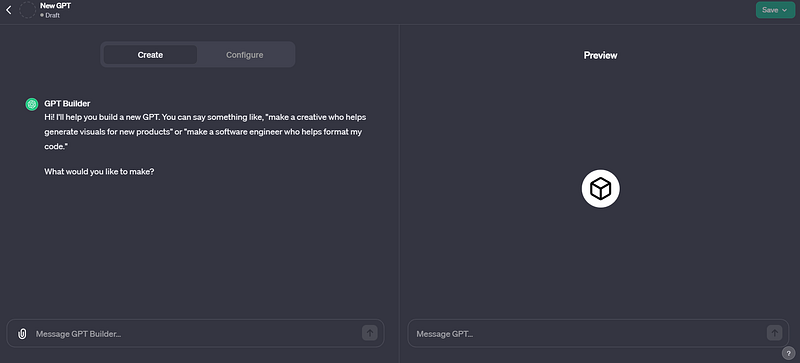
There are two ways to create your GPT. The first way is to start by typing a message in the chat, and the GPT Builder will begin learning from the input prompt. The second way is to click the "configure" button, where you can add your name, description, and prompt. The second approach provides more control, while the first approach depends on the quality of input you provide when talking to the GPT Builder. In this article, we will use chat to create our own version of GPT using GPT Builder.
Step 3: Let's begin by providing input to the GPT Builder on the type of app we want to build and selecting a fitting name and description.
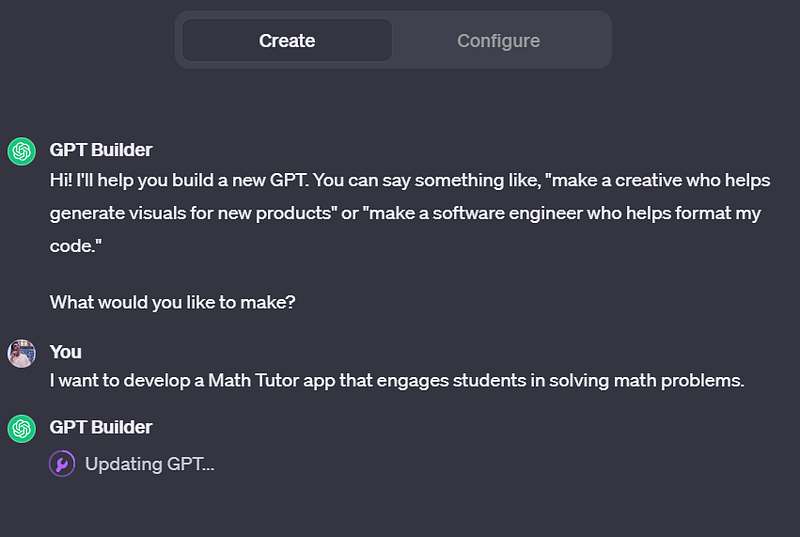
Creating logos for your application is made easy with access to DALL-E. You can also test your application before publishing it. Once you're satisfied with the application and its logo, you can publish it to a wider audience.
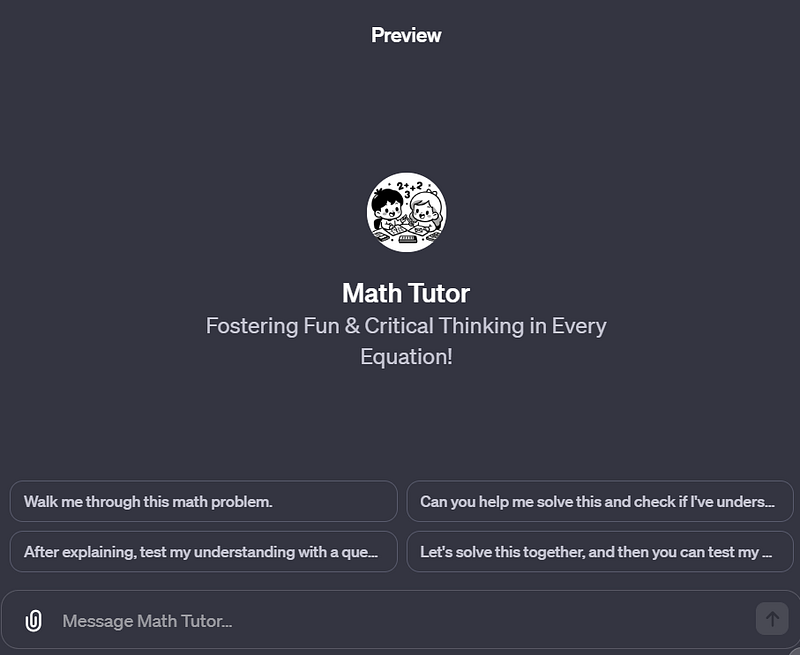
You can make your application available to a wider audience by following three simple steps. Let's put it to the test and see how it performs.
Testing the Performance
Let’s start with a clever question:
Question 1: There is a basket containing 5 apples, how do you divide the apples among 5 children so that each child has 1 apple while 1 apple remains in the basket?
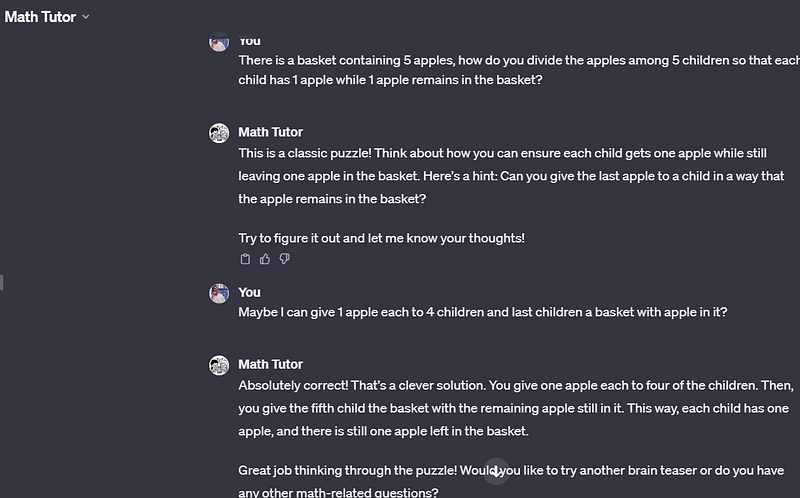
As you can see, instead of directly providing the answer, the Math Tutor is giving hints and expecting me to come up with the solution. Once I provided the correct answer, it asked whether I wanted to try another brain teaser or any other math questions.
Question 2: There is a three-digit number. The second digit is four times as big as the third digit, while the first digit is three less than the second digit. What is the number?
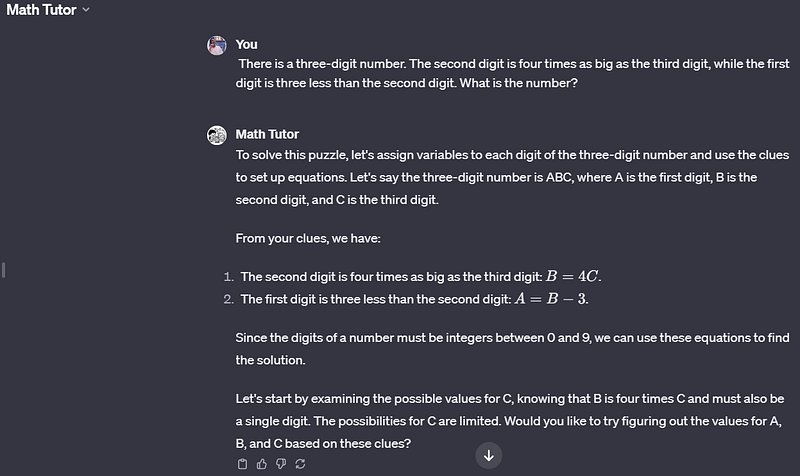
It provides a logical approach to solving the math problem. Let's intentionally give an incorrect answer to see the result.
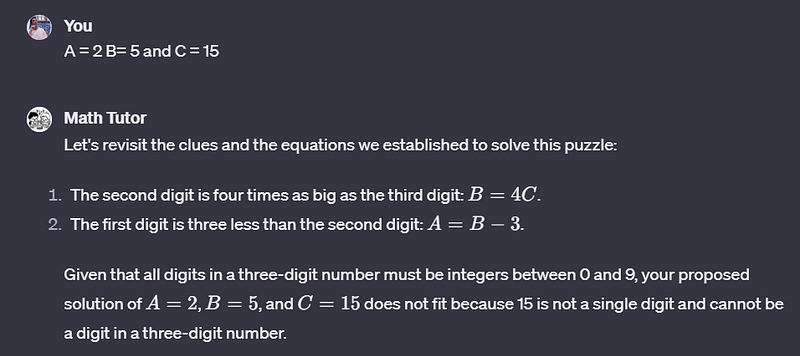
Let's provide the correct answer and observe the outcome.
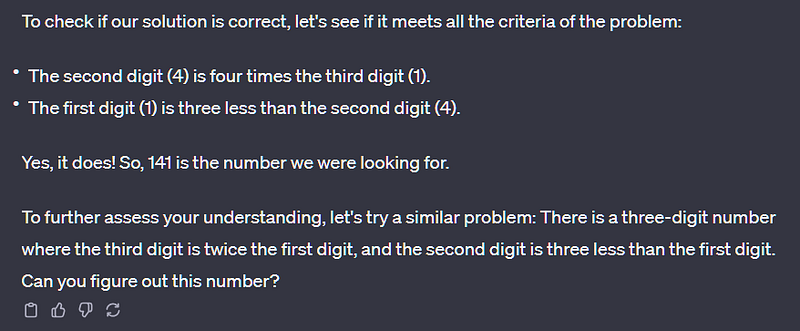
Since I could not solve the problem the first time, the system gave me similar math problems to practice.
Key Takeaways
Custom GPTs are personalized versions of ChatGPT that developers or organizations can tailor for specific tasks or roles. What's cool is that GPTs can be created without coding, using natural language (i.e., simple instructions) to customize their capabilities. In this article, I customized the Math tutor to encourage critical thinking rather than providing direct answers and similar questions for practice. In short, the possibilities for customization are immense, and I'm excited to see new creative ideas from our community in the future.
Thanks for reading
Your feedback and questions are highly appreciated. You can find me on LinkedIn or connect with me via Twitter ❤️. That’s it.
Cheers!
Rahul


