
Cultural Leadership
Culture Is Everyone’s Responsibility at Work
From janitor to CEO, you impact what it’s like to work here
Culture is often left to the C-Suite. Employees think of it as magic. Something that is divined from on-high and unchangeable. It isn’t.
Culture shifts every day. It comes from every level of the company. It’s true that the C-Suite strongly influences the larger organization’s culture. If you are dealing with a long-standing and strong culture, changing it is extremely challenging.
But you have more influence than you think.
Culture is the behaviors and interactions of any group of people. The people you most often interact with have their own culture. Because of this local nature, you have tremendous influence over the culture you experience every day.
Let’s look at the types of cultures first, then get into how you can influence the culture regardless of your position.
Four culture types
1. Truly Toxic
Some companies have a truly toxic culture. If discrimination or harassment at scale is allowed or even encouraged, find another job. Unless there’s a change in top management and the Board of Directors, you are fighting a battle you can’t win.
Fortunately, I don’t believe truly toxic cultures are as rampant as the news headlines would lead us to believe.
The more insidious culture problems generally fall into two camps. Management is either too focused on results or they are completely out of touch.
2. Too focused on results
These managers will do anything to improve the results. They will cheat their customers, overwork their employees, and reduce the quality of their products to eliminate as much expense as possible. These are the companies that look great on the outside and often have amazing financial reputations. But the employees are in a constant state of churn. If you work with a company where your sales representative changes on a regular basis, this might be them.
Unfortunately, there is little chance of changing this culture unless there is a whole-scale change at the most senior levels, usually including the Board of Directors. If you have more integrity than your senior leaders, it’s time to leave.
3. Completely out of touch
These are the saddest ones to me. Often, the employees in these companies know how things could improve. They may have even voiced those ideas and opinions. It’s even likely that an annual employee survey is done, summarized by hard-working analysts, and presented to senior management.
And then completely ignored in favor of whatever best-selling book the CEO just read on his 200 foot yacht. (Yes, true story. Unbelievably, I experienced this exact scenario not at one company, but two.)
These cultures can and do change. Sometimes it just takes one good leader. Someone at any level with an ability to influence their peers and a willingness to be out of step. Find that person and hang onto them. If they leave, go with them. That is a person worth following.
4. A culture you actually want to work in
This is not a one-size-fits-all culture. I have worked in many relatively positive and productive cultures.
- A small branch office of a larger organization. Both the branch office and the larger organization were positive cultures but very different from one another.
- A large subsidiary of a much larger (and less positive and productive) company.
- A small, customer-owned, community-centric company.
Each of these was a very different culture, but they shared three basic attributes:
✅ Certainty: People understood their roles. Even in times of great change, the lines of authority were clear. The best senior teams I’ve experienced often talk about disagreeing in private and supporting in public. A common comment from one of my favorite bosses that I adapted for my own use: When the door is closed, feel free to disagree with me as loudly and vehemently as you need to make your case. But when the door opens, we will present a single viewpoint. This kind of single viewpoint allows people some certainty.
✅ Consistency: It’s true — change in constant. If you aren’t growing, you’re dying. We love to think of change as a positive, a sign of growth and prosperity. But one of the key lessons I learned is that people, and cultures, need consistency.
When you make changes in a company, one of the most important things you can do is to determine what doesn’t change. Whole-scale transformation seldom succeeds. Humans are hard-wired to maintain the status quo. Rather than fight it, successful cultures celebrate it. When they make changes, you hear as much about the things that won’t change as the things that will.
✅ Compassion: The best cultures have, show, and talk about compassion in some way. True customer service is all about compassion. Employees are empowered to send small gifts and cards to customers who’ve experienced a difficult life event. We tried to make cards readily available to our employees and celebrated when they made a personal connection with a customer.
You will also see a company rally behind an employee with a personal problem, like an illness or family loss. I’ve seen some companies that allowed three days for the death of a child, no exceptions. I’ve also seen companies that said “take whatever time you need” and then organized a drop-off schedule to drop off food for the family every day while they grieved.
The way a company handles downturns (ex: layoffs, lower merit increases, reductions in benefits, etc.) is the ultimate test of their compassion level. You may not get a big severance package, but maybe you get a longer lead time or some kind of outplacement help. At a minimum, providing real references, or allowing them to use your office while they transition can be a huge relief.
I once described our culture to an outside group of people as “loving our people and our customers”. The outsiders raised eyebrows and cocked their heads. The employees in the room all nodded their heads. If you want to test this, check how your employees react when compassion or [gasp] love is mentioned in the workplace.
What can you do?
What if you are missing one of those three key elements? What can you do in your position?
Culture is simply a series of similar interactions between people who regularly interact with one another.
Every day, you interact with a number of employees. In the moment of that interaction, that group has a culture of its own. Whether you are talking to one coworker or twenty, you have a responsibility to build a positive culture in that moment. If you waste your time venting, complaining about “management”, or just complaining about the world, you will walk out of that interaction in a darker place.
Have you ever talked to someone who complained constantly? Did you find yourself happy and energetic, just bursting to get to the next interaction with someone else? I doubt it. We carry the energy from one group into the next.
I once had a group of coworkers who met regularly for happy hour. The company was going through quite a bit of change, and we were struggling. Happy hours turned into complaint sessions. We thought we felt better because we’d gotten our feelings out and bonded in the process. But the next day, those feelings festered. We were creating a negative culture.
I stopped going and encouraged others to attend less often. Not surprisingly, by disconnecting from one another, we were able to reenergize and start to work through the problems more effectively.
Culture builds quickly and locally
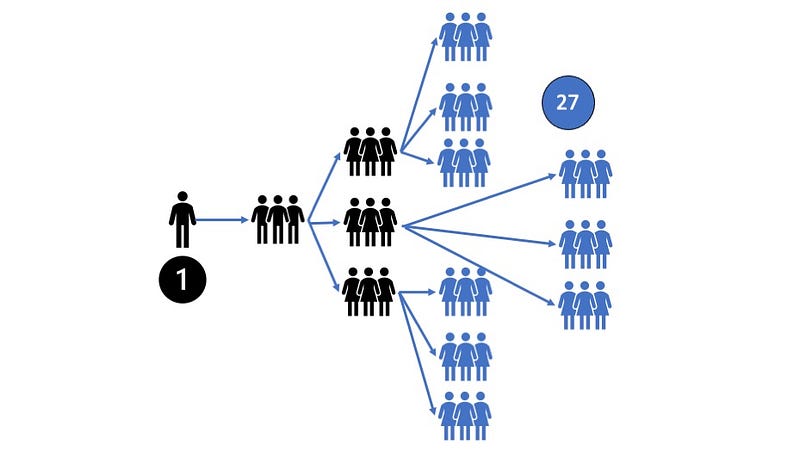
Let’s say you interact with three people in a day. Each of those three interacts with three other people. And each of them, another three. As shown in the image above, let’s assume we only get to three levels in one day. With eight hours in a normal workday, that’s a pretty light interaction level.
Under those assumptions and remembering that a negative (or positive) interaction festers and affects the next interaction, any one person influences the emotions of 27 people in a day.
Regardless of the size of the company, those 27 people are usually the same people you interact with regularly. You experience culture locally. You have tremendous impact over your local culture, your community, even in very large companies. Don’t waste time looking too far up the hierarchy. Focus on the local community and build positivity in those interactions. You will often find yourself in a much different culture more quickly than you think.
If you are in the C-Suite
Own it. While everyone can impact the culture, you have the most breadth of impact and so own the highest level of responsibility. Set the standards for:
- Meetings. Start on time or late? Start with friendly discussion or answering emails? With an agenda or without? End on time or whenever? Meetings are the cornerstone of culture since they are forced interactions of people. Decide what you want meetings to feel like. Talk about that. Teach your managers to hold a meeting you want to attend. And most importantly, role model it. Be the manager you expect them to be.
- Conflict resolution. Do you allow your managers to come to you individually when they have a disagreement with their peers? Or do you expect them to both come to you with an outline of the issue and their viewpoints? Is the process clear? If it isn’t clear for your own managers, how do they manage conflict with their teams? It’s okay to coach a manager how to better work with a peer. It’s not okay for them to complain to you about someone behind that person’s back. Make that difference clear and live by it.
- Problem escalation. When do you expect to hear about a problem? How large does it have to be? Are there certain customers you want to know about more quickly? What problems do you never want to know about? What authority do your managers have to make decisions? Decision authority and problem-resolution responsibilities are too often left unsaid. If you want a positive culture, you have to have those lines clearly defined.
- Praise. You set the standard and the expectation for praise in your company. Positive cultures thrive on praise. That doesn’t mean you don’t address problems. You should, quickly and vehemently. I used to worry that praising people would prevent them from improving on other behaviors. But people are hyper-sensitive to criticism and usually deaf to praise. Most people even actively reject praise. I was surprised by how difficult it was to train people to respond with “thank you” instead of dismissing a compliment. I’ll leave it to psychologists to explain why, but the result is that you have to increase your level of praise multiples before it begins to have any impact. When I increased the level of positive recognition I gave, I saw people step up to those compliments. Instead of ignoring where they needed to improve, they increased their efforts. They wanted to attain the level I was already recognizing them for achieving. If you think you have already done this, I challenge you to double it and see what happens.
Positive cultures thrive on positivity
No matter where in the organization you are or the size of that organization, you regularly impact the culture of the community that you live in. Take responsibility for the attitude you bring to the table. Keep it positive.
Look for the good in the moment. Build a community around you that shares your need for a positive, productive culture. You have control over the influence you have on others.
And for those of you in charge, be in charge. Lead from the front. You can’t do it alone, but you can set the standard by which others succeed.
Thanks for reading. If this is helpful or interesting to you, I’d appreciate your feedback. If you want help to understand and improve your company’s culture, please contact me at [email protected].