
JAPONICA BOOK REVIEW
Culture Hacks: Deciphering Japan, China, and America
Richard Conrad attempts to explain the differences between the people of these 3 countries
While there are certainly significant differences between how Americans, Brits, and Germans view the world, they seem small compared to the differences between Japanese, Chinese, and Americans. These three groups are, in many ways, polar opposites.
In fact, many of our articles here in Japonica focus on unique aspects of Japanese culture that differ from Western expectations, from office life to the treatment of women to why traffic lights are blue.
Richard Conrad, in his book, Culture Hacks: Deciphering Differences in American, Chinese, and Japanese Thinking, takes a theoretical view to explain the fundamental reasons for the differences between the three cultures.
Conrad brings an interesting pedigree to his study. Rather than an academic analysis, Conrad uses his experience living, studying, and working in finance in the three countries to inform his comparisons. He then sprinkles the text with interesting anecdotes to illustrate his points.
His analysis breaks down Japanese, Chinese, and American thinking into 3 axes:
Reasoning process: According to Conrad, Americans tend to think linearly, building one idea upon another in a logical sequence, the core of both scientific method and courtroom proof. But while Americans expect everyone to follow this linear method of logic, Chinese think laterally, connecting from one subject to another subject. Japanese think intuitively, making decisions based more on feeling and emotion.
Mind: Does the mind interpret the world literally or in abstract terms? According to Conrad, Japanese thinking tends to the literal, i.e., if ¥10,000 is paid for a ¥1001 bill, exactly ¥8999 must be paid in change where an American cashier will often offer $9 in change rather than count out $8.99. A meeting scheduled to start at 10 AM, starts at 10:00, not when everyone saunters in from the local Starbucks. Americans and Chinese, in contrast, tend to be far less literal.
Truth: Is something absolutely true or false, good or bad, right or wrong, or are those concepts relative depending on your point of view? Conrad asserts that Americans see truth as absolute (hence our mutual incomprehension of political differences) where in Japan and China, people view truth as malleable based on the circumstances.
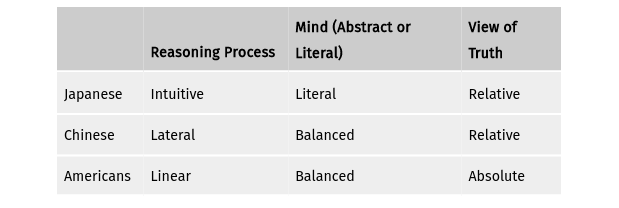
This chart is the heart of Conrad’s analysis, but by itself it’s hard to interpret. Fortunately, once this foundation is laid at the beginning of the book, Conrad puts these terms into practice by describing surprising or puzzling aspects of life in Japan and China and using this framework to explain them.
A few of the topics covered include:
- Zen and mindfulness
- Japanese perfectionism and craftsmanship
- Family vs state in China
- Rule of law vs rule of power in China
- The group vs the individual
- Doing business in the 3 countries
While Conrad is not a sociologist, much of his analysis references classic writing on the topic including Ruth Benedict’s The Chrysanthemum and the Sword, and D.T. Suzuki’s treatises on Zen Buddhism.
There’s a danger, of course, in reducing large and diverse groups of people to a few generalities and 3 poles of thinking. As I read through the book, every assertion Conrad made had me thinking but…but…but, and a few I disagreed with strongly. Every anecdote he told proving his point brought to mind a story from my own experience proving the opposite.
So it would be absurd, of course, to think that these broad generalizations are unequivocally true. The question is whether they’re useful. And the answer, at least for me, is yes. Less so for Japan, where my personal experience gives me a strong intuitive sense of how different Japanese people will respond to a given situation, but more so with China where I have far less knowledge.
By explaining Chinese thinking in general terms, especially regarding the prioritization of family over society as a whole and yielding to the rule of power, I feel I have a better understanding of what I’ve seen when visiting China and working with Chinese partners and customers.
Even in the sections where I disagreed with the author, laying out this framework for understanding the 3 very different cultures at least got me thinking from the day-to-day activities I observe to their underlying reasons.
Overall, I’d recommend this book to anyone who wants to understand the attitudes and thinking of people in these 3 important countries.


